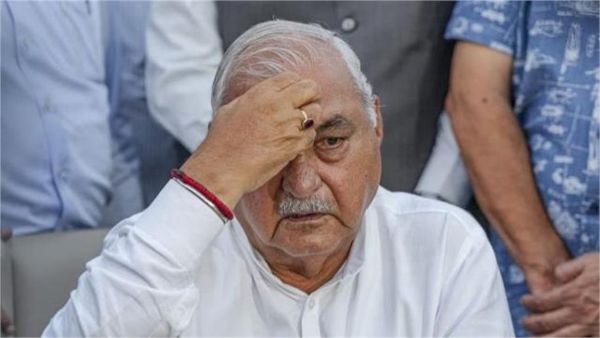
Haryana, April 16, 2026. A new controversy has emerged in Haryana’s politics, centered on the issue of waiving the penal rent associated with former Chief Minister Bhupinder Singh Hooda’s official bungalow. Differences over this decision have come to the fore even within the government.
It is notable that in 2019, the Congress party appointed former Chief Minister Bhupendra Singh Hooda as the Leader of the Opposition. The Leader of the Opposition holds cabinet rank status. Consequently, Bungalow No. 70 in Sector-7 was allotted to him. Congress party activities had been operating from this bungalow for the past 5 years. Prior to this, from 2014 to 2019, Hooda resided in the MLA Flat located in Sector-3, Chandigarh.
According to sources, three ministers in the cabinet have raised objections to the state government’s proposal to waive the penal rent. They believe that granting such relief would send the wrong message and could raise questions about the fairness of government rules. The ministers emphasized the need for transparency and adherence to clear rules in this matter.
This issue arose when penal rent was imposed on Hooda for not vacating the allotted government accommodation even after the stipulated period. Now, with the proposal to waive this outstanding amount coming to light, the political debate has intensified.
Opposition parties are also targeting the government over this issue, calling it a case of granting special favors. Meanwhile, Hooda’s supporters say this decision can be taken under the rules and there is no irregularity in it.
Due to the differences that have arisen within the government, this matter has now become more complicated. It is likely that legal and administrative opinions will be sought before a final decision is taken, in order to avoid any kind of controversy.
This entire sequence of events is creating a new stir in Haryana’s politics, where on one hand there is a debate over the interpretation of rules, and on the other, a round of political accusations and counter-accusations has also intensified.
Haryana
Haryana is a state in northern India that was carved out of the former state of East Punjab in 1966. Historically, the region has been a significant part of the Indus Valley and Vedic civilizations, with the epic battle of the Mahabharata said to have been fought at Kurukshetra within its borders. Today, it is a major economic and agricultural hub known as the “breadbasket of India.”
Bhupinder Singh Hooda
“Bhupinder Singh Hooda” is not a place or cultural site, but a prominent Indian politician who served as the Chief Minister of Haryana for two terms (2005-2014). He is a senior leader of the Indian National Congress and has been a key figure in the state’s modern political history, known for policies focused on industrial and agricultural development.
Congress party
The Indian National Congress (often called the Congress Party) is a major political party in India, founded in 1885. It played a pivotal role in the Indian independence movement against British rule, led by figures like Mahatma Gandhi and Jawaharlal Nehru. After independence in 1947, it became the dominant political force, governing India for much of its history as a modern republic.
Bungalow No. 70, Sector-7
Bungalow No. 70 in Sector-7 is a notable residential property located in the planned city of Bhubaneswar, India. It is part of the post-independence capital project, designed in the mid-20th century, and represents the distinctive government housing architecture of that era for senior officials. Today, it stands as a part of the city’s architectural heritage from its early development phase.
MLA Flat, Sector-3, Chandigarh
MLA Flat, Sector-3, is a residential complex in Chandigarh, India, originally built in the 1950s to house Members of the Legislative Assembly. It is a notable example of the city’s early modernist architecture, reflecting the urban planning principles of Swiss-French architect Le Corbusier, who designed the master plan for Chandigarh. Today, it stands as a part of the city’s architectural heritage from its founding period as a post-independence capital.
Chandigarh
Chandigarh is a modern planned city in northern India, serving as the joint capital of the states of Punjab and Haryana. It was designed in the 1950s by the Swiss-French architect Le Corbusier as a post-independence symbol of progress and urban order, featuring a grid-like layout and notable modernist architecture like the Capitol Complex.