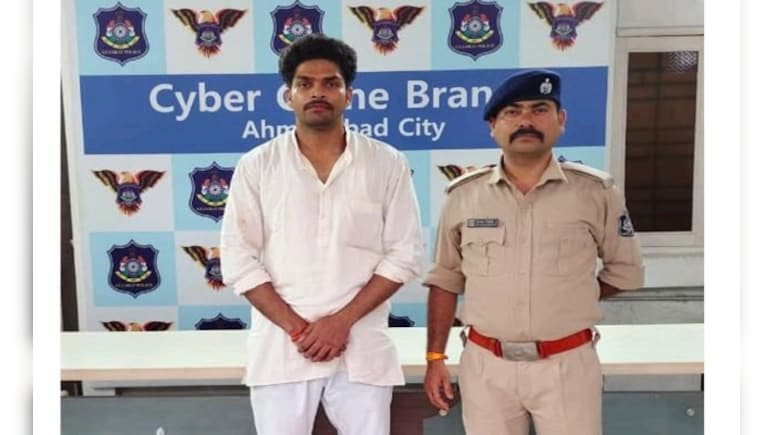
A woman endured a digital nightmare involving fake Instagram accounts and 100 nude photos and videos.
The man stalked the complainant through the internet between December 2025 and April 6.
A Delhi-based priest used artificial intelligence to create explicit, morphed images of a woman and her mother after she refused his friendship request. The 27-year-old accused, who made religious videos online, allegedly used easily accessible AI tools to manipulate the woman’s photos and uploaded them on multiple fake social media accounts.
The Ahmedabad City Cyber Crime Branch tracked him down in Delhi and arrested him on Wednesday under its new initiative, Mission Cyber Rakshika: #SecureHerSpace, which focuses on protecting women from online abuse.
Harassment Began After Online Contact
The case involves a woman from Gujarat, who came in contact with the accused, Sumit Nemchand Sharma, who delivers religious discourses online on various social media platforms.
Sharma first approached her on Instagram, where he allegedly initiated conversations on religious topics. However, the alleged accused later attempted to befriend the complainant, but she refused.
According to the complaint filed with the police, he allegedly stalked the complainant through the internet between December 2025 and April 6.
AI Tools Used To Create Explicit Content
After being rejected, Sharma began stalking the woman online. He downloaded photographs of the woman and her mother from her Instagram account.
He searched online for clothes-removing AI tools and uploaded their pictures on such platforms. Using these tools, he created over 100 explicit and morphed nude images and videos.
To publicly target the woman, Sharma created three fake Instagram accounts and a YouTube channel using her name and images. He uploaded the AI-generated content on these platforms and added comments aimed at damaging her and her family’s reputation.
During the investigation, police found that he had created eight to ten fake accounts across platforms such as X, Facebook, Instagram and YouTube.
“The accused uploaded AI-morphed nude photographs and videos of the complainant and her mother on the fake accounts and posted obscene content aimed at mentally harassing the complainant and damaging her reputation in society,” officials said.
“He downloaded photographs of the complainant and her mother from her Instagram account and used multiple websites after searching ‘AI Remove Clothes’ on Google to create morphed nude images and videos using Artificial Intelligence tools,” officials added.
Cyber Team Tracks Accused To Delhi
The victim later approached the Ahmedabad Cyber Crime team for help. A police team used digital tracking and human intelligence to trace the accused to Usmanpur in North East Delhi.
Police conducted a raid at the location and arrested Sharma.
Sharma has been booked under relevant sections of the Bharatiya Nyaya Sanhita and the Information Technology Act.
The FIR was registered in the first week of May, following which the investigation began.
Delhi
Delhi, the capital of India, is a historic city that has been continuously inhabited for over two millennia. It has served as the capital for several ancient and medieval empires, including the Delhi Sultanate and the Mughal Empire, leaving behind iconic landmarks like the Qutub Minar and the Red Fort. Today, it is a vibrant metropolis that beautifully blends its rich history with modern urban life.
Ahmedabad City Cyber Crime Branch
The Ahmedabad City Cyber Crime Branch is a specialized police unit in Ahmedabad, India, dedicated to investigating and combating cybercrimes such as online fraud, hacking, and identity theft. Established in response to the rapid digitalization and rising internet-related offenses in the region, it works to enforce cybersecurity laws and assist victims. The branch operates under the Gujarat Police, focusing on modern
<div class
Qutub Minar
The Qutub Minar is a towering 73-meter-high minaret located in Delhi, India, built in the early 13th century by Qutb-ud-din Aibak, the founder of the Delhi Sultanate. Construction began in 1193 to celebrate the victory of Islamic rule over the region, with later rulers adding upper stories. It is a UNESCO World Heritage Site and a prime example of Indo-Islamic Afghan architecture, surrounded by other historic structures from the Qutub complex.
Red Fort
The Red Fort, located in Delhi, India, is a historic fort complex built in 1648 by the Mughal emperor Shah Jahan, who also constructed the Taj Mahal. It served as the main residence of Mughal emperors for nearly 200 years and is renowned for its massive red sandstone walls and intricate Mughal architecture. Today, it is a UNESCO World Heritage Site and a symbol of India’s independence, as the Prime Minister hoists the national flag there every year on Independence Day.
Delhi
Delhi, the capital of India, is a historic city that has been continuously inhabited for over two millennia, serving as the capital of several ancient and medieval empires, including the Mughal Empire. It is home to iconic landmarks such as the Red Fort, Qutub Minar, and Humayun’s Tomb, reflecting its rich blend of Hindu, Islamic, and British colonial influences. Today, Delhi is a bustling metropolis that seamlessly combines its ancient heritage with modern urban life.
Ahmedabad
Ahmedabad, a major city in the western Indian state of Gujarat, was founded in 1411 by Sultan Ahmed Shah on the banks of the Sabarmati River. It served as the capital of the Gujarat Sultanate and later became a key center of India’s independence movement, notably hosting Mahatma Gandhi’s Sabarmati Ashram. Today, the city is renowned for its rich architectural heritage, including the historic walled city—a UNESCO World Heritage Site—and its vibrant textile industry.
Gujarat
Gujarat, in western India, is a state with a rich history as the home of the ancient Indus Valley Civilization and a key hub for maritime trade with the Roman Empire and Southeast Asia. It was the birthplace of Mahatma Gandhi and a central region in India’s independence movement. Today, it is known for its vibrant culture, diverse wildlife, and iconic sites like the Somnath Temple and the Rann of Kutch.