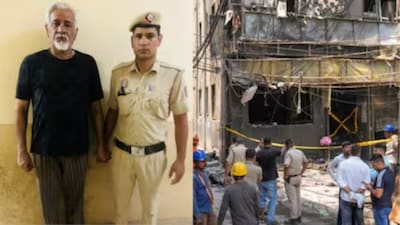
Bajaj admitted that he had knowingly allowed the accused individuals to use his residential address for obtaining Indian identity documents in exchange for money.
The key accused arrested in connection with the recent incident, Lovekesh Bajaj, was arrested last year in a case involving the alleged procurement of forged Indian identity documents for Bangladeshi nationals.
According to police sources, Bajaj was arrested in January 2025 in a case registered at Paharganj police station after an investigation uncovered his alleged role in facilitating the use of fake Indian documents, including passports and Aadhaar cards, by Bangladeshi nationals residing illegally in the country.
Provided Fake Documents To Bangladeshi Nationals
During the year 2025, a case under FIR No. 145/2025 dated January 29, 2025, under Sections 318(4)/338/336(3)/340(2)/61(2)/3(5) BNS, at PS Paharganj, was registered and investigated. The case was filed under various provisions of the Bharatiya Nyaya Sanhita (BNS).
Investigators alleged that two Bangladeshi nationals—Sweety Sarkar, also known as Beauty Hawladar and Johra Khatoon, and her daughter Pushpo Sarkar, also known as Pushpo Hawlader and Puspo Saiyada Akther—along with Pushpo’s minor son, were living illegally in Delhi using fraudulently obtained Indian identity documents.
During the investigation, police found that an Indian passport had been issued to Sweety Sarkar using an address in Chhatarpur, Delhi. Verification of the address allegedly revealed that the property belonged to Lovekesh Bajaj, a resident of Saket.
According to the police investigation, Bajaj admitted during questioning that he had knowingly allowed the accused individuals to use his residential address for obtaining Indian identity documents in exchange for money. Investigators alleged that this facilitated their illegal stay in India.
Following the probe, Bajaj, Sweety Sarkar and Pushpo Sarkar were arrested. Police subsequently filed a charge sheet against the accused before a court. Sources said Bajaj spent around 15 days in Tihar Jail before securing bail. The case remains pending before the court.
The disclosure has come as Bajaj faces scrutiny in the Malviya Nagar hotel fire case, where he was recently arrested by Delhi Police.
Delhi Hotel Fire Case: Search Underway For Suspects
Meanwhile, investigators are continuing their search for two other individuals linked to the hotel—accountant Jai Mishra and manager Rakesh—who are yet to be traced. Police said Jai Mishra, a resident of Chhatarpur, has been absconding since the incident. Efforts are also underway to gather information about manager Rakesh and other members of the hotel staff.
The massive blaze ripped through the hotel located in a congested lane of Malviya Nagar, killing 21 people and leaving many others injured. Owner, Lovekesh Bajaj, was arrested from Saket on June 3.