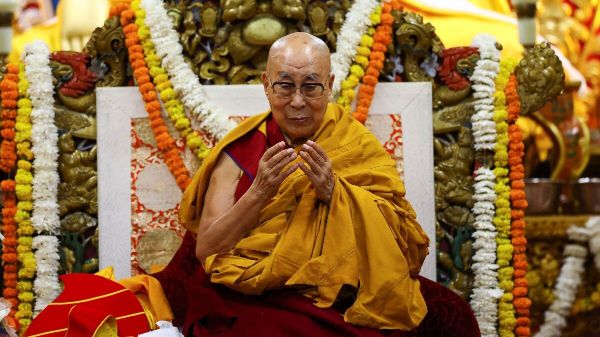
New Delhi, 25 May 2026. China has advised India to stay away from the issue of the Dalai Lama’s succession. Beijing stated that the process of determining the Dalai Lama’s reincarnation and successor is entirely China’s internal matter and no external interference will be allowed. China has said that India should stay away from this sensitive issue. Following the statement, discussions have intensified in international and diplomatic circles.
The issue of the Dalai Lama’s succession has long been a sensitive topic between China and the Tibetan community. China asserts its authority over the process related to the Dalai Lama’s successor, while Tibetan tradition and the exiled Tibetan community consider it a religious and cultural matter.
The Tibetan spiritual leader Dalai Lama has been residing in India for a long time, and Dharamshala is considered a major center for the exiled Tibetan community. In this context, China has periodically reacted to this issue.
Experts believe that the question of the Dalai Lama’s succession is not only religious but also holds geopolitical and diplomatic significance. Amid the existing border dispute and strategic competition in India-China relations, such statements can impact bilateral ties.
However, an official response from India to this latest statement is awaited. Internationally, the issue is viewed with sensitivity as it relates to religious freedom, Tibetan identity, and regional politics.
The spokesperson of the Chinese embassy in India, Yu Jing, issued a statement on Sunday saying that the Dalai Lama’s reincarnation occurs according to centuries-old religious customs and historical traditions.
This statement from China comes at a time when on May 27, the head of the Central Tibetan Administration (CTA), or the exiled Tibetan government, Penpa Tsering, is set to take oath for a second time in Dharamshala, India. The Dalai Lama may also attend this event.
The Chinese embassy also reminded India of its old stance on Tibet. The statement said that India should not provide a platform for activities related to Tibetan independence. This is essential for regional stability and India-China relations.
New Delhi
New Delhi is the capital of India, a planned city designed by British architect Edwin Lutyens and inaugurated in 1931 to replace Calcutta as the seat of British colonial power. It stands as a blend of imperial history and modern governance, housing iconic landmarks like India Gate and the Rashtrapati Bhavan. Today, it serves as the vibrant political and cultural heart of the world’s largest democracy.
Dharamshala
Dharamshala, located in the Indian state of Himachal Pradesh, is a scenic hill station known as the home of the Tibetan government-in-exile and the Dalai Lama. Its history includes being a summer retreat for the British Raj, and after 1959, it became a major center for Tibetan Buddhism and culture following the Dalai Lama’s exile. The town is divided into the lower, more modern part and the upper area of McLeod Ganj, which serves as a global hub for Buddhist study and meditation.
Tibet
Tibet, often called the “Roof of the World,” is a high-altitude region in Central Asia known for its unique Buddhist culture and stunning Himalayan landscapes. Historically, it was an independent kingdom with a rich spiritual heritage, ruled by Dalai Lamas from the 17th century until the mid-20th century. Since 1959, Tibet has been an autonomous region within China, with Lhasa, its capital, home to iconic sites like the Potala Palace.
Central Tibetan Administration (CTA)
The Central Tibetan Administration (CTA) is the government-in-exile established by the 14th Dal
New Delhi
New Delhi is the capital of India, officially inaugurated in 1931 as the imperial capital of British India, designed by British architects Edwin Lutyens and Herbert Baker. It replaced Calcutta as the center of government and features wide boulevards, grand government buildings, and significant landmarks like the India Gate and Rashtrapati Bhavan. Today, it serves as the seat of India’s national government and a vibrant cultural hub blending colonial heritage with modern urban life.
Dharamshala
Dharamshala is a hill station in the Indian state of Himachal Pradesh, best known as the home of the Tibetan government-in-exile and the residence of the 14th Dalai Lama. Historically, it was part of the Kangra region and gained prominence in the 19th century as a British colonial summer retreat. Today, it serves as a major center for Tibetan culture and Buddhism, with attractions like the Norbulingka Institute and the Bhagsu Nag temple.
Tibet
Tibet, often called the “Roof of the World,” is a high-altitude region in Central Asia known for its stunning Himalayan landscapes and deep Buddhist heritage. Historically, it was an independent kingdom with a unique culture centered on Tibetan Buddhism, ruled by Dalai Lamas from the 17th century until the mid-20th century. Since the 1950s, it has been under the control of the People’s Republic of China, which administers it as the Tibet Autonomous Region.
Central Tibetan Administration (CTA)
The Central Tibetan Administration (CTA) is the Tibetan government-in-exile, established in 1959 by the 14th Dalai Lama after fleeing the Chinese takeover of Tibet. Based in Dharamshala, India, it serves as a political and administrative body for the Tibetan diaspora, advocating for Tibetan self-determination and cultural preservation. The CTA operates a parallel government structure, including a parliament and cabinet, though it is not recognized by the People’s Republic of China.