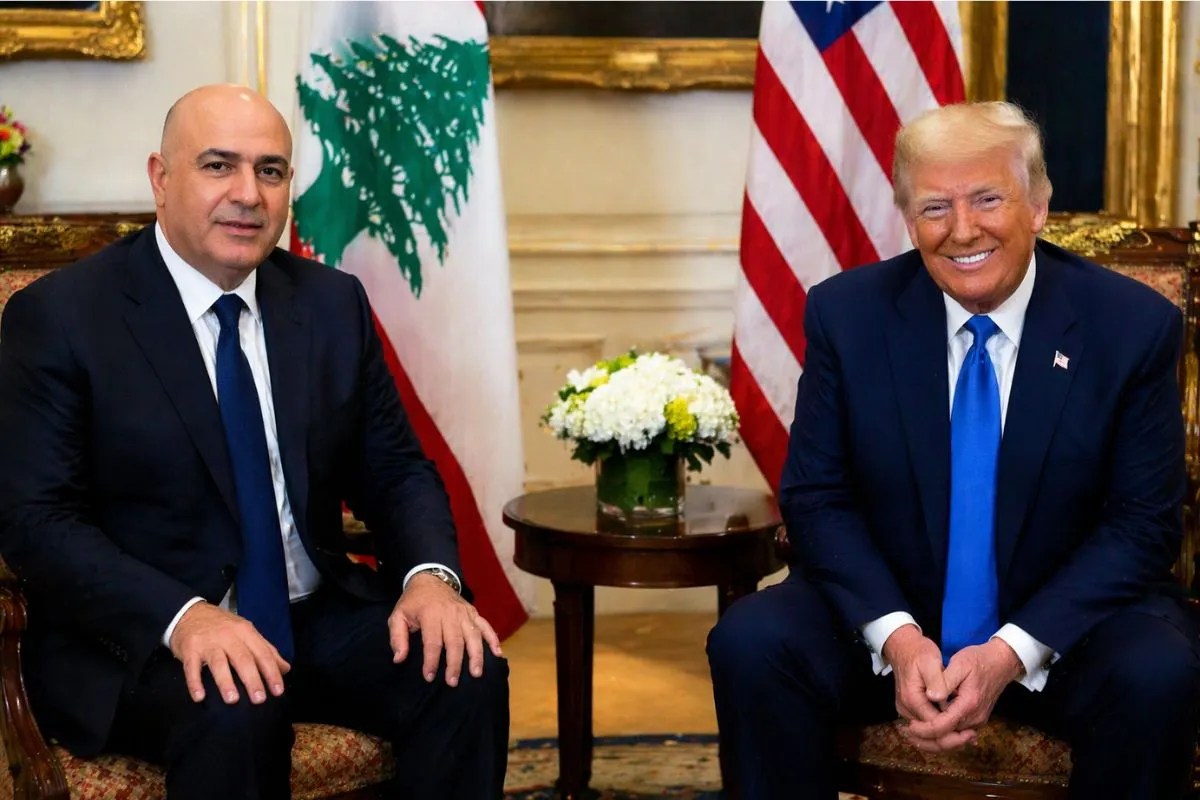
Lebanon Israel War: Amid ongoing tensions in the Middle East, a welcome piece of news has now emerged. An important phone conversation took place between US President Donald Trump and Lebanese President Joseph Aoun. In this conversation, the two leaders discussed stopping the conflict in the region and moving towards lasting peace. The Lebanese side described this conversation as positive. President Aoun praised Trump’s efforts, saying his steps are opening a path towards peace. He expressed hope that these efforts will continue and the situation can return to normal soon. It was announced that Trump declared a 10-day ceasefire in the Israel-Lebanon war. He also spoke with the leaders of both countries.
On the other hand, Trump reiterated his full support for Lebanon. He clearly stated that the United States is fully committed to restoring peace in the region. Trump claimed that an agreement has been reached on a 10-day ceasefire between Lebanon and Israel. He shared this information on his social media platform. According to him, talks on this agreement progressed after discussions with Benjamin Netanyahu. Trump stated that both countries will implement this ceasefire starting at 5 PM (EST). He also said he would soon invite the leaders of Lebanon and Israel to the White House to further advance the dialogue.
If this happens, it will be the first time since 1983 that such a large-scale, direct, and important conversation will take place between the two countries. Trump believes that both sides now want peace and the situation can improve quickly. For now, this ceasefire is like a ray of hope. People want it not to be just a few days’ agreement, but the beginning of long-term peace. The focus is now on which direction this initiative takes in the coming days.
Lebanon
Lebanon is a small Middle Eastern country on the Mediterranean coast, historically known as the heart of Phoenician civilization, a major maritime and trading culture from around 3200 BCE. Its rich history includes successive rule by various empires and, in the modern era, it gained independence from France in 1943, though it has faced significant periods of civil war and regional conflict. The country is renowned for its ancient archaeological sites, such as Baalbek and Byblos, and its diverse cultural and religious heritage.
Israel
Israel is a modern nation-state established in 1948 in the historic region of the Land of Israel, an area with profound significance for Judaism, Christianity, and Islam. Its history spans millennia, from ancient biblical kingdoms to successive periods of rule by various empires, Ottoman control, and a British Mandate before its contemporary founding. The country is home to numerous sacred sites, such as Jerusalem’s Western Wall and the Dome of the Rock, and is a central focus of both historical heritage and ongoing geopolitical discourse.
Middle East
The Middle East is a transcontinental region centered on Western Asia and Egypt, historically known as the “Cradle of Civilization” for the rise of ancient Mesopotamian, Egyptian, and Persian empires. It is the birthplace of major world religions—Judaism, Christianity, and Islam—and has been a central crossroads for trade, culture, and geopolitical power for millennia. Its modern history has been profoundly shaped by the 20th-century discovery of vast oil reserves and the subsequent complex political dynamics.
United States
The United States is a North American nation founded in 1776 after declaring independence from Great Britain, establishing a constitutional republic that expanded across the continent. Its history is marked by westward expansion, industrialization, and its emergence as a global superpower in the 20th century. Culturally, it is a diverse society shaped by waves of immigration, producing globally influential contributions in areas like music, film, technology, and democratic ideals.
White House
The White House is the official residence and workplace of the President of the United States, located in Washington, D.C. It was designed by James Hoban, with construction beginning in 1792 and the first president, John Adams, moving in in 1800. The building, which was rebuilt after being burned by British forces in 1814, has since been expanded and renovated, serving as a powerful symbol of the U.S. government and its history.