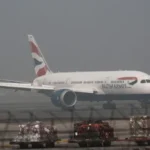
Iran missile attack at Kuwait airport kills one Indian; tensions escalate in the Middle East.
Kuwait City. Tensions in the Gulf Region have once again reached a peak. On Wednesday, an Indian citizen was tragically killed in a missile and drone attack carried out by Iran at Kuwait International Airport. The Indian embassy in Kuwait has confirmed this news. Following the attack, the United States has launched military operations near the Strait of Hormuz, deepening the state of war across the entire Middle East.
Airport Devastated, Flights Temporarily Suspended
According to Kuwait’s Health Minister, at least 63 people were injured in this severe attack, including both airport staff and passengers. Kuwaiti officials reported that the Iranian drone and missile attack caused heavy damage to the airport’s infrastructure and nearby diplomatic missions. Flights at Kuwait International Airport were temporarily suspended for security reasons. However, the Civil Aviation Authority later completed safety checks and resumed flights from Kuwait Airways Terminal 4.
India Strongly Objects
The Indian Ministry of External Affairs (MEA) strongly condemned this cowardly attack. In its statement, the ministry said: “We strongly condemn the attack on Kuwait International Airport, which resulted in the death of an innocent Indian citizen and injuries to several others. Since the beginning of tensions in the Middle East, India’s stance has been clear that civilians and civilian infrastructure should not be targeted. We appeal to all parties to immediately stop such attacks.”
Ceasefire on the Brink of Collapse
Following this attack, the ceasefire established in April is at risk of breaking down. Iran has claimed that it targeted the headquarters of the US Navy’s Fifth Fleet in Bahrain and an airbase in another regional country. The Bahraini army retaliated by destroying three missiles and several drones in mid-air.
According to a report released by the US military, two Iranian missiles fired toward Kuwait crashed or disintegrated in mid-air before reaching their target, preventing major damage.
Kuwait International Airport
Kuwait International Airport, located in Farwaniya, serves as the primary aviation hub for Kuwait. Originally opened in 1928 as a small airstrip, it was significantly expanded in the 1960s after oil revenues boosted the country’s economy and air travel demand. The airport has since undergone multiple renovations, including the opening of a new state-of-the-art terminal in 2022 to modernize facilities and increase capacity.
Strait of Hormuz
The Strait of Hormuz is a narrow, strategically vital waterway connecting the Persian Gulf to the Gulf of Oman and the open ocean. Historically, it has been a crucial chokepoint for global oil shipments, with about one-fifth of the world’s petroleum passing through it. Its significance has made it a focal point for geopolitical tensions, particularly between Iran and other global powers, for centuries.
Kuwait Airways Terminal 4
Kuwait Airways Terminal 4 is a modern, dedicated terminal at Kuwait International Airport, opened in 2018 to serve as the primary hub for the national carrier. It was designed to handle the airline’s growing operations and provide a premium travel experience, reflecting Kuwait’s investment in upgrading its aviation infrastructure. The terminal’s development was part of a broader plan to modernize the airport and accommodate increasing passenger traffic.
US Navy’s Fifth Fleet headquarters in Bahrain
The US Navy’s Fifth Fleet headquarters is located at Naval Support Activity Bahrain in Manama, Bahrain. Established in 1995, the command oversees naval operations in the Persian Gulf, Red Sea, and Indian Ocean, playing a critical role in regional security. The base’s presence in Bahrain dates back to a 1971 agreement, reflecting a long-standing strategic partnership between the United States and Bahrain.
Bahrain
Bahrain is an island nation in the Persian Gulf with a rich history as a center of trade and pearl diving, dating back to the ancient Dilmun civilization around 3000 BCE. It was a key hub on maritime trade routes and later came under the influence of various empires, including the Portuguese and Persians, before becoming a British protectorate in the 19th century. Today, Bahrain is known for its modern capital, Manama, and its UNESCO World Heritage sites, such as the Bahrain Fort and the ancient burial mounds.