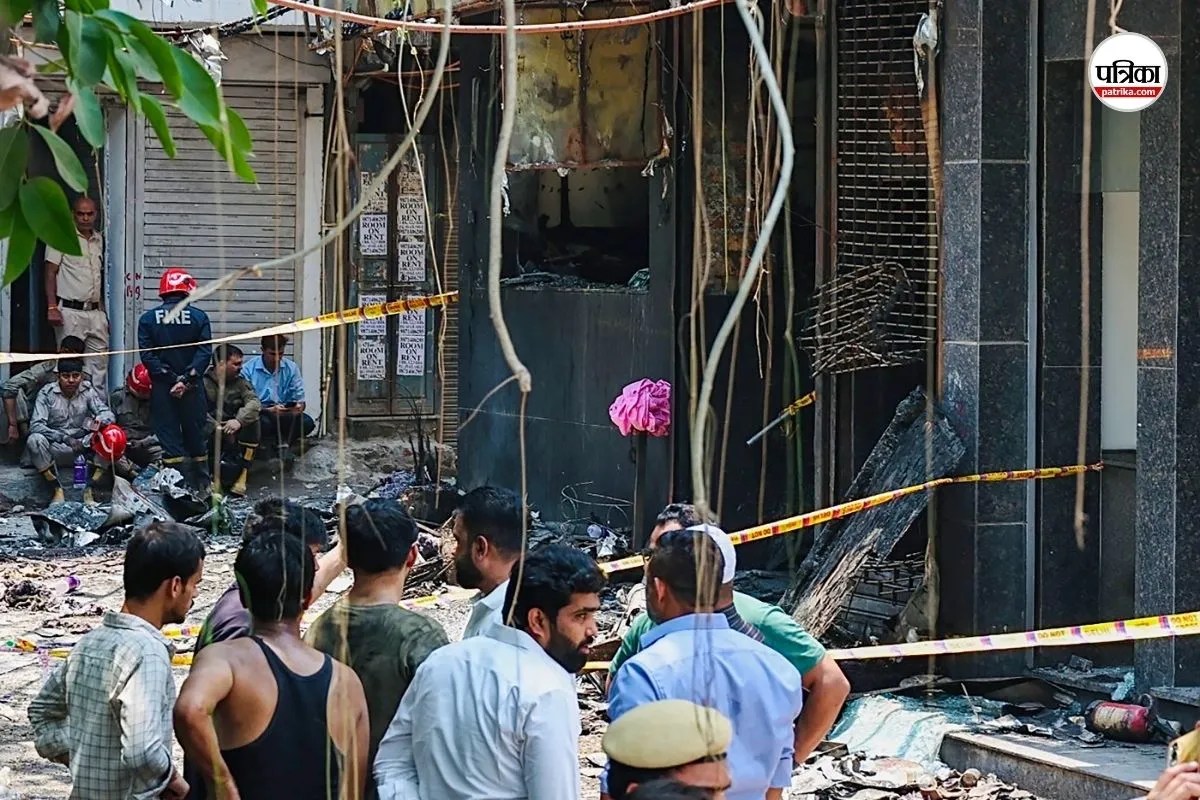
Malviya Nagar Hotel Fire Delhi: A major revelation has emerged in the investigation of the Malviya Nagar hotel fire in Delhi. According to sources connected to the investigation, the emergency exit leading to the hotel’s roof was closed at the time of the fire, blocking a crucial escape route for those trapped inside.
Given the seriousness of the case, Delhi Police has formed a total of 10 teams for the investigation. Five of these teams are searching for and working to arrest the absconding hotel manager, Jai Mishra, while the remaining teams are investigating other aspects of the case.
It is noteworthy that before the arrest of hotel owner Lavkesh Sharma, the police had also issued a Lookout Circular (LOC) against him and his wife to prevent them from fleeing the country. Investigative agencies suspected that both could escape abroad, as their children live overseas. It is reported that Lavkesh Sharma is the sole owner of the hotel building.
The investigation has also revealed that the hotel was originally only two stories high, but later approximately two and a half additional floors were illegally added.
Meanwhile, a team from the Central Forensic Science Laboratory (CFSL) will inspect the scene again on Thursday. Previously, the team was only able to examine one floor.
21 people died in this devastating fire. Most of the deceased were found on the third floor and in the basement of the hotel. Preliminary investigation suggests that most deaths were due to suffocation.
The police are also searching for a key eyewitness, Keshar Singh. It is believed that his testimony will help understand the real cause and sequence of the fire.
Meanwhile, Delhi Police has identified 9 of the 12 foreign nationals who lost their lives in the accident. Their identification was made based on passports recovered from the scene. The police have sent information about all foreign nationals to the Ministry of External Affairs (MEA) to facilitate the process of sending their bodies to their respective countries.
The police have also completed DNA profiling of all foreign nationals. This process was carried out after obtaining permission from the embassies of the respective countries. Additionally, autopsies of all foreign nationals’ bodies were conducted only after approval from the embassies.