Complaint against Governor over ‘removal’ of Senthil Balaji; CM Stalin tells President that Governor Ravi should be removed.
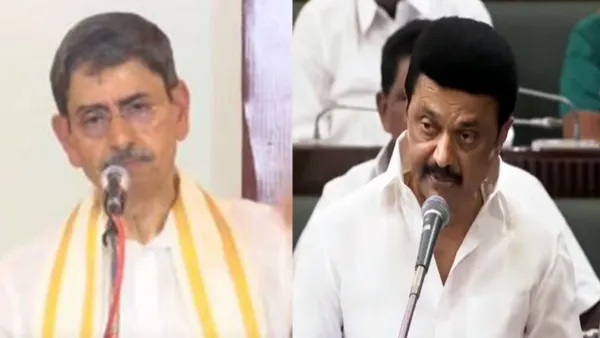
The Tamil Nadu government stated that Chief Minister MK Stalin has written to President Droupadi Murmu complaining against Governor RN Ravi. The matter is related to Minister Senthil Balaji, who was removed from the cabinet.
Stalin has also sent a list of alleged violations by the Governor to the President. According to Stalin’s government, Governor Ravi is “liable to be removed” from the post of Governor.
Stalin wrote that the Governor has violated his oath of office by acting against the people and interests of the state and the Constitution. He wrote that among the alleged violations, the unilateral dismissal of arrested Minister Senthil Balaji is the most recent case.
Alleging that the decision was reversed within hours, Stalin’s government said the Governor’s action was not correct. They stated that deciding on the appointment of ministers is the Chief Minister’s prerogative, not the Governor’s.
He wrote that Governor Ravi, who is seeking an opportunity to topple the government in an opposition-ruled state, will only be seen as a “central agent.” Stalin’s government has left it to the President to decide whether Ravi’s continued tenure as Governor is “acceptable and proper.”
Accusing the Governor of waging a “political war,” the ruling DMK, through CM Stalin, said Ravi works against the state government’s policy and obstructs legislative work by delaying his assent to bills passed by the house.
The Chief Minister wrote that even after providing the clarifications he requested, final decisions are not made. He said RN Ravi also unnecessarily delays permission for corruption cases against former ministers of the AIADMK.
He also alleged that the Governor is divisive and does not believe in secularism. He expresses personal views on religion, glorifies Hinduism, disparages Tamil culture by belittling it, and hurts people’s sentiments.
The Chief Minister alleged that his suggestion to rename the state reflects his hatred for Tamil Nadu. According to Stalin, RN Ravi also insults the Indian Constitution by calling the federal system an “administrative convenience.”
The government says that Governor RN Ravi insulted India by omitting the names of Periyar, BR Ambedkar, Kamaraj, Anna, and Kalaignar in his official assembly speech. He also did not mention social justice, equality, and the Dravidian model of governance in the official assembly address.
Citing political voices from the state, they alleged that Mr. Ravi had also interfered in the elected government of Nagaland during his tenure as Governor. The Raj Bhavan has not yet responded to this issue.
Tamil Nadu
Tamil Nadu is a state in southern India known for its rich cultural heritage, ancient Dravidian architecture, and classical arts. Historically, it was home to powerful kingdoms like the Chola, Pandya, and Pallava dynasties, which left behind magnificent temples and monuments. Today, it remains a vibrant center for Tamil language, literature, and traditional practices such as Bharatanatyam dance and Carnatic music.
Indian Constitution
The Indian Constitution, adopted on January 26, 1950, is the supreme law of India and the world’s longest written constitution. It was drafted by the Constituent Assembly over nearly three years, led by Dr. B.R. Ambedkar, and draws from various global sources while establishing India as a sovereign, socialist, secular, and democratic republic. This document not only replaced the Government of India Act 1935 but also enshrined fundamental rights and duties, shaping the nation’s governance and identity.
Hinduism
Hinduism is one of the world’s oldest religions, with roots dating back over 4,000 years to the Indus Valley civilization in present-day India and Pakistan. It has no single founder, but instead evolved as a synthesis of diverse traditions, sacred texts like the Vedas and Upanishads, and the concept of dharma. Today, it is the third-largest religion globally, characterized by a belief in reincarnation, karma, and a multitude of deities representing a single ultimate reality.
Tamil culture
Tamil culture is one of the world’s oldest continuous civilizations, with roots dating back over 2,000 years to the ancient Sangam period in southern India and northern Sri Lanka. Renowned for its classical language, Tamil, it boasts a rich heritage of literature, architecture, and performing arts, including Bharatanatyam dance and Carnatic music. Historically, the culture flourished under powerful kingdoms like the Cholas, Pandyas, and Pallavas, whose temples and traditions continue to influence Tamil identity today.
Tamil Nadu
Tamil Nadu is a state in southern India, renowned for its ancient Dravidian culture, classical Tamil language, and magnificent Hindu temples. Historically, it was home to powerful dynasties like the Cholas, Pandyas, and Pallavas, who left a legacy of grand architecture, literature, and trade. Today, it remains a vibrant center of art, music, and tradition, with sites like the Meenakshi Temple and Brihadeeswarar Temple drawing visitors from around the world.
Nagaland
Nagaland, located in northeastern India, is a state known for its rich tribal culture, with 16 major tribes each having distinct traditions, languages, and festivals. Historically, the region was largely independent until the British colonial period, and after India’s independence, it became a state in 1963 following years of conflict and negotiation. Today, Nagaland is famous for its vibrant Hornbill Festival, which showcases the state’s heritage, music, and dance.
Raj Bhavan
Raj Bhavan refers to the official residence of the Governor of an Indian state, with many such buildings dating back to the British colonial era. Originally constructed as the “Government House” for British officials, these stately structures often blend European and Indian architectural styles and have served as administrative and ceremonial centers since the 19th century. Today, they remain important symbols of state governance and heritage, hosting official functions and dignitaries.
Dravidian model
The “Dravidian model” refers to a socio-political framework primarily associated with the state of Tamil Nadu, India, emphasizing social justice, rationalism, and the empowerment of marginalized communities, particularly through affirmative action and anti-caste policies. Its history traces back to the early 20th-century Dravidian movement, which opposed Brahminical dominance and sought to revive Tamil language and culture, later evolving into political parties like the DMK and AIADMK. The model has shaped regional governance by prioritizing education, welfare schemes, and secularism, distinguishing it from other Indian political approaches.