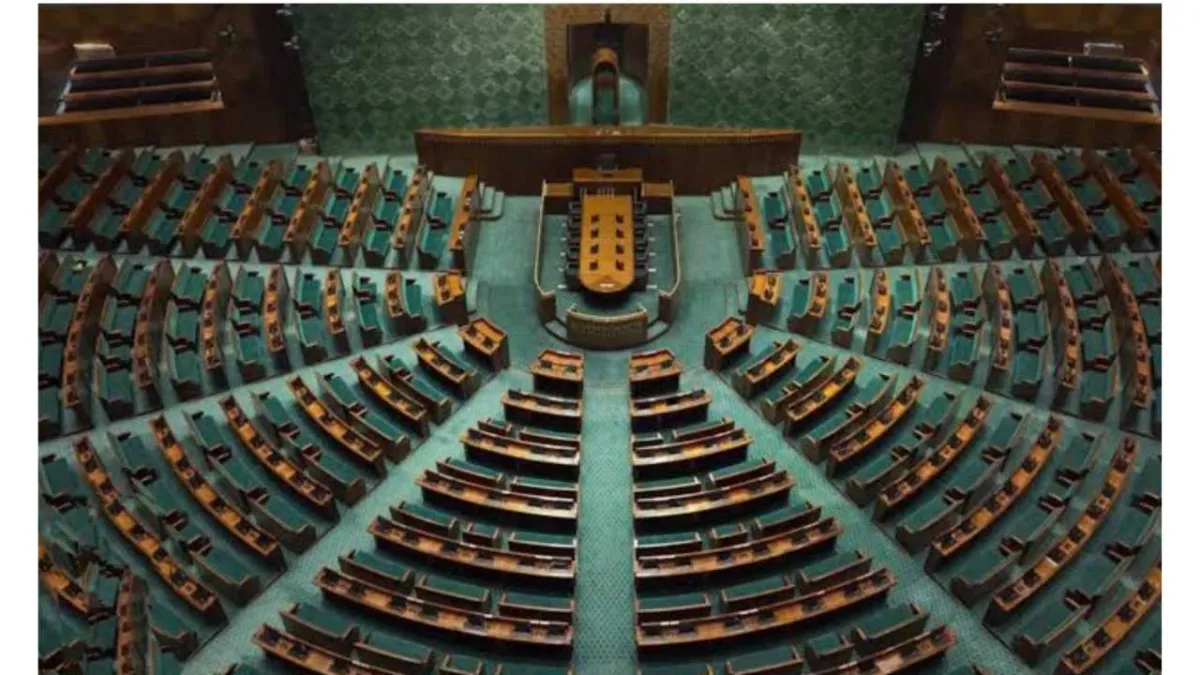
In a significant step for women’s empowerment in the country, President Droupadi Murmu has given assent to the 33 percent Women’s Reservation Act-2023 for Parliament and State Legislative Assemblies.
Following the notification issued in this regard, debate has intensified in political corridors.
Amid the central government convening a special session of Parliament to introduce bills related to women’s reservation, the opposition has raised questions about its implementation and the delimitation process.
Meanwhile, a leader stated that according to the President’s notification, women’s reservation could also be implemented on the existing 543 Lok Sabha seats.
It was explained in a post that if the constitutional amendment bill related to increasing the number of Lok Sabha seats and implementing the reservation does not secure the necessary two-thirds majority in Parliament, the path to providing 33 percent reservation for women will not be closed. This provision can be implemented on the existing seats themselves.
It was stated that ensuring women’s participation in Parliament is not just the government’s responsibility, but that of the entire nation. It was also said that the opposition has long raised this demand and now is the opportunity to implement it.
Parliament’s Collective Commitment to Women
Referring to the ‘Nari Shakti Vandan Act’ passed in 2023, it was stated that this law symbolizes Parliament’s collective commitment to the women of the country. At that time, a resolution was taken that women would be given adequate political representation by 2029.
Parliament
The term “Parliament” most commonly refers to the Palace of Westminster in London, the meeting place of the UK’s House of Commons and House of Lords. The current Gothic Revival building was constructed between 1840 and 1870 after a fire destroyed much of the old palace, though the site has been a center of political power since the 11th century. It is a UNESCO World Heritage Site, famous for its iconic clock tower, Big Ben.
State Legislative Assemblies
State Legislative Assemblies are the lower houses of state legislatures in India, modeled after the Lok Sabha (national parliament). They are directly elected bodies responsible for making laws on state subjects, overseeing the state government, and approving the state budget. Their history dates to the Government of India Act 1935, which established provincial legislatures, with the current structure being formalized under the Constitution of India in 1950.
Lok Sabha
The Lok Sabha is the lower house of India’s bicameral Parliament, located in New Delhi. Established by the Constitution of India in 1952, it is the primary legislative body where members are directly elected by the people. Its history is tied to India’s independence, succeeding the Constituent Assembly and operating from the iconic Sansad Bhavan (Parliament House), a heritage building from the British colonial era.
Nari Shakti Vandan Act
The “Nari Shakti Vandan Act” is not a physical place or cultural site, but a landmark Indian legislation. Formally known as the Constitution (One Hundred and Sixth Amendment) Act, 2023, it mandates the reservation of one-third of seats for women in the Lok Sabha (India’s lower house of Parliament) and state legislative assemblies. This historic act, passed after decades of advocacy, aims to enhance women’s political representation and participation in India’s governance.