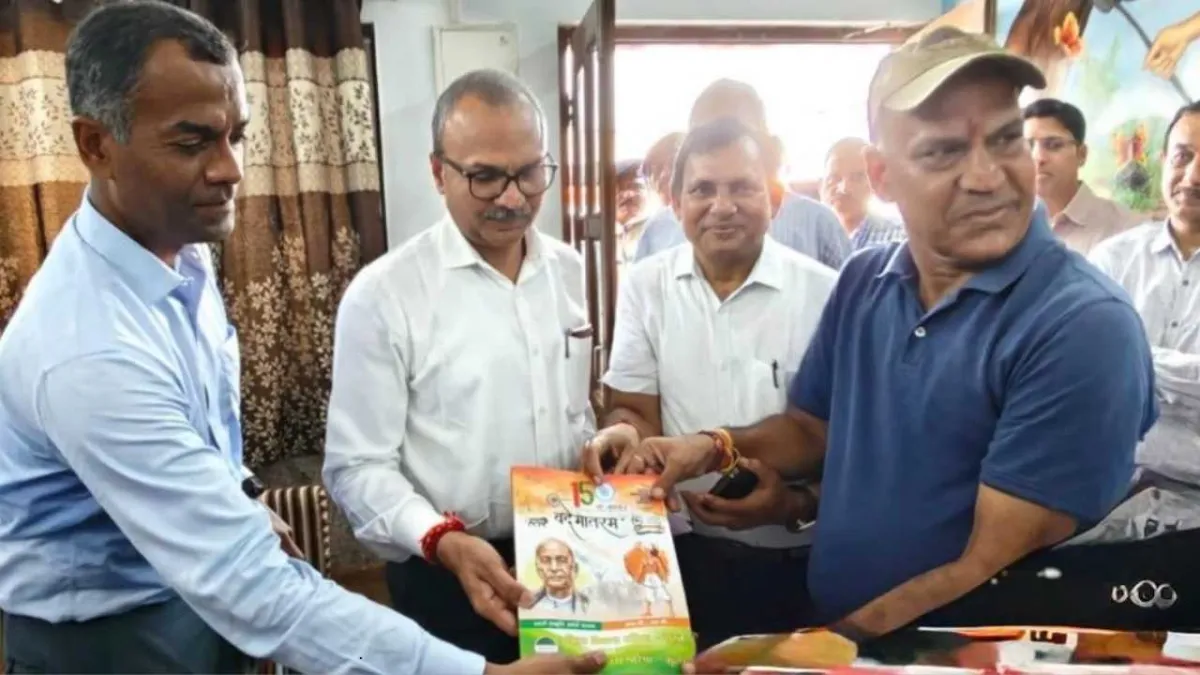
Officials of Bihar Vikas Parishad met with the General Manager of Western Railway at Udhna Railway Station to discuss issues in detail.
Officials of Bihar Vikas Parishad met with the General Manager of Western Railway at Udhna Railway Station on Monday to discuss in detail the disorder that occurred on Sunday and other passenger issues. On Sunday, around 20,000 passengers, who were traveling towards Bihar and Uttar Pradesh, suddenly arrived at the station. Due to this unexpected crowd of passengers, there was chaos on platform number 6.
The railway administration had made some arrangements in advance, but these proved insufficient in the face of the sudden surge in crowd, causing severe difficulties for passengers. The General Manager assured that efforts would be made soon to start regular trains.
Considering the increasing number of passengers, the railway also arranged a special train in a short time. However, the lack of proper dissemination of information worsened the situation. A large number of passengers assumed that they would easily get seats on this unreserved train, which led to an increase in crowd and disorder.
The severity of the situation can be gauged from the fact that seats on regular trains going to Bihar are not available for the next two months. This has created a major crisis for passengers traveling.
Bihar Vikas Parishad has long been demanding an increase in the number of regular trains from the Central Railway Minister. Compared to the large population of migrant Biharis living in Surat, the number of trains is quite low, which is why such incidents occur repeatedly.
For a permanent solution to the problem, the council has suggested that train number 20933 Udhna-Danapur Express be regularly operated daily up to Jaynagar. Additionally, demands have been made to start a new daily train from Udhna to Bhagalpur and to start a daily train service from Udhna to Koderma via Gaya. If these proposals are implemented, such chaos can be avoided in the future, and passengers can get smooth and safe travel facilities.
Bihar Vikas Parishad
Bihar Vikas Parishad is a non-governmental organization founded in 1977 in Bihar, India, dedicated to the socio-economic and cultural development of the state. It works to address regional disparities, promote education, and preserve Bihari heritage through various initiatives and research. The organization has played a key role in advocating for policies and projects aimed at improving the quality of life for people in Bihar.
Udhna Railway Station
Udhna Railway Station, located in Surat, Gujarat, India, is a key junction on the Western Railway zone. Originally established during the British colonial era, it has grown into a major hub for both passenger and freight traffic, serving as an important stop on the Mumbai–Delhi main line. The station plays a vital role in connecting the industrial region of South Gujarat with the rest of the country.
Western Railway
The Western Railway is one of the 18 zones of Indian Railways, headquartered in Mumbai. Its history dates back to the mid-19th century, with the first passenger train in India running from Bombay (Mumbai) to Thane in 1853 on what is now part of the Western Railway network. The zone was formally established in 1951 through the merger of several former railway companies, and today it serves as a vital transportation artery for western India, connecting major cities like Mumbai, Ahmedabad, and Vadodara.
Udhna-Danapur Express
The Udhna-Danapur Express is a long-distance train service in India, connecting Udhna (near Surat, Gujarat) to Danapur (near Patna, Bihar). It serves as a vital rail link for passengers traveling between western and eastern India, facilitating movement for work, trade, and pilgrimage. The train reflects the extensive Indian Railways network’s role in bridging diverse regions and supporting cultural and economic exchange.
Jaynagar
Jaynagar is a town in the Indian state of Bihar, historically known as a key gateway to Nepal and a significant trade route hub. It was a prominent center during the Maurya and Gupta empires, with nearby archaeological sites like the ancient city of Vaisali linking it to early Buddhist and Jain traditions. Today, it is primarily recognized for its railway junction and as the starting point of the Jaynagar-Bijalpura-Bardibas railway line connecting India to Nepal.
Bhagalpur
Bhagalpur is a historic city in Bihar, India, located on the southern bank of the Ganges River. Known for its ancient past, it was once the capital of the Anga Kingdom and later flourished under the Gupta and Pala empires. Today, it is famous for its silk industry, particularly Bhagalpur silk, and landmarks like the Vikramshila University ruins, a major Buddhist learning center from the 8th century.
Koderma
Koderma is a district in the Indian state of Jharkhand, historically known as a major hub for mica mining, which earned it the nickname “Mica Capital of India.” The region’s mica deposits were extensively exploited during the British colonial era and continued to fuel the local economy for decades. Today, Koderma is also recognized for its scenic landscapes, including the Tilaiya Dam and nearby forests, which have boosted tourism in the area.
Gaya
Gaya is a historic city in the Indian state of Bihar, renowned as a major pilgrimage site for Hindus, who perform the ritual of *Pind daan* (offerings for ancestors) along the banks of the Falgu River. Its significance is deeply rooted in Hindu mythology, as it is believed to be the place where Lord Buddha attained enlightenment under the Bodhi tree at the nearby Mahabodhi Temple in Bodh Gaya. The city’s history spans over two millennia, with the ancient kingdom of Magadha playing a key role in its development as a center for religion and culture.