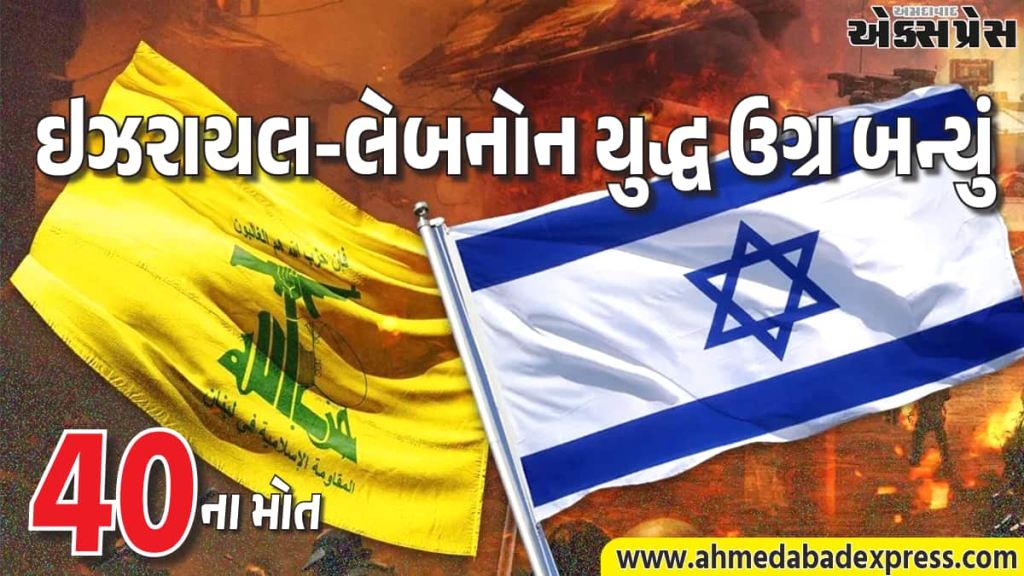
The situation in the Middle East has deteriorated further as Israel sent ground troops into southern Lebanon on Tuesday. Following rocket and drone attacks by Hezbollah on northern Israel, Israel retaliated with heavy bombardment in Beirut and southern Lebanon, resulting in at least 40 deaths and over 246 injuries so far.
Signs of a World War? Israeli Army Enters Southern Lebanon, Issues Ultimatum to Evacuate 80 Villages
Israel sent soldiers into southern Lebanon on Tuesday and warned residents of over 80 villages to leave immediately. This move came after Hezbollah expressed readiness for an “open war” with Israel following the US-Israel war.
This sequence of events unfolded after Hezbollah launched rockets and drone attacks toward northern Israel early Monday morning. Israel retaliated with airstrikes in Lebanon, killing 40 people, including a Palestinian militant and a Hezbollah intelligence officer in the southern suburbs of Beirut.
Thousands Forced to Flee Their Homes
The Health Ministry initially reported 52 deaths but later revised the number down to 40. The Lebanese Health Minister stated on Tuesday that the death toll stands at 40. The attacks injured 246 people and forced thousands to flee their homes.
Hezbollah Fires Rockets at Northern Israel
On Tuesday, Hezbollah again fired rockets at northern Israel twice. An Israeli airstrike also damaged a building housing Hezbollah’s TV and radio station. Multiple airstrikes hit southern Beirut on Tuesday afternoon without warning. The Israeli military later stated it had targeted Hezbollah officials. An Israeli military spokesperson warned residents of over 80 villages and towns in southern Lebanon to leave the area and not return until further notice.
“No Option But to Fight Israel”
A senior Hezbollah official stated that after observing a ceasefire for over a year despite continuous Israeli attacks on Lebanon, their patience has run out and they have no option but to fight Israel. The official said the Zionist enemy wants an open war, which did not end after the ceasefire agreement. The official added, “Therefore, it must be an open war.”
The war in Gaza began after Hamas attacked Israel in October 2023, and the conflict gradually spread to Lebanon. A US-mediated ceasefire occurred in November 2024, but Israel continued its attacks afterward. According to the Lebanese Health Ministry, 397 people have been killed in Israeli attacks since the ceasefire.
Middle East
The term “Middle East” refers to a transcontinental region centered on Western Asia and parts of North Africa, historically known as the “Cradle of Civilization” for the rise of ancient Mesopotamian, Egyptian, and Persian empires. It is the birthplace of major world religions—Judaism, Christianity, and Islam—and has been a central crossroads for trade, culture, and geopolitical power for millennia. Its modern history has been profoundly shaped by the 20th-century dissolution of the Ottoman Empire, the discovery of vast oil reserves, and ongoing regional conflicts.
Israel
Israel is a country in the Middle East, established as a modern state in 1948, with historical and religious roots stretching back millennia as the ancient homeland of the Jewish people. It is a central location for major world religions, containing sacred sites such as Jerusalem’s Western Wall, the Church of the Holy Sepulchre, and the Al-Aqsa Mosque. Its complex history involves ancient kingdoms, foreign rule, and ongoing geopolitical significance.
Lebanon
Lebanon is a small Middle Eastern country on the Mediterranean coast, historically known as the home of the ancient Phoenician civilization, famed for its maritime trade and alphabet. Its rich cultural heritage is a tapestry of diverse influences, including Roman ruins like those at Baalbek, Crusader castles, and historic cities such as Byblos, one of the oldest continuously inhabited settlements in the world. Modern Lebanon is also defined by its vibrant, cosmopolitan capital Beirut and its complex 20th-century history, including a prolonged civil war.
Beirut
Beirut is the capital and largest city of Lebanon, with a history stretching back over 5,000 years to Phoenician times. It has been ruled by numerous empires, including the Romans, Ottomans, and French, which shaped its diverse cultural heritage. Often called “the Paris of the Middle East,” modern Beirut is renowned for its vibrant arts scene, historic architecture, and resilience, having undergone extensive reconstruction following the Lebanese Civil War (1975-1990).
Gaza
Gaza is a historic coastal city in the Palestinian territories, with a history dating back over 3,000 years as a strategic hub for various empires, including the Egyptians, Philistines, Romans, and Ottomans. Today, it is the center of the densely populated Gaza Strip and is known for its deep cultural heritage, but it faces severe humanitarian challenges due to a prolonged blockade and recurring conflicts.
Hezbollah
Hezbollah is a Lebanese political party and armed group founded in the 1982 context of the Lebanese Civil War and the Israeli invasion of Lebanon, with ideological and material support from Iran. It positions itself as a resistance movement against Israel and has become a major military and political force within Lebanon, playing a significant role in the country’s governance and regional conflicts. While it is a designated terrorist organization by several countries and international bodies, it also maintains a vast network of social services for its supporters in Lebanon.
Hamas
“Hamas” is not a place or cultural site; it is a political and military organization founded in 1987 during the First Intifada, with origins in the Palestinian Muslim Brotherhood. It is designated as a terrorist group by several countries and governs the Gaza Strip. Therefore, it does not fit the category of a historical or cultural location for a summary.
Zionist
“Zionist” refers not to a specific place or cultural site, but to a political and ideological movement. Its history began in the late 19th century with the goal of establishing and supporting a Jewish homeland in the historic Land of Israel. This movement was central to the founding of the modern State of Israel in 1948.