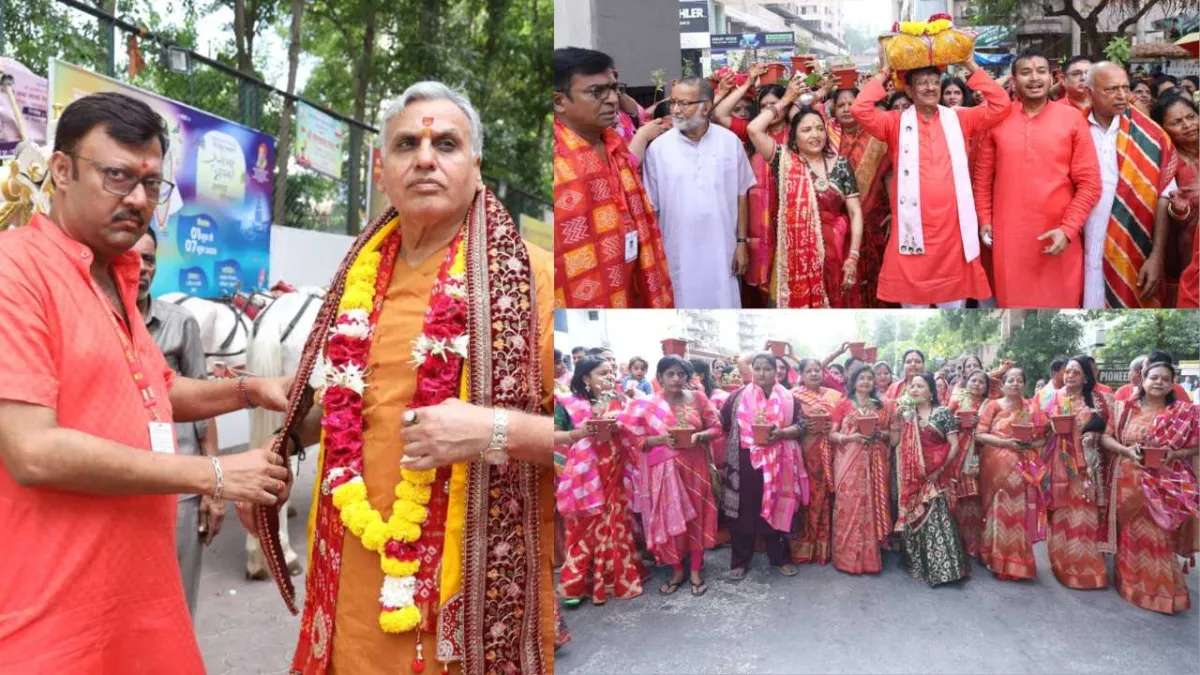
Devotees Flock to the Storytelling Event Celebrating the Silver Jubilee Year of the Rani Sati Dadi Temple; Bhagavata Acharya Radheshyam Shastri Explains the Importance of Devotion
The seven-day Srimad Bhagavata Katha Gyan Yajna, organized by the Shri Shakti Dham Seva Samiti to commemorate the silver jubilee year of the Shri Rani Sati Dadi Temple, began on Tuesday with a grand Tulsi procession. This religious event will be held daily from 3:00 PM to 7:00 PM from June 9 to June 15 at the Panchavati Hall of the Maharaja Agrasen Palace in City Light.
Before the storytelling commenced, a grand Tulsi procession was taken out from the Rani Sati Dadi Temple on Tuesday morning. The procession traveled through various routes and reached the venue. During the Tulsi procession, Bhagavata Acharya Radheshyam Shastri, seated on a chariot, accepted the blessings of the devotees as he moved along. Thousands of women, carrying Tulsi plants on their heads, joined the procession with chants, while the host family walked in the front row carrying the sacred Bhagavata scripture on their heads.
At the start of the storytelling, the host family performed the Vyasa Puja. Following this, Bhagavata Acharya Radheshyam Shastri, from the speaker’s seat, provided a detailed description of the glory of the Srimad Bhagavata, highlighting the greatness of devotion, knowledge, and renunciation. He emotionally narrated episodes related to the Sanakadi sages, Naimisharanya, and the Shaunakadi sages.
Shastriji said that the fortune of listening to the Srimad Bhagavata Katha is obtained only through the grace of God. He stated that this storytelling is being organized during the month of Purushottam through the inspiration and grace of Shri Rani Sati Dadi. Addressing the devotees, he said that without seeking refuge in Lord Govind, it is impossible to be free from the sorrows of life. Remembering God and devotion are the paths to the welfare of human life.
He said that the Srimad Bhagavata is the very form of Lord Shri Krishna, and listening to and reciting it leads the soul to liberation and Vaikuntha. During the storytelling, the devotees became emotionally overwhelmed and immersed in the essence of devotion upon hearing the bhajans ‘Shri Krishna Govind Hare Murari, He Nath Narayan Vasudeva’ and ‘Rama-Rama, chanting and chanting, the entire life passed by.’
Expressing concern over the current social environment, Radheshyam Shastri said that association with the good elevates human life, while bad company leads to a person’s downfall. He said that today, society needs to impart values to children, not just property. He stated that dedicating oneself to God while alive is the true welfare.
During the storytelling, the entire atmosphere became filled with devotion with the chanting of the mantra ‘Shri Krishna Sharanam Mamah.’ The organizing committee informed that on Wednesday, the storytelling will describe the episodes of Lord Shiva’s marriage and the arrival of Sukhdev.
Rani Sati Dadi Temple
Rani Sati Dadi Temple is a prominent Hindu temple located in Jhunjhunu, Rajasthan, dedicated to Rani Sati, a legendary woman who is believed to have immolated herself on her husband’s funeral pyre in the 13th century, an act of self-sacrifice that has made her a symbol of devotion and loyalty. The temple, built in the 17th century, is a major pilgrimage site, particularly for the Marwari community, and features intricate architecture with a striking red facade. It is one of the most famous sati temples in India, drawing thousands of devotees annually, despite the controversial nature of the practice it commemorates.
<div class="my-4
Rani Sati Dadi Temple
The Rani Sati Dadi Temple is a renowned Hindu temple located in Jhunjhunu, Rajasthan, dedicated to Rani Sati, a legendary figure who is believed to have immolated herself on her husband’s funeral pyre in the 13th century. The temple, built in the 1920s by the Marwari community, is a significant pilgrimage site and features intricate architecture with a striking red facade. It honors the tradition of sati (self-sacrifice) and is particularly revered by the business-oriented Marwari community.
Panchavati Hall
Panchavati Hall is a historic site located in Nashik, Maharashtra, India, believed to be the area where Lord Rama, Sita, and Lakshmana lived during their exile in the Ramayana epic. The hall is named after the five banyan trees (Panchavati) that once stood there, and it is a significant pilgrimage spot, featuring a sacred water tank and a temple dedicated to Sita. Its history is deeply intertwined with Hindu mythology and the ancient epic, making it a key cultural and religious landmark in the region.
Maharaja Agrasen Palace
Maharaja Agrasen Palace, also known as the Agrasen ki Baoli, is a historic stepwell located in the heart of New Delhi, India. Originally built during the Mahabharata era and later reconstructed in the 14th century by the Agrawal community, it honors the legendary King Agrasen. The site is renowned for its impressive architecture, with 108 steps leading down to a water reservoir, and serves as a popular tourist attraction and a protected monument under the Archaeological Survey of India.
City Light
City Light is a renowned public artwork by American sculptor Richard Serra, located in Seattle, Washington. Installed in 1974, it consists of four tall, rectangular steel plates arranged in a cross-like formation, creating a dynamic interplay of light and shadow. The piece was commissioned for the city’s waterfront park and reflects Serra’s interest in industrial materials and the viewer’s spatial experience.
Naimisharanya
Naimisharanya, located in the Sitapur district of Uttar Pradesh, India, is an ancient forest and pilgrimage site deeply revered in Hindu mythology. It is traditionally believed to be where the sage Veda Vyasa narrated the Puranas and the Mahabharata to his disciples, and it served as a prominent center for spiritual learning and discourse. The site is also famous for its “Naimisharanya Chakra,” a sacred pond and temple complex, and remains a significant destination for pilgrims seeking spiritual merit.
Vaikuntha
Vaikuntha is the celestial abode of the Hindu god Vishnu, described in sacred texts as a transcendent realm of eternal bliss, purity, and divine light. According to Hindu mythology, it exists beyond the material universe, where Vishnu resides with his consort Lakshmi in a palace made of gold and gems. The concept of Vaikuntha is central to Vaishnavism, symbolizing the ultimate spiritual goal of liberation (moksha) and union with the divine.
Jhunjhunu
Jhunjhunu is a historic town in the Shekhawati region of Rajasthan, India, known for its richly painted havelis (mansions) and frescoes. Founded in the 15th century, it served as the capital of the Shekhawat Rajputs and later became a major trading center under the Mughal Empire. The town’s vibrant architecture and stepwells reflect its prosperous mercantile history and are a popular tourist attraction.
Rajasthan
Rajasthan, located in northwestern India, is a state renowned for its vibrant culture, majestic forts, and vast Thar Desert. Its history is deeply rooted in the era of Rajput kingdoms, with cities like Jaipur, Udaipur, and Jodhpur showcasing opulent palaces and battlements from the medieval period. Today, Rajasthan preserves this rich heritage through its folk music, colorful festivals, and architectural marvels, making it a popular destination for travelers.