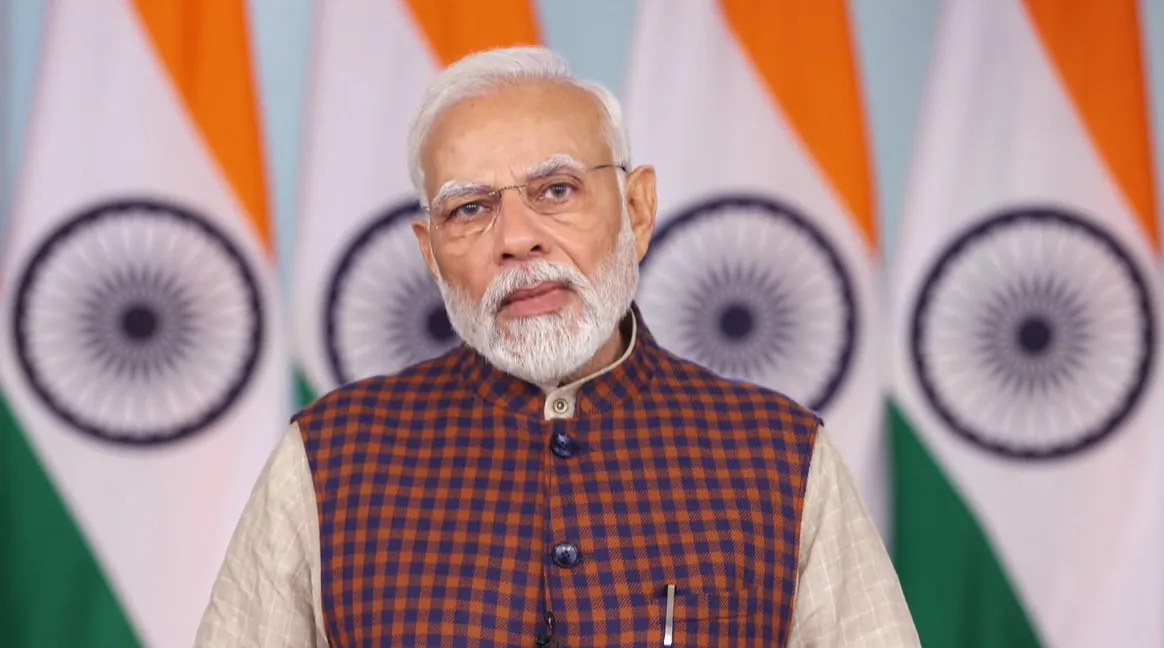
The Prime Minister urged the adoption of nine resolutions for a developed India and stated that if all citizens advance with honesty and firm determination on these nine resolutions, they can accelerate the journey towards building a Developed India by 2047.
Addressing a massive public gathering at the Adichunchanagiri Mutt in Mandya district, it was said this initiative transcends regional boundaries and represents a nationwide call for collective participation and lifestyle changes.
It was emphasized that the personal habits and daily choices of citizens will play a decisive role in shaping the country’s future. It was stated that if all move forward with honesty and firm determination on these nine resolutions, progress towards a developed Karnataka and a developed India can be accelerated.
Presenting development as a people’s movement rather than merely a government-driven effort, it was stressed that change must begin at the level of everyday behavior.
Water conservation was identified as a top priority in regions dependent on river systems and a collective pledge was urged. It was said, let us all resolve for water conservation and its better management.
On environmental sustainability, a call was made for large-scale tree planting under the ‘One Tree in Mother’s Name’ initiative. It was said, let us plant trees in honor of our mothers and protect Mother Earth.
Describing cleanliness as a civic duty, it was stated that maintaining cleanliness in public spaces, religious sites, villages, and cities is a shared responsibility. It was said, whether it is a religious site, a public place, a village, or a city, maintaining cleanliness is our collective responsibility.
Regarding economic self-reliance, the importance of promoting domestic production and supporting Indian industries was emphasized. Citing the ‘Vocal for Local’ approach as the foundation for economic empowerment, it was said, let us embrace Indian products and strengthen our industries.
National awareness and cultural integration were encouraged by urging citizens to travel across the country and learn about its diversity.
It was said, let us travel across all of India and promote domestic tourism. It was further stated that better connection among people will strengthen national unity and boost the cultural economy.
Health and nutrition were highlighted, emphasizing the inclusion of coarse grains in diets and expressing concern that rising obesity has become a major public health issue.
It was also urged that citizens reduce oil consumption by 10 percent. On agriculture, farmers were told, let us move towards chemical-free natural farming.
Greater emphasis was placed on physical fitness, saying, yoga, sports, and fitness should become part of our daily lives. It was stated that healthcare should be established as a national priority.
On this occasion, a call was made for a strong spirit of public service, saying, serving those in need strengthens society and gives life a greater purpose.
It was said these nine resolutions represent a comprehensive people-participation governance model, where behavioral changes at the citizen level can collectively bring about national transformation.
It was stated that such collective commitment will make a significant contribution to the vision of a developed Karnataka and a developed India.
Earlier in the day, the Sri Guru Bhairavaikya Temple in the historic Adichunchanagiri Mutt complex in Mandya district was inaugurated, a new spiritual site dedicated to the late saint Sri Balagangadharanath Swamiji.
Located amidst the misty hills of Adichunchanagiri, this gaddige monument is a tribute to the legacy that has been advanced for decades by the mutt through works in education, health, and social service.
Constructed under the centuries-old Nath tradition of Shaivism, this temple is seen as an extension of the guru-disciple tradition that defines the spiritual lineage of this institution.
As chants resonated through the hilltop complex, a large number of devotees gathered there, turning the inauguration into a confluence of devotion, heritage, and public participation.
Adichunchanagiri Mutt
Adichunchanagiri Mutt
Sri Guru Bhairavaikya Temple
Mandya district
Karnataka
India
Nath tradition of Shaivism
gaddige monument
Sri Balagangadharanath Swamiji
Related news

Working with Mohanlal is a matter of good fortune: Ekta Kapoor
Amit Shah congratulates individuals nominated for Rajya Sabha
Emotional tribute paid to revered Sindhi spiritual saint Sadhram in Surat.
Prime Minister Modi asked engineers to document their experiences with the bullet train project.