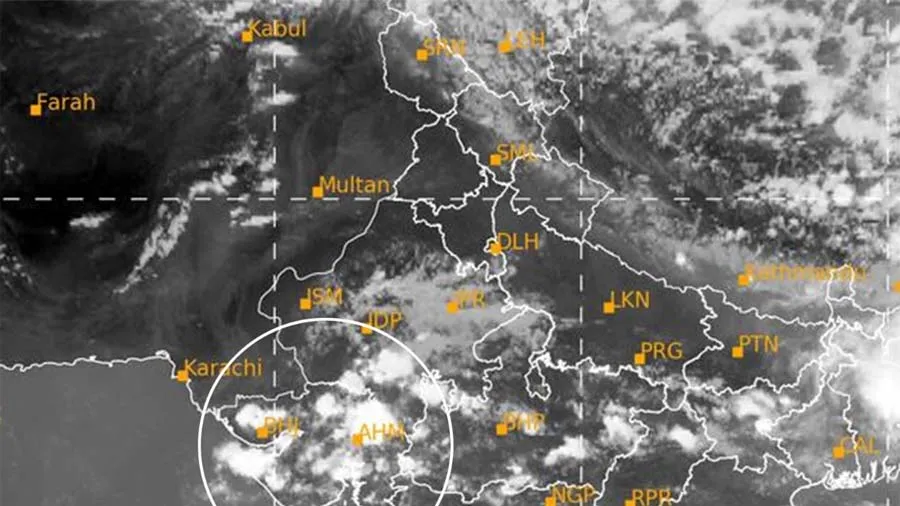
Concerning news has emerged regarding the crucial southwest monsoon for the country’s agriculture and economy.
The India Meteorological Department has stated in its latest forecast that the monsoon this year is likely to be weaker than normal overall.
This is the first time since 2023 that the weather department has predicted below-average rainfall.
According to the weather department, rainfall during June to September this year is expected to be around 92 percent of the long-period average (LPA). The department has allowed for a 5 percent model error margin in this forecast.
The main reason for this lower rainfall is believed to be the developing El Niño conditions in the Pacific Ocean, which often affect the Indian monsoon.
Statistically, the LPA for the four-month monsoon season is set at 87 centimeters. If the forecast holds true, the average rainfall across the country could be limited to around 80.04 centimeters.
According to the weather department’s criteria, rainfall between 90 to 95 percent of the LPA is categorized as below normal. The department has indicated that most parts of the country will face a rainfall deficit, although the situation may be slightly better in some areas of Northeast, Northwest, and the Southern Peninsula.
Analysis suggests there is a 35 percent probability of a weak monsoon and a 31 percent probability of a below-normal monsoon.
However, a silver lining is that lower rainfall does not always mean poor crops. If the timing and distribution of rainfall are correct, the impact on Kharif crop production could be minimized.
Nevertheless, the risk has increased for pulse and oilseed crops grown in non-irrigated areas. If production of these crops declines, there is a risk of increased import bills and a spike in food inflation, which could affect the country’s economic growth rate.
Currently, 55 percent of India’s agricultural area is irrigated, which helps combat drought-like conditions. The weather department will release its updated forecast at the end of May, which will provide information on the monsoon’s precise onset date.
India Meteorological Department
The India Meteorological Department (IMD), founded in 1875, is the principal government agency responsible for meteorological observations, weather forecasting, and seismology in India. It is one of the world’s oldest weather services, originally established to study the southwest monsoon for agricultural planning. Today, it provides vital public weather services and early warnings for cyclones and other severe weather events across the country.
Pacific Ocean
The Pacific Ocean is the world’s largest and deepest ocean, covering more than 30% of the Earth’s surface. Its history is defined by ancient human migrations across its islands, European exploration in the 16th-18th centuries, and its critical role in global trade and ecology. Today, it remains a vital conduit for international commerce and a focus for environmental conservation efforts.
Indian monsoon
The Indian monsoon is not a specific place or cultural site, but a vital seasonal weather system. It is characterized by a reversal of wind patterns that brings heavy rainfall to the Indian subcontinent from June to September, crucial for agriculture and water supply. Its predictable yet volatile arrival has shaped the region’s ecology, economy, and culture for millennia, influencing festivals, harvest cycles, and historical events.
Northeast
The term “Northeast most commonly refers to the **Northeastern United States**, a region historically comprising some of the original Thirteen Colonies and a major center of early American industry and immigration. Culturally, it is known for its dense urban corridors, distinct seasons, and influential role in American finance, education, and politics.
Alternatively, it can describe the **Northeast region of India**, a culturally rich and geographically isolated area comprising eight states, with a history of independent tribal kingdoms and later integration into modern India. It is renowned for its diverse indigenous cultures, vibrant festivals, and unique biodiversity.
Northwest
“Northwest” is too broad a term for a specific summary, as it could refer to a region like the Pacific Northwest of North America or a direction. If referring to the **Pacific Northwest cultural region**, it is historically defined by indigenous peoples like the Coast Salish for thousands of years, with European exploration and settlement expanding significantly in the 18th and 19th centuries. Its modern identity is shaped by a blend of Native American heritage, maritime history, and industries like forestry and technology.
Southern Peninsula
The Southern Peninsula, often referring to the Reykjanes Peninsula in Iceland, is a geologically active region known for its dramatic lava fields, hot springs, and the recent volcanic eruptions near the town of Grindavík. Historically, it has been inhabited since the Viking Age and is home to the “Bridge Between Continents,” symbolizing its location on the Mid-Atlantic Ridge where the Eurasian and North American tectonic plates meet. The area gained global significance with the 2021 establishment of Fagradalsfjall volcano as a major new tourist attraction.
Kharif crop
“Kharif crop” is not a specific place or cultural site, but rather an agricultural term. It refers to the category of crops in South Asia, such as rice, maize, and cotton, that are sown with the onset of the monsoon season (around June-July) and harvested in autumn. This seasonal farming practice has been central to the region’s agrarian history and cultural rhythms for centuries.
India
India is a vast South Asian country with one of the world’s oldest continuous civilizations, dating back over 5,000 years to the Indus Valley. Its long and complex history is marked by the rise of major religions like Hinduism and Buddhism, the rule of powerful empires such as the Maurya and Mughal, and British colonization before gaining independence in 1947. Today, it is a vibrant, pluralistic republic renowned for its immense cultural, linguistic, and architectural diversity.