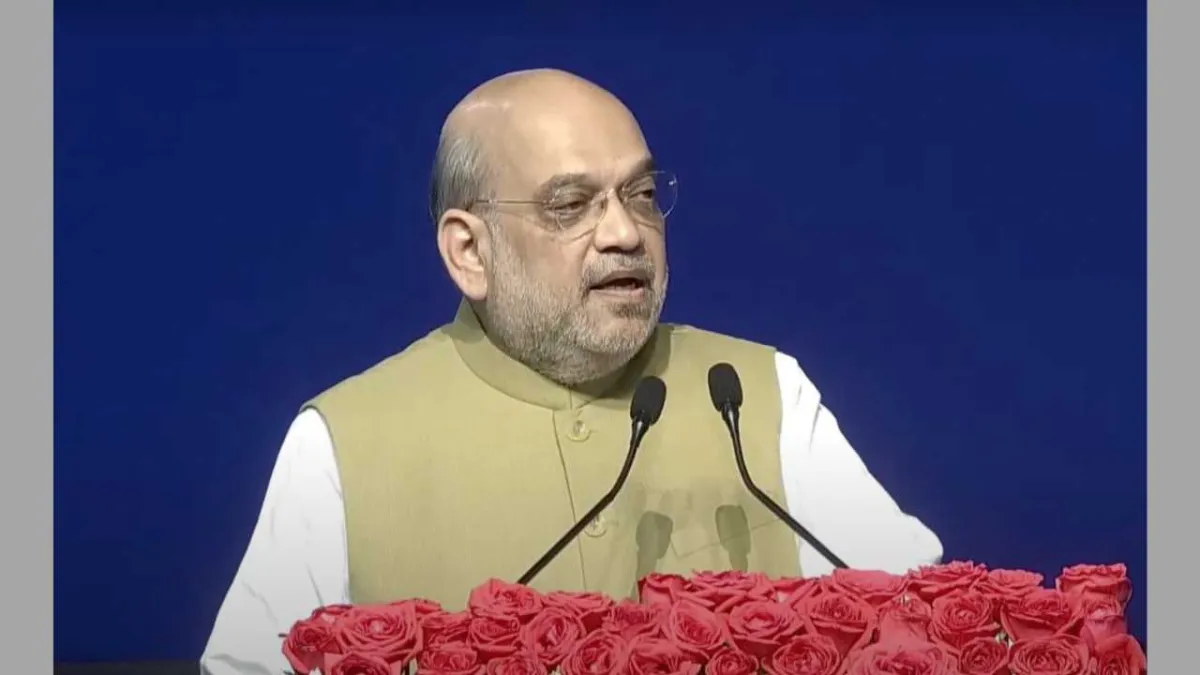
Union Home Minister Inaugurates and Lays Foundation Stone for Various Projects Worth ₹267 Crore in Gandhinagar District
Despite repeated attempts at destruction, citing the example of the reconstruction of the Somnath temple, it was stated on Tuesday that it is not easy to erase India’s Sanatan Dharma, culture, and the faith of its people. It was said that those who attacked the temple ultimately perished, but the temple still stands proudly at the same location on the seashore in Gujarat’s Gir Somnath district. These remarks were made while addressing a program after inaugurating and laying the foundation stone for various projects worth ₹267 crore in Mansa, Gandhinagar district. It may be noted that the Prime Minister inaugurated the Somnath Swabhiman festival on January 11. Mahmud Ghazni had launched the first attack on the Somnath temple 1,000 years ago.
It was stated that even after 1000 years and being destroyed 16 times, the Somnath temple still stands and its flag flies high in the sky. It was mentioned that a grand Somnath Corridor is also being constructed there. It was said, this is a message to the entire world that erasing India’s Sanatan Dharma, Indian culture, and the faith of the Indian people is not so easy. It is eternal and immortal like the sun and the moon. This Somnath temple is a symbol of India’s faith, belief, and pride.
The Somnath Swabhiman festival will be celebrated for an entire year. It was stated that the Somnath Swabhiman festival will be celebrated for a full year. During this period, numerous programs will be organized across the country, aiming to stir India’s soul, awaken its consciousness, and strengthen the roots of Sanatan Dharma to the deepest levels of society. It was said, nearly a thousand years ago, our magnificent Somnath temple was destroyed by Mahmud Ghazni. After that, other invaders like Alauddin Khilji, Ahmad Shah, Mahmud Begada, and Aurangzeb also repeatedly attacked it. But each time, this temple was rebuilt.
It was stated, the mindset of the destroyers believed in destruction, while the faith of the builders was in creation. Today, a thousand years later, those destroyers have vanished into history, but the Somnath temple still stands proudly facing the sea. -The strike on our faith, our religion, and our self-respect. It was said that after independence, the reconstruction of this temple was accomplished through the efforts of Sardar Vallabhbhai Patel, K.M. Munshi, the Maharaja of Jamnagar, and the country’s first President, Dr. Rajendra Prasad. It was stated that all of them had taken a vow for the restoration of the Somnath temple. It was said, the sentiment behind that vow was that the attack on Somnath was not merely an attack on a temple, but rather a strike on our faith, our religion, and our self-respect. The answer lies not in another attack, but in protecting our self-respect.
Somnath temple
The Somnath temple, located in Gujarat, India, is one of the twelve sacred Jyotirlinga shrines of Shiva. Historically, it has been destroyed and rebuilt several times, most famously by Mahmud of Ghazni in 1026 CE, symbolizing Hindu resilience. The present structure, reconstructed in 1951, stands as a major pilgrimage site on the Arabian Sea coast.
Gandhinagar district
Gandhinagar district is the administrative capital of the Indian state of Gujarat, established in 1964 and named after Mahatma Gandhi. It was planned and built to replace Ahmedabad as the state capital, featuring wide, orderly streets and significant government buildings. The district is also home to the Akshardham temple, a major modern Hindu cultural complex completed in 1992.
Gir Somnath district
Gir Somnath is a district in Gujarat, India, renowned for housing the revered Somnath Temple, one of the twelve sacred Jyotirlinga shrines of Lord Shiva. The temple has a long history of destruction and reconstruction, most famously rebuilt in 1951 after India’s independence, following earlier demolitions by invaders. The district is also the sole home of the endangered Asiatic lions in the Gir National Park.
Somnath Swabhiman festival
The Somnath Swabhiman festival is an annual cultural and spiritual event held at the historic Somnath Temple in Gujarat, India. It commemorates the temple’s resilience and reconstruction, celebrating its history of being destroyed and rebuilt several times, most notably after India’s independence in 1947. The festival features religious ceremonies, cultural performances, and patriotic events that highlight the temple’s symbolic role in national pride and Hindu faith.
Somnath Corridor
The Somnath Corridor is a recently developed, expansive walkway and infrastructure project in Gujarat, India, leading to the revered Somnath Temple—one of the twelve sacred Jyotirlinga shrines of Shiva. Historically, the temple itself has been destroyed and rebuilt several times over centuries, most famously by Mahmud of Ghazni in 1026 CE, symbolizing Hindu resilience. The new corridor, inaugurated in 2023, aims to enhance pilgrimage access and the visitor experience around this ancient site.
Mahmud Ghazni
Mahmud Ghazni refers to Mahmud of Ghazni (971–1030 CE), the most prominent ruler of the Ghaznavid Empire, centered in modern-day Afghanistan. He is historically significant for launching numerous military campaigns into the Indian subcontinent, which expanded his empire and facilitated the spread of Islamic influence in the region. His capital, Ghazni, became a major center of Persian culture and learning, though his legacy is often viewed critically due to the destructive nature of his raids on Indian temples.
Alauddin Khilji
Alauddin Khilji was not a place but a powerful ruler of the medieval Khilji dynasty in India, reigning from 1296 to 1316 CE. His reign is historically significant for his military conquests, which expanded the Delhi Sultanate, and for his ambitious administrative and economic reforms, such as strict market price controls.
Ahmad Shah
“Ahmad Shah” most commonly refers to **Ahmad Shah Durrani** (c. 1722–1772), the founder of the Durrani Empire and regarded as the founding father of modern Afghanistan. He unified the Pashtun tribes and established an empire that stretched from eastern Persia to northern India, with his mausoleum located in Kandahar, Afghanistan, which remains an important cultural and pilgrimage site.