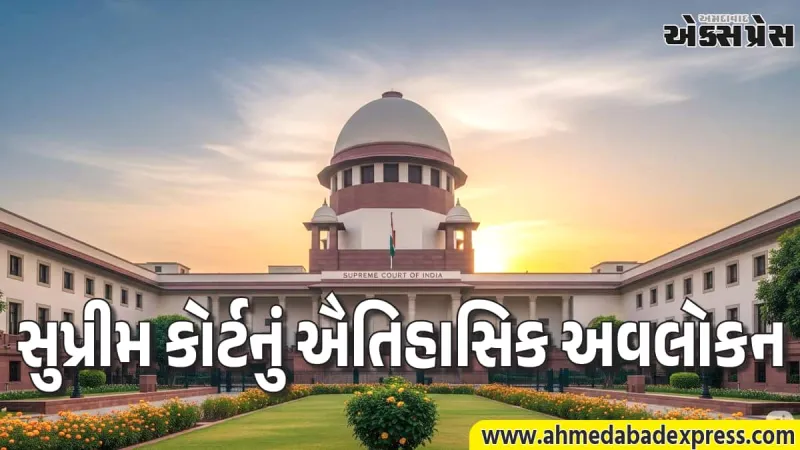
The Supreme Court’s nine-judge constitutional bench made an important observation regarding Hinduism, stating that Hinduism is not just a method of worship but a way of life. During the hearings on the Sabarimala and religious freedom cases, the Chief Justice and Justice B.V. Nagaratna clarified that going to a temple or performing religious rituals is not mandatory to be a Hindu.
During the hearings on cases related to religious freedom and women’s entry into religious places, the Supreme Court made an important observation about Hinduism on Wednesday. The court stated that going to a temple or performing specific religious rituals is not a prerequisite for being a Hindu. The court noted that lighting a lamp at home is sufficient to express one’s faith. The court clarified that Hinduism is not limited to methods of worship but is a way of life. It clearly stated that for a person to be a Hindu, going to a temple or performing religious rituals is not mandatory.
This observation was made by a nine-judge constitutional bench led by the Chief Justice. This bench is currently hearing cases related to women’s entry into the Sabarimala temple, religious freedom, and traditions prevalent in various religions. The bench also includes several other justices.
Reference to the 1966 Precedent
During the hearing, a senior lawyer representing an intervenor submitted that demands for social justice from religious communities are constantly emerging. Citing a 1966 judgment, he noted that at that time, the court defined a ‘Hindu’ as a person who considers the Vedas supreme in matters of religion and philosophy. He raised the question of whether every person currently recognized as a Hindu actually gives supreme authority to the Vedas. He argued that the reality of society is much broader and different than what this definition suggests.
‘Hinduism as a Way of Life’
Responding to the lawyer’s arguments, Justice B.V. Nagaratna commented, “This is the reason why Hinduism is described as a way of life. For a Hindu, going to a temple or performing religious rituals is not mandatory.” He further stated that every person is free to express their faith in their own way, and no one has the right to interfere with another person’s devotion.
‘Lighting a lamp even in a hut is enough’
The Chief Justice also observed that if a person lights a lamp—even within the confines of a simple hut—it is enough to show their faithfulness to their belief.
What the Court Said Earlier
The Supreme Court had earlier observed that if individuals start challenging every religious practice or matter related to religion before a constitutional court, it would result in hundreds of petitions being filed, potentially leading to the fragmentation of every religious faith.
Ban on Women’s Entry Lifted
In September 2018, a five-judge constitutional bench of the Supreme Court delivered a historic verdict with a 4-1 majority, declaring the ban on the entry of women aged 10 to 50 into the Sabarimala Ayyappa temple as unconstitutional and subsequently lifting the ban. The court ruled that this centuries-old Hindu religious practice was both illegal and unconstitutional. Currently, a larger nine-judge bench is hearing broader issues related to religious freedom and equality, including the validity of this verdict.