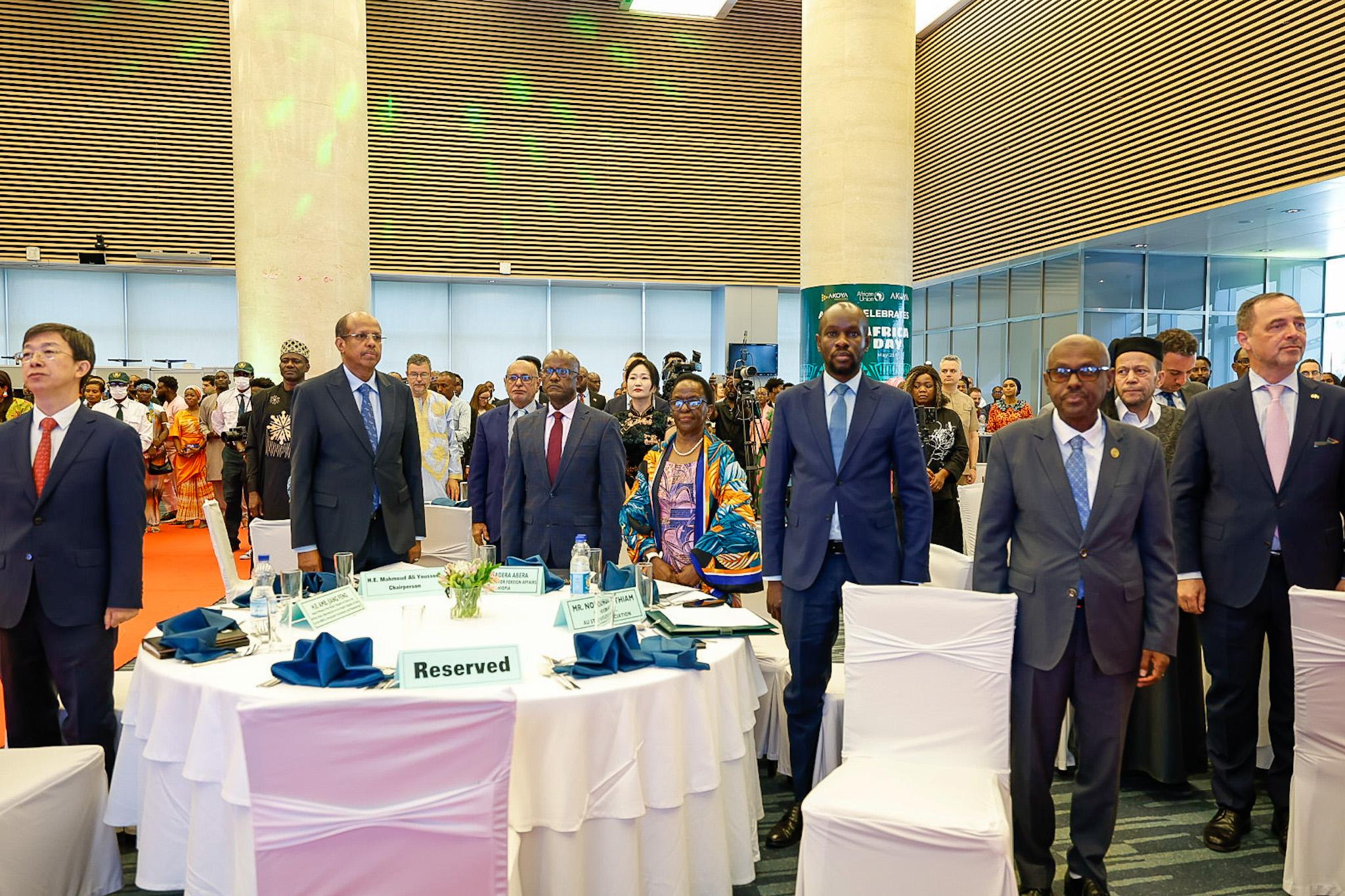
Addis Ababa, May 25, 2026 The African Union commemorated the sixty-third anniversary of the founding of its predecessor, the Organization of African Unity.
The celebration was held under the theme “Sixty-three Years of Unity, Integration, and Development: Let Us Celebrate Together.”
This event brought together African heads of state, diplomats, and international partners to reflect on the continent’s achievements.
The gathering also served as a platform to renew collective commitments to continental unity, sustainable development, and strengthening global cooperation.
In a speech during the event, a state minister for foreign affairs of Ethiopia described Africa Day as a historic milestone symbolizing the vision and determination of African leaders who struggled for a free, united, and prosperous continent.
The state minister welcomed the recent decision by the United Nations General Assembly recognizing slavery and colonialism as serious crimes against humanity, calling this step historic and significant.
He further stated that Africa’s abundant natural resources, its youth, and the rapid progress in renewable energy and climate action offer vast opportunities for sustainable development and economic transformation.
Meanwhile, the Chairperson of the African Union Commission highlighted Africa’s growing influence on the global stage and expressed optimism about the continent’s future.
At the same time, the permanent representative of China to the African Union reaffirmed the historic partnership between China and Africa, and conveyed congratulations from the Chinese president on the occasion of Africa Day.
He added that China has expanded zero-tariff treatment to all 53 African countries that have diplomatic relations with Beijing.
The representative also affirmed China’s support for Africa’s digital transformation, industrialization, and agricultural modernization, calling for enhanced cooperation in multilateral institutions, including the United Nations and the G20.
He stated that China supports African-led solutions to regional challenges and endorses the African Union’s efforts to promote peace and stability and implement the “Silencing the Guns” initiative.
African Union
The African Union (AU) is a continental union founded in 2002 in Durban, South Africa, as a successor to the Organization of African Unity (OAU), which was established in 1963 to promote decolonization and unity. Headquartered in Addis Ababa, Ethiopia, the AU aims to drive economic integration, peace, and development across all African nations. Its history reflects a shift from supporting independence movements to addressing modern challenges like governance, conflict resolution, and continental trade.
Organization of African Unity
The Organization of African Unity (OAU) was established on May 25, 1963, in Addis Ababa, Ethiopia, with the aim of promoting unity and solidarity among African states, eradicating colonialism, and fostering economic cooperation. It played a crucial role in supporting liberation movements across the continent and mediating conflicts. In 2002, the OAU was dissolved and replaced by the African Union, which adopted a more ambitious agenda for political and economic integration.
United Nations General Assembly
The United Nations General Assembly is one of the six principal organs of the United Nations, serving as its main deliberative, policymaking, and representative body. Established in 1945, it meets annually at the UN headquarters in New York City, where all 193 member states have equal representation to discuss and coordinate on international issues. Its history reflects the post-World War II effort to foster global cooperation and prevent future conflicts through multilateral diplomacy.
United Nations
The United Nations (UN) is an international organization founded in 1945 after World War II, with the primary goal of maintaining global peace and security, fostering friendly relations among nations, and promoting social progress and human rights. Its headquarters are located in New York City, and it currently has 193 member states. The UN succeeded the ineffective League of Nations and has since played a central role in international diplomacy, humanitarian aid, and conflict resolution.
G20
The G20, or Group of Twenty, is an international forum established in 1999 to bring together the world’s major economies to discuss global financial and economic issues. It was initially created as a response to the financial crises of the late 1990s, focusing on cooperation between developed and emerging economies. Today, the G20 summits address a wide range of global challenges, including trade, climate change, and sustainable development.
Africa Day
Africa Day, celebrated annually on May 25th, commemorates the founding of the Organisation of African Unity (OAU) in 1963, which later became the African Union (AU). The day honors the continent’s collective progress toward unity, independence from colonial rule, and the ongoing struggle for economic and political freedom. It serves as a celebration of African culture, diversity, and the shared vision of a prosperous and integrated Africa.