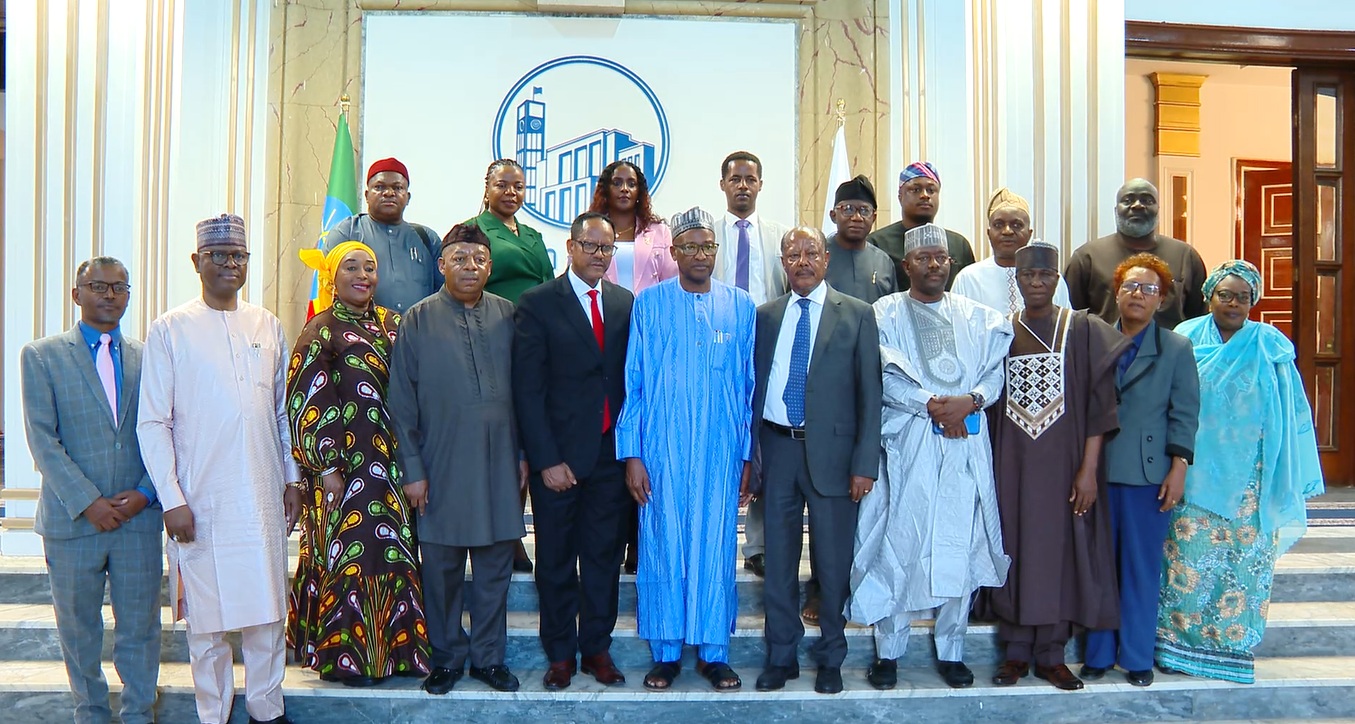
This follows today’s meeting in Addis Ababa, where a delegation from the Nigerian National Assembly Service Commission, led by Commissioner Luan Mahmoud Mana, held talks with the Ethiopian House of Peoples’ Representatives.
The discussions focused on exchanging practical approaches to parliamentary administration and governance, and exploring ways to enhance cooperation through continuous dialogue and mutual learning.
In his remarks during the meeting, Dima Niguo, Chairman of the Standing Committee for Foreign Relations and Peace Affairs in the Ethiopian House of Peoples’ Representatives, stated that the exchange of expertise and legislative cooperation are essential for expanding diplomatic channels beyond traditional government-to-government relations.
For his part, Commissioner Luan Mana Mahmoud emphasized the role of parliamentary institutions in strengthening bilateral understanding, noting that relations between the two peoples grow stronger when legislative bodies actively work to encourage cultural exchange, civic cooperation, and policy coordination.
He affirmed his parliament’s commitment to continuing consultations and sustained communication to advance shared priorities and support long-term cooperation between the two countries.
Addis Ababa
Addis Ababa is the capital and largest city of Ethiopia, founded in 1886 by Emperor Menelik II. It serves as the political and diplomatic hub of Africa, hosting the headquarters of the African Union and the United Nations Economic Commission for Africa. The city’s history is reflected in sites like the National Museum, home to the fossil “Lucy,” and St. George’s Cathedral, built to commemorate Ethiopia’s victory at the Battle of Adwa.
Nigerian National Assembly Service Commission
The Nigerian National Assembly Service Commission is a federal government body established in 2000 to oversee the administrative and professional staff serving the National Assembly (the Senate and House of Representatives). Its creation was part of a broader legislative reform to ensure the autonomy and efficiency of the parliamentary bureaucracy, separate from the executive branch’s civil service. The commission is responsible for appointments, promotions, and discipline, supporting the legislative arm of government.
Ethiopian House of Peoples’ Representatives
The Ethiopian House of Peoples’ Representatives is the lower house of the Federal Parliamentary Assembly, serving as the country’s primary legislative body. It was established following the adoption of the 1995 constitution, which created Ethiopia’s current ethnic federalism system. Its members are directly elected to represent constituencies and are responsible for passing federal laws, approving the budget, and overseeing the executive branch.
Standing Committee for Foreign Relations and Peace Affairs
The “Standing Committee for Foreign Relations and Peace Affairs” is not a specific physical place or cultural site, but a common name for a committee within a legislative body, such as a national parliament. In many countries, including China, such a committee is responsible for overseeing foreign policy, international relations, and matters related to peace and security. Its history is tied to the development of the parent legislative institution, where it plays a key role in shaping diplomatic and strategic legislative agendas.