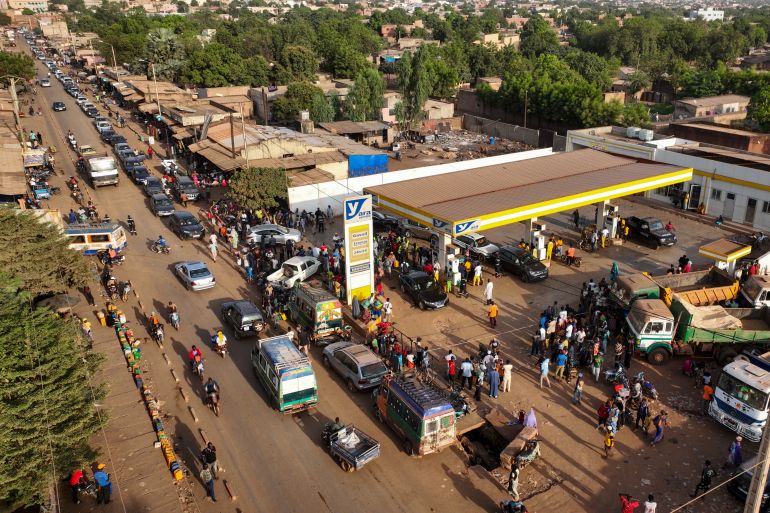
It warned of “unacceptable consequences” of a siege imposed by the Group for the Support of Islam and Muslims on the Malian capital, and called on the armed group to respect and ensure the safety of civilians, amid the disruption of vital roads and rising prices of some essential goods.
The organization said in a statement that the ongoing siege of Bamako “unacceptably restricts the freedom of movement of civilians” and could lead to “serious violations of their rights to health and life,” calling on the group to “stop targeting civilians or civilian objects” and to respect the rules of war.
It noted that three main roads leading to Bamako have been cut since April 28, after the al-Qaeda-linked group announced a “siege” of the Malian capital. According to the organization, on May 6, a convoy of commercial trucks, including trucks carrying fruit, was attacked between Bamako and Bougouni, without being under military escort or carrying military equipment or personnel.
The statement quoted the director of the West and Central Africa program at Amnesty International as saying that “attacks on civilian vehicles with a civilian purpose are unlawful,” stressing that international humanitarian law “obliges all parties to the conflict to always distinguish between civilians and combatants,” and that “attacks directed against civilians or civilian objects, including vehicles and infrastructure indispensable to the survival of the civilian population, are prohibited.”
He added that “siege actions must not violate the economic and social rights of the civilian population,” and stressed that the Group for the Support of Islam and Muslims must respect the rules of international humanitarian law and ensure that Bamako’s residents continue to have access to water, food, and other basic needs.
Amnesty International explained that as of May 15, three of the six main roads leading to Bamako and connecting to regional ports were disrupted by attacks on traffic heading to the capital, cutting the city off from vital routes for transporting goods and supplying the population. It noted that media and residents the organization spoke to reported rising prices for some essential goods.
The organization pointed out that the Human Rights Commission called on May 5 for an “immediate cessation of fighting” and urged all parties to comply with international humanitarian law, including the protection of civilians and civilian infrastructure.
Amnesty International mentioned that the group announced on May 6 a “softening” of the siege, saying that people seeking healthcare would be allowed to travel to Bamako, but it noted that it “was unable to verify” whether this announcement was being implemented on the ground.
Fuel convoys
Amnesty International recalled a previous siege of Bamako announced by the Group for the Support of Islam and Muslims in September 2025, when it declared its intention to “prevent and disrupt” fuel supplies heading to the capital from regional ports, and attacked a number of trucks coming from Dakar on the Kayes-Bamako road before announcing in November that fuel truck drivers “would be considered combatants” and would be targeted.
Bamako
Bamako, the capital and largest city of Mali, is a major port situated on the Niger River in West Africa. Originally a small fishing and trading village inhabited by the Bambara people, it grew rapidly under French colonial rule after being captured in 1883 and became the capital of the French Sudan. Today, it is a bustling cultural and economic hub, known for its vibrant music scene and institutions like the National Museum of Mali.
Bougouni
Bougouni is a town and administrative center in southern Mali, located in the Bougouni Cercle within the Sikasso Region. Historically, it was a significant trading post during the pre-colonial and colonial eras, serving as a crossroads for commerce between the savanna and forest regions. Today, Bougouni is known for its local markets and as a gateway to nearby natural attractions, though much of its earlier history remains tied to the broader cultural and economic exchanges of the Mali Empire.
Dakar
Dakar, the capital of Senegal, is a vibrant port city located on the Cap-Vert Peninsula, the westernmost point of mainland Africa. Originally a small fishing village, it grew into a major colonial hub under French rule in the 19th century, serving as a key center for trade and administration. Today, Dakar is known for its rich cultural scene, including the iconic African Renaissance Monument and the historic Île de Gorée, a poignant reminder of the transatlantic slave trade.
Kayes
Kayes, located in western Mali, is a historic city that served as the capital of French Sudan (now Mali) from 1892 to 1900, and later became a key administrative and economic center. Known as the “city of three borders” near Senegal and Mauritania, it was a vital hub for the colonial railway and trade routes. Today, Kayes is recognized for its intense heat, diverse ethnic communities, and landmarks like the Fort of Médine, a remnant of French colonial expansion.
Mali
Mali is a West African country with a rich history, once the heart of the powerful Mali Empire, which thrived from the 13th to 16th centuries under rulers like Mansa Musa, known for its wealth and Islamic scholarship. Today, it is home to UNESCO World Heritage sites such as Timbuktu and Djenné, which reflect its cultural and architectural heritage. Despite modern challenges, Mali remains a significant cultural crossroads, with traditions in music, storytelling, and vibrant festivals.
Amnesty International
Amnesty International is a global non-governmental organization focused on human rights, founded in 1961 by British lawyer Peter Benenson after he learned of two Portuguese students imprisoned for raising a toast to freedom. It campaigns against abuses such as torture, political imprisonment, and the death penalty, relying on grassroots activism and research to pressure governments and other entities. Over the decades, it has grown into a major force for justice, winning the Nobel Peace Prize in 1977 for its efforts.
Group for the Support of Islam and Muslims (JNIM)
The Group for the Support of Islam and Muslims (JNIM) is a jihadist militant coalition formed in March 2017 through the merger of several al-Qaeda-aligned groups active in the Sahel region, primarily Mali, Burkina Faso, and Niger. Its creation brought together factions such as Ansar Dine, the Macina Liberation Front, and the Sahara branch of Al-Qaeda in the Islamic Maghreb, with the aim of unifying operations against local and international forces. JNIM has since become one of the most powerful extremist organizations in West Africa, conducting frequent attacks and exploiting regional instability to expand its influence.
Human Rights Commission
The Human Rights Commission is not a single place or cultural site, but a general term for government bodies established to protect and promote human rights. These commissions often investigate violations, educate the public, and advise on policy, with many tracing their origins to the post-World War II human rights movement. For example, the United Nations Human Rights Council was created in 2006 to replace the earlier Commission on Human Rights, reflecting a global commitment to uphold fundamental freedoms.