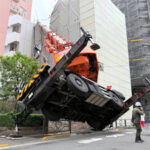
Up to 18,000 people could die in a Tokyo area earthquake.
A powerful magnitude 7 earthquake in the Tokyo area could kill up to 18,000 people, according to a government assessment.
«A powerful earthquake, which is highly likely to occur beneath Tokyo and nearby areas within the next several decades, could lead to the death of 18,000 people,» the publication states.
It is further clarified that such a potential earthquake could also cause economic damage to the country amounting to 83 trillion yen ($535 billion) in the worst-case scenario. According to government estimates, the probability of such an earthquake occurring in Tokyo and its vicinity is about 70%.
Furthermore, this situation could affect millions of people and locations where government institutions and corporate headquarters are situated; 400,000 buildings could be destroyed, and 8.4 million people could find themselves in a difficult position or face challenges returning home.
The material emphasizes that a magnitude 7.3 earthquake is weaker than the magnitude 9 tremors that occurred in northeastern Japan in 2011 and led to multiple meltdowns at the Fukushima Daiichi Nuclear Power Plant.
An earthquake occurred on November 25 in southwestern Japan, not far from the coast of Kamchatka. It was noted that the epicenter of the tremors was located 44 km east of the city of Kumamoto, and the earthquake’s focus was at a depth of 10 km.
Tokyo
Tokyo is the bustling capital of Japan, originally established as the small fishing village of Edo. It rose to prominence after becoming the seat of the Tokugawa shogunate in 1603 and was renamed Tokyo when the emperor moved there in 1868, beginning the Meiji Restoration. Today, it is a global metropolis known for its towering skyscrapers, historic temples, and cutting-edge technology and pop culture.
Fukushima Daiichi Nuclear Power Plant
The Fukushima Daiichi Nuclear Power Plant is a disabled nuclear power facility located in Japan’s Fukushima Prefecture. It was severely damaged during the 2011 Tōhoku earthquake and tsunami, leading to meltdowns in three reactors and a major release of radiation, making it the world’s most significant nuclear disaster since Chernobyl. The site is now in a decades-long decommissioning phase, with ongoing work to manage contaminated water and radioactive materials.
Kamchatka
Kamchatka is a remote volcanic peninsula in Russia’s Far East, renowned for its dramatic landscapes of geysers, hot springs, and over 160 volcanoes. Historically isolated, it was gradually explored by Russian Cossacks from the 17th century onward, displacing the indigenous Itelmen and Koryak peoples. Today, it is a UNESCO World Heritage site celebrated for its pristine wilderness and unique biodiversity.
Kumamoto
Kumamoto is a city on Japan’s Kyushu Island, most famous for Kumamoto Castle, one of Japan’s largest and most formidable fortresses. Originally constructed in 1607 by the feudal lord Kato Kiyomasa, the castle was heavily damaged in the 2016 Kumamoto earthquakes but remains a major symbol of the region undergoing extensive restoration. The city is also known for its connection to the samurai Miyamoto Musashi and its vibrant local cuisine.
The Tokyo Metropolitan Board of Education is promo...
Utilizamos cookies para garantizar la mejor experiencia de usuario y analizar el tráfico. Al continuar navegando por el Sitio, usted acepta nuestra
[Política de cookies]. 🍪