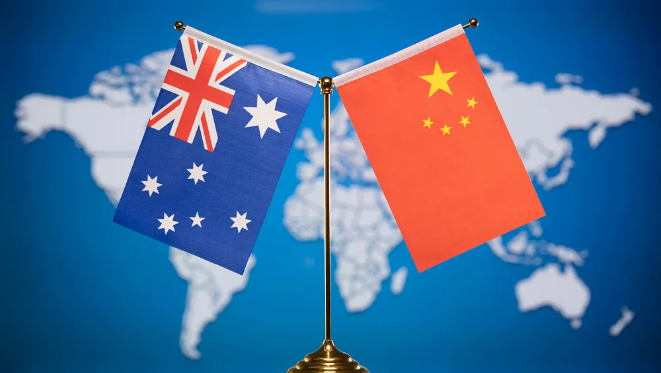
Canberra Cannot Have Its Cake and Eat It Too
Marking a step to support trade with China, the Australian government unveiled a plan on Monday to expand domestic exporters’ access to the Chinese market. As trade barriers between the two countries continue to ease, this measure will facilitate the development of bilateral economic cooperation.
The market access initiative — a two-year plan backed by A$50 million (US$33.32 million) — encourages farmers, fishers, miners, and winemakers to tap into the Chinese market, according to a statement from the Australian Department of Foreign Affairs and Trade.
This step further highlights the pragmatic approach of the Australian government toward China. Since taking office in 2022, the leadership has sought to improve relations with China, which was met with a reciprocal response from Beijing. The stabilization of bilateral ties since then has brought tangible benefits to both sides. This should encourage the government to view China more objectively.
However, this pragmatism appears to have its limits.
The latest evidence of this emerged roughly two weeks before Canberra unveiled its trade initiative, when Australia concluded its largest 15-day joint military drills with the Philippines and the United States in the South China Sea, a de facto step to embolden the Philippines to continue its provocative actions against China.
Australia should confront the stark contradiction between its economic interests and its security policy, as the latter only heightens regional tensions and undermines stability. While benefiting from trade with China, Australia continues to attempt to uphold the AUKUS pact, a US-led mechanism targeting China, and provide support to the Philippines in the South China Sea. Such behavior exposes Australia’s implicit calculations of trying to butter both sides of its bread.
While China places great importance on economic and trade relations with Australia, it will under no circumstances tolerate such encroachments on its core interests.
China poses no threat to Australia. Canberra should recognize that it is an external party to the maritime disputes in the South China Sea and that its reckless security policy serves neither regional peace nor Australia’s own strategic standing. Its dual-track policy toward China is not sustainable in the long run.
The Australian government is strongly urged to develop a rational understanding of China not only as Australia’s largest trading partner but also as a responsible major country committed to promoting peace and stability in the Asia-Pacific region and beyond.
Deepening economic and trade cooperation between the two countries will further unlock the potential of their economic complementarity and ensure common growth, while enhancing strategic coordination on regional and international affairs will serve their shared interests and those of the region.
China has never demanded that Australia choose sides but urges it to maintain its strategic autonomy in international relations.
As this year marks the 10th anniversary of the China-Australia Free Trade Agreement, both countries should maintain close cooperation, continue the high-quality implementation of the agreement, and jointly conduct an analysis to identify areas for further improvement or expansion.
To create the necessary conditions for mutually beneficial cooperation not only in the economy and trade but also in other fields, the government knows what needs to be done.
Related News
China
China is one of the world’s oldest continuous civilizations, with a recorded history spanning over 4,000 years, marked by successive dynasties, profound philosophical traditions like Confucianism, and inventions such as paper and gunpowder. Today, it is a vast modern nation-state officially known as the People’s Republic of China, blending its immense historical heritage with rapid economic development and global influence. Key cultural sites, like the Great Wall and the Forbidden City, stand as enduring symbols of its imperial past and architectural achievement.
Australia
Australia is both a country and a continent, with a human history spanning over 65,000 years of continuous Indigenous cultures, most notably the Aboriginal and Torres Strait Islander peoples. Its modern history began with British colonization in 1788, which led to its development as a nation of six states and two territories, officially federated in 1901. Today, it is known for its unique biodiversity, iconic landmarks like Uluru and the Sydney Opera House, and a diverse multicultural society.
South China Sea
The South China Sea is a major marginal sea of the western Pacific Ocean, bordered by several Southeast Asian nations. Historically, it has been a vital maritime trade route for centuries, connecting East Asia with the Indian Ocean and beyond. Today, it is also a region of significant geopolitical and economic importance due to competing territorial claims over islands and resources, as well as crucial shipping lanes.
AUKUS pact
The AUKUS pact is a trilateral security partnership between Australia, the United Kingdom, and the United States, announced in September 2021. Its primary initial goal is to support Australia in acquiring nuclear-powered submarines, representing a significant strategic shift in the Indo-Pacific region largely in response to China’s growing influence. While focused on advanced technology sharing, the pact has also sparked geopolitical tensions and debates about nuclear proliferation and regional stability.
Philippines
The Philippines is an archipelagic nation in Southeast Asia with a rich cultural history shaped by centuries of indigenous traditions, Spanish colonial rule (1565-1898), and later American influence. Its cultural sites, such as the Baroque Churches of the Philippines and the historic city of Vigan—both UNESCO World Heritage Sites—reflect this unique fusion of Asian, European, and local heritage.
United States
The United States is a federal republic founded in 1776 after declaring independence from Great Britain, with its modern government established by the Constitution in 1789. Culturally, it is a vast and diverse nation built on immigration, known for its global influence in areas like technology, entertainment, and democratic ideals. Key historical sites span from Indigenous heritage and colonial settlements to landmarks of the American Revolution and Civil Rights Movement.
Canberra
Canberra is the purpose-built capital city of Australia, established in 1913 as a compromise between the rival cities of Sydney and Melbourne. Its design was the result of an international competition won by American architect Walter Burley Griffin, who envisioned a «garden city» with expansive greenbelts. Today, it is home to Australia’s national institutions, including Parliament House, the Australian War Memorial, and the National Gallery.
Beijing
Beijing is the capital of China and a major historical and cultural center, with a history spanning over 3,000 years. It served as the seat of imperial power during the Ming and Qing dynasties, a legacy visible in sites like the Forbidden City and the Temple of Heaven. Today, it is a vast modern metropolis that blends ancient architecture with contemporary global influence.