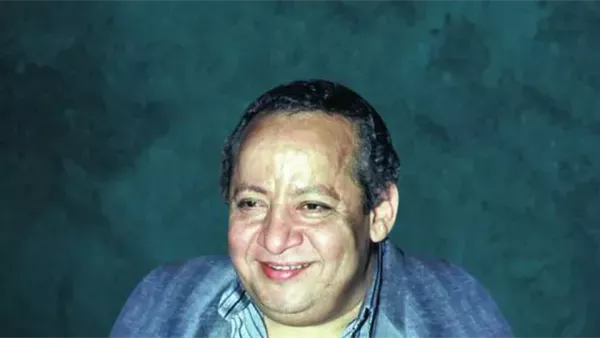
On this day, March 27th, we mark the anniversary of the passing of the great artist George Sidhom, one of the most prominent pillars of comedy in Egypt and the Arab world, and the owner of a unique artistic imprint unlike any other.
Anniversary of George Sidhom’s Passing
George Sidhom was not merely an actor who made the audience laugh; he was a singular artistic phenomenon. He managed to turn simplicity into art and spontaneity into a school of its own. From his beginnings, his performance was characterized by a natural, effortless wit, which made him close to the hearts of people of all ages and backgrounds.
His name is linked to the “Theater Lights Trio,” where the trio presented a new model of comedy that combined light sketches with intelligent performances. They achieved remarkable success through theater and television, especially with their participation in the early Ramadan riddles shows, which became a distinctive landmark in the history of Ramadan programming.
His success was not based solely on quick punchlines, but on building a complete comedic character with clear human features, blending kindness and naivety at times with subtle cleverness at others.
Works of George Sidhom
On the theater stage, Sidhom shone in a number of productions that became classics of Egyptian theater, including “Welcome, Doctor,” “The Married Ones,” “Love in the Dressing Room,” “Hard Labor Hotel,” and “Music in the Eastern District.” He was distinguished by his unique style based on spontaneous performance and a simple, human presence.
In cinema, he presented diverse roles that proved he was not just a comedic actor, but an artist capable of expressing the finest details. He also left a clear mark in television drama, with one of his most notable works being the series “The Helwani Gate,” which showed a different aspect of his talent.
In 1997, he suffered a severe health crisis after a stroke, which resulted in paralysis on the right side of his body and affected his ability to speak, leading to his withdrawal from the artistic scene. Despite this, he remained present in the hearts of his audience, who never forgot his smile or the works that created a history of genuine laughter.
Theater Lights Trio
The Theater Lights Trio is not a widely recognized historical or cultural site. Based on available information, it appears to be a modern musical group or performance act, likely named for its atmospheric or theatrical style. Therefore, it does not have a significant historical background as a physical place.
Welcome, Doctor
“Welcome, Doctor” is a famous bronze statue in the city of Guadalajara, Mexico, created by sculptor Miguel Miramontes in 1982. It depicts a kindly, seated doctor with an empty space on the bench beside him, inviting passersby to sit and take a photo. The statue honors the medical profession and has become a beloved cultural landmark, symbolizing the city’s warmth and hospitality.
The Married Ones
“The Married Ones” (Los Casados) is a famous bronze sculpture located in Plaza de los Casados in Marbella, Spain. Created by Salvador de Ory in 1995, it depicts a couple in a loving embrace, symbolizing the union of two people and the city’s romantic spirit. It has become a popular meeting point and a symbol of Marbella’s modern artistic heritage.
Love in the Dressing Room
“Love in the Dressing Room” is a 2023 Chinese romantic drama film directed by Liu Zun, not a physical place or historical cultural site. The story follows two strangers who meet in a bridal shop dressing room and impulsively decide to get married, exploring themes of modern relationships and societal expectations. As a recent cinematic work, its “history” is part of contemporary film culture rather than that of a permanent location.
Hard Labor Hotel
The Hard Labor Hotel is a fictional establishment, as there is no widely recognized real-world place or cultural site by this exact name. It may be a creative reference from a novel, film, or local legend, often used to evoke themes of hardship or historical penal labor. Without a specific real-world context, its detailed history cannot be summarized.
Music in the Eastern District
“Music in the Eastern District” refers to the vibrant live music scene and cultural heritage of Hong Kong’s Eastern District, particularly areas like Causeway Bay and North Point. Historically, from the mid-20th century, it became a hub for nightclubs and ballrooms that featured famous Canto-pop singers, and later, a center for indie and underground bands. Today, it remains a dynamic area with live houses, street performances, and music festivals that blend traditional Chinese, Western, and local Hong Kong influences.
The Helwani Gate
The Helwani Gate is a historic entrance located in the ancient city of Babylon, in modern-day Iraq. It was constructed during the reign of King Nebuchadnezzar II in the 6th century BCE as part of the city’s grand fortifications and ceremonial processional way. Today, it stands as a significant archaeological remnant of the Neo-Babylonian Empire, though much of the original structure has been lost or reconstructed.