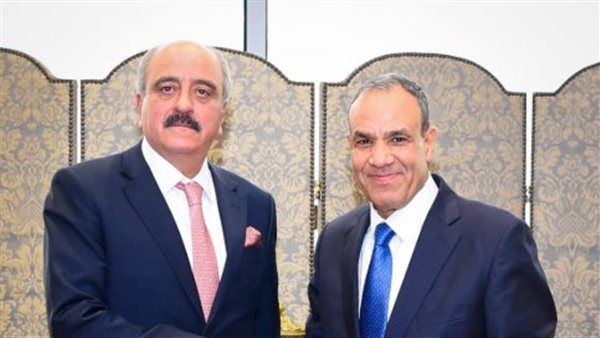
Dr. Badr Abdel Ati receives his Tunisian counterpart, Mohamed Ali Al-Nafti, today, Thursday, at the ministry’s headquarters in the new capital.
Egyptian-Tunisian Relations
It is noteworthy that Egypt hosts today, Thursday, the ministerial meeting of the Libya’s Neighboring Countries Mechanism, with the participation of the foreign ministers of Egypt, Algeria, and Tunisia.
The meeting is attended by Egyptian Foreign Minister Dr. Badr Abdel Ati, and his Algerian counterpart Ahmed Attaf, and Tunisian counterpart Mohamed Ali Al-Nafti.
The meeting of the Libya’s Neighboring Countries Mechanism is chaired by the three ministers, with the participation of Ms. Hanna Tetteh, the Special Representative of the United Nations Secretary-General for Libya and Head of the United Nations Support Mission in Libya.
new capital
The term “New Capital” often refers to planned or relocated administrative centers, such as Egypt’s new administrative capital under construction east of Cairo, designed to relieve overcrowding and modernize government functions. Historically, many nations have moved their capitals to spur development, like Brasília in Brazil (inaugurated in 1960) or Naypyidaw in Myanmar (2005), often to centralize power or promote regional balance. These projects typically symbolize national ambition, economic growth, and a break from the past.
Libya’s Neighboring Countries Mechanism
The Libya’s Neighboring Countries Mechanism is a diplomatic framework established in 2014 to coordinate efforts among Libya’s immediate neighbors—Algeria, Chad, Egypt, Niger, Sudan, and Tunisia—to address the country’s instability following the 2011 civil war. Its primary goals include supporting a peaceful political transition, securing borders, and countering the spread of armed groups and illicit trafficking. The mechanism has convened multiple summits to promote dialogue and regional cooperation, though its effectiveness has been limited by ongoing internal conflicts and differing national interests.