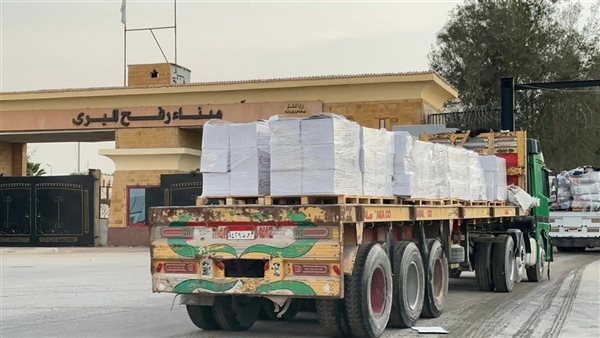
The first group of Palestinians returning from Egypt to the Gaza Strip arrived this Monday morning, following the official reopening of the crossing a short while ago.
Hospitals in North Sinai are the primary destination for the wounded and sick Palestinians arriving from the Gaza Strip.
Reopening of the Rafah Crossing
There is a full mobilization from all entities within the Egyptian state to provide support for the Palestinians arriving from the Gaza Strip.
Reports indicated that the number of people departing from Egypt to Gaza is 50, and the number arriving from the Strip is 50 others during the days of the crossing’s operation from both sides.
It was reported that a trial opening of the Rafah crossing from the Egyptian and Palestinian sides took place yesterday, Sunday, with the official opening scheduled to begin today, Monday.
Rafah Crossing
The Rafah Crossing is a border crossing located on the Gaza–Egypt border, serving as the primary transit point for people and limited goods into and out of the Gaza Strip. Its operation has been heavily influenced by the Israeli–Egyptian blockade of Gaza since 2007, with its opening and security protocols frequently dictated by political and security agreements between Egypt, Israel, and the Palestinian authorities. Historically, it has been a critical, though often restricted, humanitarian lifeline for Gaza’s population.
Gaza Strip
The Gaza Strip is a small coastal territory on the Mediterranean Sea, historically part of Palestine and administered by Egypt after the 1948 Arab-Israeli War. It came under Israeli occupation following the 1967 Six-Day War and has been governed by the Palestinian political faction Hamas since 2007, following Israel’s unilateral disengagement in 2005. The area is densely populated and has been a focal point of the Israeli-Palestinian conflict, subject to a prolonged Israeli-Egyptian blockade and repeated military conflicts.
Egypt
Egypt is home to one of the world’s oldest civilizations, with a recorded history spanning over 5,000 years and iconic monuments like the Pyramids of Giza and the Sphinx built during the era of the pharaohs. Its rich cultural legacy, from ancient hieroglyphs and temples along the Nile to later Islamic and Coptic influences, continues to define its identity as a cradle of human achievement. Today, these archaeological treasures and the enduring Nile River make Egypt a globally significant historical and cultural destination.
North Sinai
North Sinai is a governorate in northeastern Egypt, historically significant as a land bridge between Africa and Asia, which has seen millennia of trade, migration, and conflict. Its history includes ancient Egyptian routes, biblical exodus narratives, and its strategic role in modern Arab-Israeli wars. Today, it is known for its coastal resorts on the Mediterranean, such as El Arish, and its vast desert landscapes, though it has faced recent challenges with security and instability.
Palestinians
“Palestinians” refers to an Arab people with a shared history, culture, and national identity, primarily originating from the geographic region of historic Palestine. Their modern history is deeply shaped by the *Nakba* (“catastrophe”) of 1948, which involved the displacement of hundreds of thousands during the establishment of the State of Israel, and their ongoing struggle for self-determination. Key cultural sites central to Palestinian heritage and identity include the historic cities of Jerusalem (Al-Quds) with the Al-Aqsa Mosque compound, Hebron (Al-Khalil) with the Ibrahimi Mosque, and the ancient city of Jericho.