Wuhan Tops the List of Popular Spring Flower Viewing Destinations for 2026.
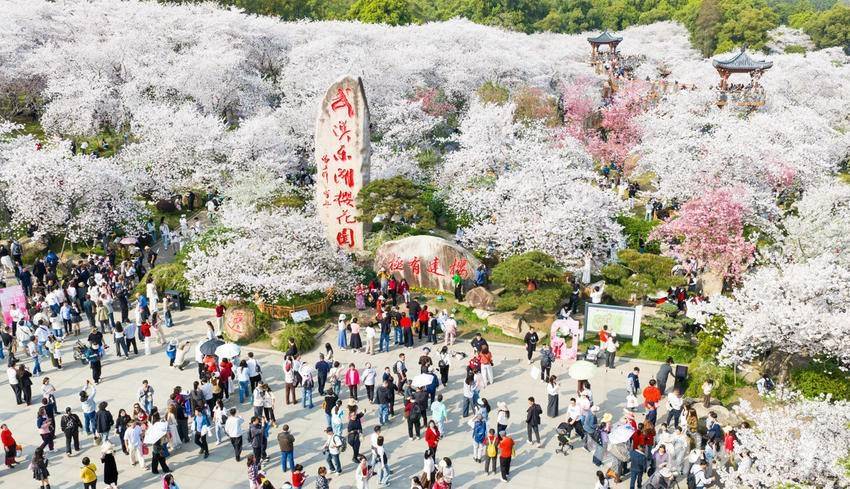
On April 8th, the Data Center of the Ministry of Culture and Tourism and the China Tourism Academy released the “China Flower Appreciation Tourism Development Report (2026)”. The report shows that flower appreciation tourism has shifted from a niche preference to a mainstream travel motivation covering all age groups. In the past year, over 70% of surveyed individuals traveled primarily for the purpose of viewing flowers. Among these, Wuhan ranked first among the top ten popular destinations for spring flower appreciation tourism in 2026, becoming a benchmark city for the national flower appreciation economy.
Data indicates that during the 2026 Qingming Festival holiday period, Wuhan’s East Lake Scenic Area received approximately 1.2187 million cumulative visitors, a year-on-year increase of 4.61%; it achieved a comprehensive tourism revenue of 356 million yuan, a year-on-year increase of 4.40%. In the platform’s published list of the top ten popular destinations for spring flower appreciation tourism in 2026, Wuhan (East Lake Cherry Blossom Garden / Wuhan University Cherry Blossoms) ranked first, followed by Wuyuan, Wuxi, Guiyang, Luoyang, Pinggu, Kunming, Nyingchi, Qujing, and Shanghai.
The report notes that the travel radius for flower appreciation trips has significantly extended, expanding from within cities to suburban areas and neighboring cities. Special research shows that regarding the spatial choice of flower viewing destinations, “short micro-vacations for flower viewing in surrounding cities” ranked first at 36.6%. Hubei Province, using “Meet in Spring to View Cherry Blossoms” as a unified brand, coordinated 295 core scenic spots, launched 400 themed flower appreciation activities, and simultaneously published recommendation lists and premium itineraries for various tourist groups through provincial platforms. This integrated floral resources originally scattered across Wuhan, Xiangyang, Yichang, and other locations into a provincial flower appreciation matrix with national influence and international reach. Consequently, Wuhan’s cherry blossoms are no longer just a highlight of a single scenic area but have become a traffic engine for the province’s spring tourism.
Furthermore, comprehensive service capability has become a key competitive factor for flower appreciation destinations. Flower appreciation tourism has typical timeliness; once the bloom period is misjudged, it not only leads to failed trips but also directly damages the credibility of the scenic area and destination. Bloom period information has shifted from promotional content to a public service providing travel certainty, an area where Wuhan has actively explored. In March of this year, multiple departments jointly issued the “2026 Wuhan Cherry Blossom Forecast”. Relying on AI-powered meteorological warnings and nearly 80 years of historical bloom pattern data, it accurately predicted the peak bloom of mid-season cherry varieties around March 17th, covering over 500,000 cherry blossom trees citywide, providing scientific guidance for the travel plans of millions of visitors.
Special research in the report shows that 27.4% of tourists expressed strong interest in experiential activities like hiking or cycling through flower fields, and 24.9% were willing to pay for “flower appreciation + sports events”. On March 22nd, the 2026 Wuhan Marathon commenced, combining sea-of-flowers landscapes with the road running experience. This “Cherry Blossom Marathon” attracted 30,000 runners from 69 countries and regions worldwide, becoming a typical sample of “sports-tourism integration” cited in the report.
The East Lake Scenic Area in Wuhan, China, is the largest urban lake in the country, celebrated for its picturesque landscapes and cultural heritage. Its history dates back over a thousand years, with many classical Chinese poems and historical figures associated with its shores. Today, it is a major recreational park blending natural beauty with pavilions, gardens, and historical sites like the Chutian Terrace.
East Lake Cherry Blossom Garden
The East Lake Cherry Blossom Garden is a scenic park located by Wuhan’s East Lake, renowned for its annual spring display of over 10,000 cherry trees. It was established in 1978 with a gift of 78 cherry saplings from Japan, symbolizing post-war friendship and cultural exchange. Today, it is one of China’s top destinations for cherry blossom viewing, attracting countless visitors each year.
Wuhan University
Wuhan University, founded in 1893 as Ziqiang Institute, is one of China’s oldest and most prestigious comprehensive universities. It is renowned for its picturesque campus, especially the iconic cherry blossom-lined avenues around its historic administration building, which blend Eastern and Western architectural styles. The university has played a significant role in China’s modern educational and scientific development.
Wuyuan
Wuyuan is a picturesque county in Jiangxi Province, China, renowned for its well-preserved ancient Huizhou-style villages, blooming rapeseed flower fields, and traditional rural landscapes. Historically, it was a significant cultural and commercial center during the Ming and Qing dynasties, with many scholars and merchants originating from the area, leaving behind a legacy of elegant architecture and a rich literary heritage. Today, it is celebrated as one of China’s most beautiful countryside destinations, attracting visitors with its timeless charm and natural beauty.
Wuxi
Wuxi is a historic city in Jiangsu province, China, situated on the northern shore of Lake Taihu. Its history dates back over 3,000 years, and it flourished as a center for the rice and cloth trade during the Ming and Qing dynasties due to its location on the Grand Canal. Today, it is known as a major industrial city and a scenic tourist destination, famous for its lake views, classical gardens like Jichang Garden, and the nearby Lingshan Grand Buddha.
Guiyang
Guiyang is the capital city of Guizhou Province in southwestern China, historically significant as a regional center since the Ming Dynasty due to its strategic location along ancient trade routes. Today, it is known as a major modern hub within the province, famous for its cool climate, lush green mountains, and the rich cultural diversity of surrounding ethnic minority groups like the Miao and Dong.
Luoyang
Luoyang is an ancient city in China’s Henan Province, historically significant as the capital for multiple dynasties including the Eastern Zhou and Eastern Han. It served as a major center of Chinese civilization and is renowned as the eastern terminus of the Silk Road and the location of the Longmen Grottoes, a UNESCO World Heritage site with Buddhist carvings dating back over 1,500 years.
Pinggu
Pinggu is a district in northeastern Beijing, China, best known for its vast peach orchards and the annual International Peach Blossom Music Festival. Historically, its strategic location near the Great Wall made it an important defensive area, with sections like the Jinshanling Great Wall running through it. Today, it serves as a major agricultural base and a popular scenic retreat from the city.