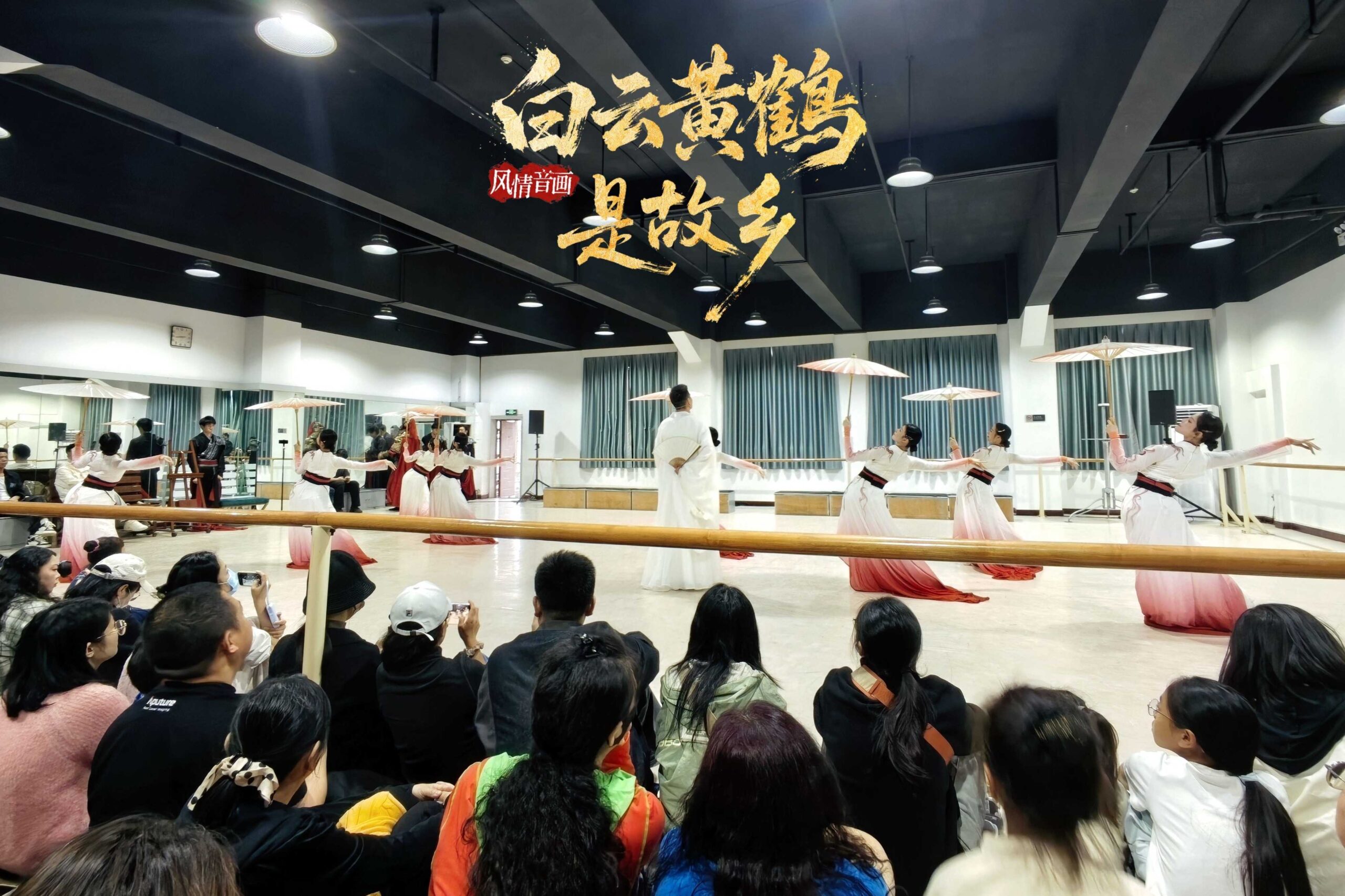
In 90 minutes, understand a city through the scenic and musical performance “White Clouds and Yellow Cranes Are Hometown,” premiering this Saturday.
On the afternoon of April 12, a behind-the-scenes event for the visual and musical show “White Clouds and Yellow Cranes: A Hometown” was held at the rehearsal hall of the Wuhan Song and Dance Theater, under the guidance of the Wuhan Municipal Bureau of Culture and Tourism. Through an online recruitment, 80 audience members went behind the scenes to get a preview of this “must-see performance in Wuhan.”
Audience members enjoy a rehearsal of the visual and musical show “White Clouds and Yellow Cranes: A Hometown.” Provided by Wuhan Song and Dance Theater.
“White Clouds and Yellow Cranes” Revealed for the First Time
“Wuhan’s art can be this trendy”
During the event, the creative team presented a rehearsal of the show, marking its first public unveiling since its creation. Acts such as the guqin piece “Flowing Water” riding the waves, the dialect rap “Garlic Bird” with its humorous and spicy style, the song “Yellow Crane Ballad” intertwining vocals and acrobatics, and the coloratura soprano piece “Tides” appeared in succession. Although it was a rehearsal, the actors’ full engagement and the smooth transitions between segments drew applause from the audience.
Later, the costume director brought the audience up close to admire the costumes for pieces like “Ode to the Orange,” “Garlic Bird,” and “Yangtze River and Han River,” explaining the urban imagery behind the color schemes of different chapters—the profound connection of high mountains and flowing water, the ethereal traces of white clouds and yellow cranes, the lively street scenes of Chu and Han culture, and the majestic convergence of the Yangtze and Han Rivers.
During the interactive session, the creative team engaged in face-to-face conversations with the audience. One audience member asked, “Why choose ‘Garlic Bird’ as the entry point for the dialect rap?” The creative team responded, “‘Garlic Bird’ is not just an internet buzzword; it reflects the Wuhan philosophy of ‘let it go, it’s not easy for anyone.’ Using the trendiest form to convey the simplest truths is exactly what makes this show relatable.”
“I used to think Chu opera and Han opera were distant from me, but I never expected them to be so trendy when combined with folk songs and rap,” said a post-90s audience member. A mother who brought her child added, “My child was captivated by the acrobatics, and I was moved to tears by ‘Hanyangmen Garden.’ This show is truly suitable for the whole family.”
Audience members enjoy a rehearsal of the visual and musical show “White Clouds and Yellow Cranes: A Hometown.” Provided by Wuhan Song and Dance Theater.
Creative Team’s Interpretation:
Let the Audience “Be Seen,” Let the City “Be Remembered”
The chief director, Xiong Tao, shared the creative vision on site. He stated that “a must-see performance in Wuhan” is not just a slogan but a promise from the creative team to the city. “Every year, Wuhan receives a large number of tourists, and they need a performance that allows them to understand the soul of Wuhan in a theater. We hope that for Wuhan locals, ‘White Clouds and Yellow Cranes: A Hometown’ will be a source of pride saying, ‘This is our Wuhan’; for out-of-town visitors, it will be a reason to say, ‘I’ll come again next time.’ It will be a flowing scroll of urban scenery.”
It was introduced that the visual and musical show “White Clouds and Yellow Cranes: A Hometown” brings together multiple institutions, including the Wuhan Song and Dance Theater, the Wuhan Acrobatic Troupe, the Wuhan Art School, the Wuhan Chu Opera Theater, the
White Clouds and Yellow Cranes
“White Clouds and Yellow Cranes” is a famous scenic spot in Wuhan, China, centered around the Yellow Crane Tower, a historic pavilion with over 1,700 years of history. The site derives its name from a legendary tale of a Taoist immortal who rode away on a yellow crane, leaving only white clouds behind, symbolizing transcendence and nostalgia. It has been a beloved cultural landmark, inspiring countless poems, including a renowned work by Tang Dynasty poet Cui Hao.
Yellow Crane Ballad
“Yellow Crane Ballad,” also known as “Yellow Crane Tower,” is a famous Tang dynasty poem by Cui Hao, celebrating the iconic Yellow Crane Tower in Wuhan, China. The poem reflects on the tower’s legendary history, where a Taoist immortal was said to have ridden a yellow crane into the sky, leaving the structure as a symbol of fleeting beauty and nostalgia. This work has deeply influenced Chinese literature and culture, inspiring later poets like Li Bai.
Yangtze River and Han River
The Yangtze River and Han River are two major waterways in China, with the Yangtze being the longest river in Asia and the Han its largest tributary. Historically, the confluence of these rivers at Wuhan has been a crucial hub for trade, transportation, and cultural exchange for over two millennia, playing a key role in the development of central China. Together, they have shaped the region’s agriculture, economy, and urban growth, with the Han River also serving as a vital link between northern and southern China.
Chu and Han culture
Chu and Han culture refers to the historical and cultural traditions originating from the ancient states of Chu (centered in present-day Hubei, Hunan, and surrounding regions) and Han (associated with the Han River valley and the Han dynasty). The Chu culture, known for its romanticism, shamanistic practices, and distinctive art style, thrived during the Warring States period before being absorbed into the unified Qin and subsequent Han empires. This fusion of Chu’s vibrant, mystical traditions with Han’s centralized, Confucian-influenced governance laid a foundational layer for Chinese civilization, influencing literature, music, and regional customs that persist today.
Chu opera
Chu opera is a traditional Chinese opera form originating from the Hubei and Hunan regions, with roots dating back to the Qing Dynasty. It evolved from local folk songs and dances, incorporating elements of Hubei’s Han opera and Anhui’s Hui opera. Known for its lively melodies and expressive performances, Chu opera remains an important part of central China’s cultural heritage.
Han opera
Han opera is a traditional Chinese opera form originating from the Hubei province, with a history spanning over 300 years. It combines local folk music, dance, and theatrical storytelling, and is known for its diverse vocal styles and elaborate costumes. During the Qing dynasty, Han opera heavily influenced the development of Peking opera, contributing essential elements such as melodies and performance techniques.
Hanyangmen Garden
Hanyangmen Garden is a historic public park located in Wuhan, China, built on the site of the ancient Hanyangmen city gate, which was part of the Ming Dynasty-era city wall. The garden preserves remnants of the old gate and wall, serving as a green space that commemorates the area’s rich urban history. Today, it offers locals and visitors a peaceful retreat while showcasing archaeological features from Wuhan’s past.
Wuhan Chu Opera Theater
The Wuhan Chu Opera Theater is a cultural venue in Wuhan, China, dedicated to the preservation and performance of Chu Opera, a traditional local opera style originating from the Hubei region. Established in the mid-20th century, it has played a key role in promoting this art form, which dates back to the Ming and Qing dynasties and blends folk music, dialect, and storytelling. The theater continues to host regular performances and cultural events, helping to keep the heritage of Chu Opera alive for modern audiences.