On April 15th, coinciding with the National Reading Month, the 14th Metro Reading Festival, themed “Open Your City’s Book,” kicked off at the Guanggu Square Metro Station, Asia’s largest transportation complex.

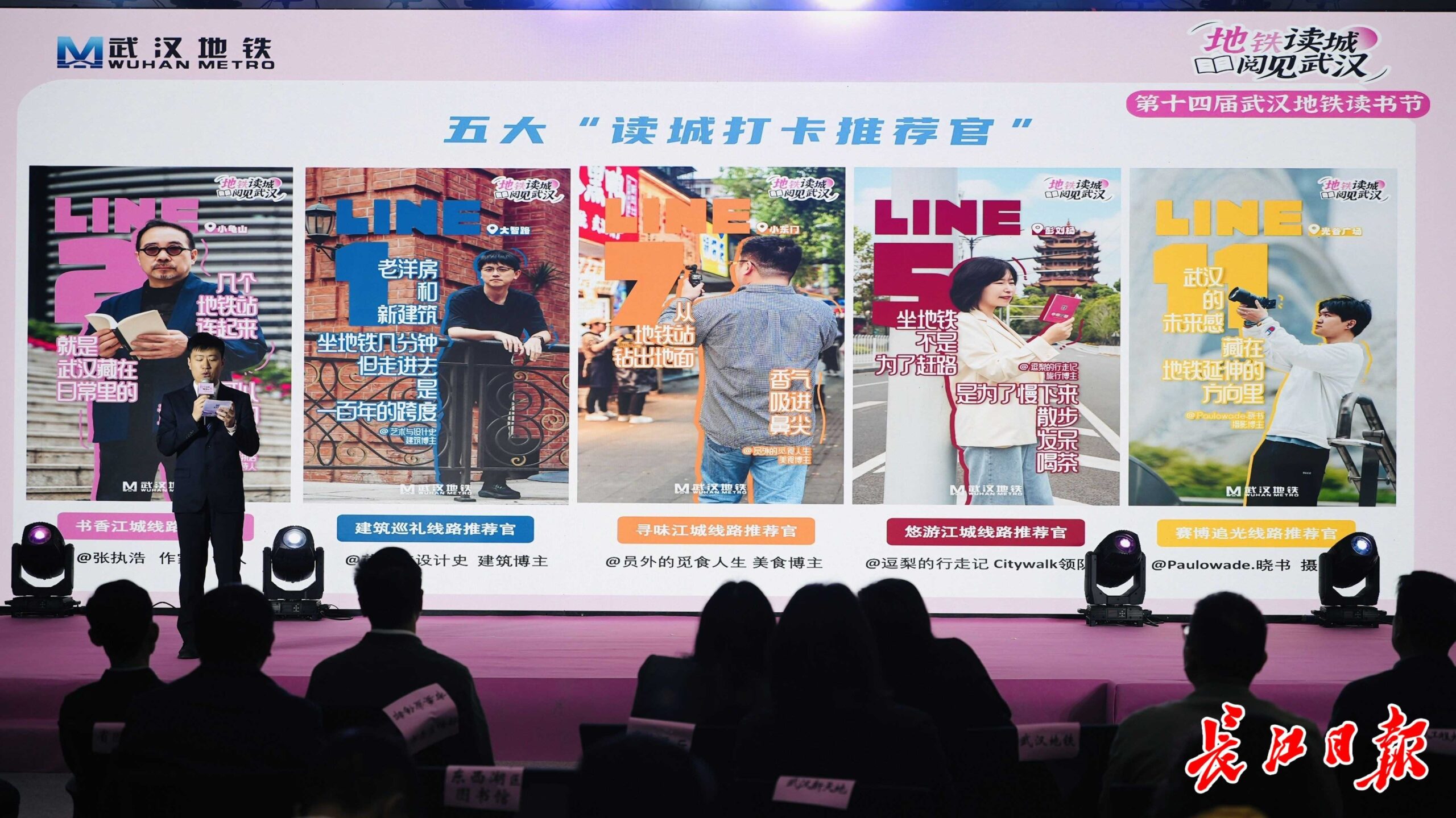
Five popular bloggers recommended “City Reading” check-in routes.
On-site, the Wuhan Metro officially launched the “Open Your City’s Book” themed stamp collection check-in activity, unveiling five “City Reading” routes. Over the next month and a half, a variety of “extended reading” activities will be rolled out along the metro lines.
This year’s reading festival collaborated with five well-known bloggers from various fields to meticulously create “City Reading” check-in routes covering five major areas: literature, architecture, food, culture and museums, and technology. Using the five themes “City of Books,” “Architectural Tour,” “Taste of the City,” “Leisurely City Stroll,” and “Cyber Light Chase” as the main threads, they cleverly connected city landmarks such as the Hubei Provincial Library, the Panlongcheng Ruins Museum, Tanhualin, and the Optics Valley Science and Technology Innovation Circle. This effort mapped out a unique “Urban Cultural Map on the Rails,” achieving widespread dissemination through blogger-fan interactions.
At the launch ceremony, a “City Reading Ambassador” recommended the “City of Books” route to citizens. This route includes cultural landmarks like the Hubei Provincial Library near Xiaoguishan Station on Line 2 and the Wuhan Central Book City at Fanhu Station on Line 3. It was stated: “The metro space is an intersection of fast and slow, of starting points and destinations. Holding cultural activities here is of extraordinary significance.”
To allow citizens to deeply experience the joy of “City Reading,” the event specially upgraded the check-in experience. A local university and the art group “Sketch Wuhan” jointly designed 40 city architecture-themed stamps and an original hand-drawn stamp collection handbook. These were distributed free in limited quantities during the event period, encouraging citizens to interpret the city’s cultural code through fun exploration.
It was explained that this marks the fifth collaboration between the institution and Wuhan Metro. This year, the stamp designs underwent a comprehensive upgrade, aiming to deliver a surprising experience for citizens. It was noted that the metro is not just a transportation tool but also a carrier for cultural dissemination. Through the reading festival activities, the metro can carry more cultural significance, linking city attractions and allowing visitors to learn about Wuhan while riding the subway.
It was learned on-site that this year, Wuhan Metro also partnered with the Hubei Provincial Library to establish “Metro Cloud Libraries.” This initiative brings over 1.2 million types of digital resources from the provincial library—including e-books, periodicals, audiobooks, and videos—into the metro space. Citizens simply need to scan a QR code to read anytime during their commute, creating a personal “Pocket Library.” Currently, the first batch of “Metro Cloud Libraries” has been set up at six stations: Huiji 2nd Road on Line 3, Zhongjiacun on Line 6, Xujiapeng on Line 7, Huangpu Road on Line 8, Hongshan Road on Line 8, and Ziyang Lake on Line 11.

“City Reading” routes and stamp collection check-in rules.
Guanggu Square Metro Station
Guanggu Square Metro Station
Hubei Provincial Library
Panlongcheng Ruins Museum
Tanhualin
Optics Valley Science and Technology Innovation Circle
Wuhan Central Book City
Xiaoguishan Station
Fanhu Station
Related news
First 50-kilometer cross-city drone logistics route successfully tested.
Three Gorges Reservoir Water Level Rises, Cargo Handling Efficiency at Docks Significantly Improves
Wuhan Tianhe Airport achieves nearly 90% on-time departure rate in first half of year, ranking first among major airports in central-southern region
Please download the news app for more information.