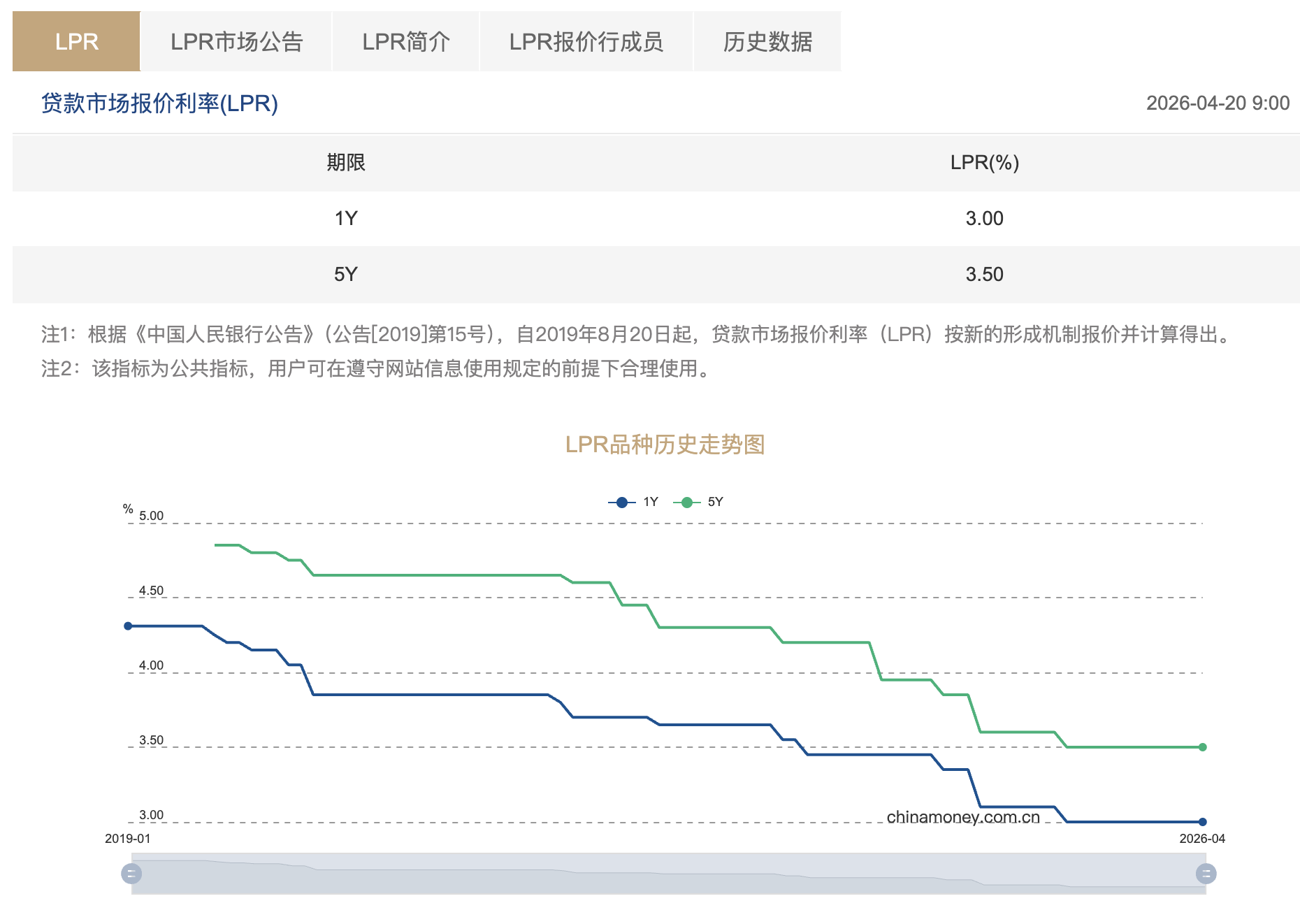
The latest Loan Prime Rate (LPR) was released on April 20.
The one-year LPR stood at 3.00%, and the five-year and above LPR at 3.50%, both unchanged from the previous month. This marks the 11th consecutive month that LPR has remained steady, following a 10-basis-point cut in both tenors in May 2025.
The Loan Prime Rate is quoted by designated reporting banks based on the open market operation rate (the seven-day reverse repurchase rate) plus a spread. It is calculated by the National Interbank Funding Center and serves as a pricing reference for bank loans. The spread mainly depends on each bank’s funding costs, market supply and demand, and risk premiums.
Source: China Foreign Exchange Trade System official website
Since the beginning of the year, LPR has remained unchanged. The fundamental reason is that exports significantly exceeded expectations in early 2025, domestic investment growth stopped declining and rebounded in the first quarter, consumption also improved, and rapid development in new quality productive forces including high-tech manufacturing drove a strong start to the macroeconomy in 2026. The first-quarter GDP growth reached 5.0%, hitting the upper limit of this year’s target range of 4.5% to 5%. Currently, the need for economic stimulus is not high, and monetary policy is in an observation phase, with policy rates and LPR staying stable.
Since March, geopolitical conflicts in the Middle East have notably pushed up domestic prices, and the impact on economic growth momentum requires further observation. Considering various factors, the macroeconomy in the second quarter is expected to remain stable. Given that the sharp rise in international oil prices is being transmitted domestically and exports are likely to maintain positive growth in the second quarter, macroeconomic policy will continue in an observation phase in the short term, making interest rate cuts or reserve requirement ratio cuts unlikely.
According to the latest data from the National Bureau of Statistics, in March, both the CPI and core CPI excluding food and energy maintained a year-on-year growth rate above 1%, with a slight decline mainly due to seasonal adjustments in food prices and service consumption after the Spring Festival holiday. The PPI rose 0.5% year-on-year, turning positive from negative, and increased 1% month-on-month, maintaining positive growth for six consecutive months. The PMI price index also showed an upward trend. In March, the purchasing price index for major raw materials rose to 63.9%, and the factory gate price index rose to 55.4%, increasing by 9.1 and 4.8 percentage points month-on-month, respectively.
Industry experts noted that China’s macroeconomy has started well, with effective demand gradually recovering, market competition order continuously improving, and the supply-demand relationship in the real economy steadily improving. Prices are expected to continue a reasonable recovery trend. The rise in the PMI price index reflects both the impact of higher international commodity prices and the recovery of domestic demand, which has strengthened companies’ willingness to restock and improved supply chain pricing power. If corporate profit margins can further expand, this will provide solid support for subsequent production expansion and increased investment.
However, experts also cautioned that the imported impact of Middle East geopolitical conflicts on domestic prices requires close attention. While external supply shocks may help boost the current low price levels, there is also a need to be vigilant about the negative effects of such imported inflation on raw material costs, corporate profit margins, and market expectations.
In the short term, as external uncertainties increase, domestic monetary policy will maintain ample market liquidity while also tilting toward stabilizing prices. The timing of interest rate cuts or reserve requirement ratio reductions may be delayed. Later, if external shocks intensify the disturbance to domestic economic growth, especially if there are clear signs of a slowdown in external demand, monetary policy will correspondingly increase its moderate easing efforts.