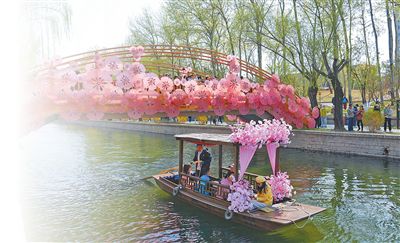
A rowing boat in the Yuan Dynasty City Wall Ruins Park.
In April, Beijing is bathed in a gentle spring breeze and filled with blooming flowers, exuding vibrant vitality everywhere. The “Crabapple Blossom Stream” area of the Yuan Dynasty City Wall Ruins Park has entered its prime viewing period. Pink Malus spectabilis, vermilion Chaenomeles speciosa, white ‘Snow Drop’, rose-red ‘Joyful’… Over 10,000 crabapple trees of 56 varieties stretch for 4.8 kilometers along both banks of the Xiaoyue River. The colorful sea of flowers, set against the ancient city walls and the murmuring stream, creates a scene like a flowing springtime painting. When a breeze passes, petals slowly fall and drift quietly with the river water, offering a unique charm.
Beyond admiring the scenery from the shore, visitors can also take a traditional-style rowing boat to experience the poetic scene of “people boating in a painting, the city resting among flowers.” As the wooden oar parts the water and the boat glides slowly through the reflections of the flower sea, one is instantly transported to the gentle water towns of southern China.
“The Yuan Dynasty City Wall Ruins Park is the urban park with the largest number of planted crabapple trees in North China. Different varieties bloom in succession, with the flowering period lasting until mid to late April. We have also set up special landscapes like the Crabapple Blossom Bridge and the Time Tunnel, creating a high-quality flower-viewing and leisure destination that combines ecological beauty with ornamental value for residents and visitors.”
Beijing’s Zhongshan Park is famous for its tulips. In 1977, tulip bulbs gifted by the Queen of the Netherlands took root in Zhongshan Park. Since then, the park has formed an inseparable bond with tulips. After over 40 years, the Zhongshan Park Tulip Cultural Festival has become an indispensable floral celebration in Beijing’s spring.
The outdoor planted tulips entered their best viewing period in early April. Over a hundred varieties, totaling 180,000 tulips, are displayed in succession along the tree-lined paths, like a spilled palette of spring colors. Combined with bulb flowers like hyacinths and daffodils, they outline a richly layered and brilliantly colored spring flower sea, resembling a vibrant oil painting from a distance. In the variety display area located in the Peach Blossom Garden, more than 20 novel varieties made their debut, including multi-flowered and double-petaled special types like ‘Flame Club’, ‘Vediora Sunrise’, and ‘Ruby’, fully showcasing the diverse charm of tulips.
Jingshan Park is a popular destination in the capital for viewing peonies. The Jingshan Park Peony Cultural Festival opened, featuring a concentrated display of over 700 forced-cultivation peonies. These peonies have full blooms and brilliant colors, including nearly 20 varieties such as the traditional famous types ‘Black Dragon Holding Splendor’ and ‘Purple Two Qiao’, as well as the visitor-favorite ‘Green Curtain Hiding Jade’.
As the capital’s most renowned peony viewing site, Jingshan Park has a history of cultivating peonies spanning centuries. The park brings together over 500 varieties and more than 20,000 peony plants from both China and abroad, encompassing all nine color series and ten flower forms. From the Central Plains peonies carrying historical charm to exotic fine varieties from overseas, visitors can deeply appreciate the diverse fusion of peony culture here. Around the time of the Grain Rain solar term, tens of thousands of peonies bloom in competition, complementing the ancient architecture and red walls.
Visit the Summer Palace to admire peach blossoms and enjoy coffee, experiencing the romance of an imperial garden; go to Jiangfu Park to see the violet cuckooflowers and check out the artistic district; visit Yuyuantan Park to capture the beautiful frame of splendid cherry blossoms with the TV tower; take the “Train to Spring” suburban railway S2 line, traversing the sea of apricot blossoms at the Juyong Pass… In the blooming month of April, one can encounter seas of flowers with distinct charms and feel the unique allure of Beijing without traveling far.
Yuan Dynasty City Wall Ruins Park
Yuan Dynasty City Wall Ruins Park
Xiaoyue River
Crabapple Blossom Bridge
Time Tunnel
Zhongshan Park
Peach Blossom Garden
Jingshan Park
Summer Palace
Related news
A flood prevention drill was held at a key construction site in Beijing.
AI Works: Tech Outsourcing or Original Creation? Guangdong Defines Copyright Boundaries
Beijing Municipal Government Holds Executive Meeting to Review Sci-Tech Finance Work and Other Matters
“Telling the World About Chongqing” – International Student Cultural Tourism Promotion Ambassador Selection Event