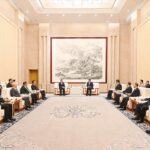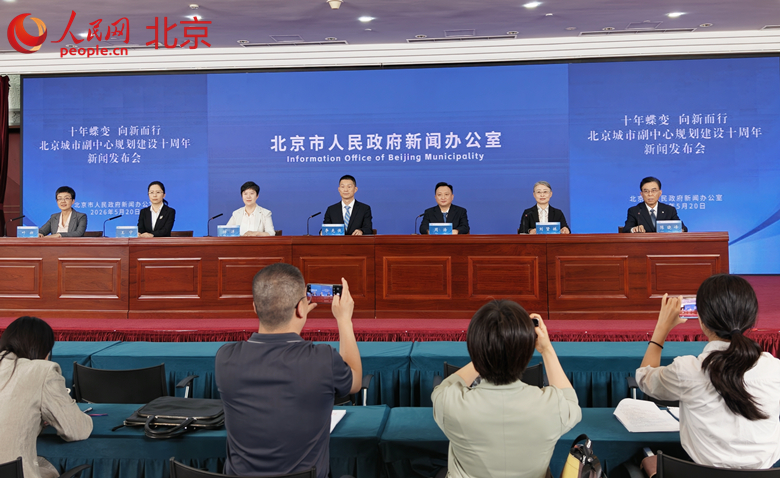
A press conference marking the tenth anniversary of the planning and construction of Beijing’s municipal administrative center.
It was announced at a press conference on May 20 that the municipal administrative center has made significant progress in relieving non-capital functions and absorbing relocated entities. The relocation of municipal government offices is largely complete, with over 33,000 staff now working there, and state-owned enterprises are accelerating their move in.
The deputy director of the Beijing Municipal Development and Reform Commission stated that Beijing is planning, constructing, and managing the municipal administrative center with high standards, based on the broader coordinated development of the Beijing-Tianjin-Hebei region. The goal is to achieve annual progress, and a modern, vibrant, and livable new city is rapidly emerging. This city is continuously strengthening its development towards innovation and high quality, serving as a key support for the modern capital metropolitan area.
Beijing has promoted the issuance of national-level opinions supporting the high-quality development of the municipal administrative center. Implementation is driven by a plan and three lists covering tasks, projects, and policies, resulting in a series of visible and tangible outcomes. To enhance green development, the central government approved the implementation plan for building a national green development demonstration zone in the municipal administrative center. The national voluntary greenhouse gas emission reduction trading market has officially launched, and the national green technology trading center, along with the country’s only green price certification research center, have been established.
Reforms in key factors are injecting new momentum. The municipal administrative center has been included in a pilot program for comprehensive reforms in market-based allocation of production factors, with 60 specific tasks arranged to achieve major breakthroughs in key areas and form a set of institutional and systematic arrangements. Its role as a strategic hub is becoming more prominent. The spatial coordination plan for the modern capital metropolitan area has been approved, positioning the municipal administrative center as a new growth pole for capital development and a model for coordinated development in the new era.
Beijing has strengthened the leadership of major projects to enhance the comprehensive carrying capacity and attractiveness of the municipal administrative center. Investment has been maintained at over 100 billion yuan for six consecutive years, leading to the successive completion of several landmark projects. The city’s framework is fully expanding, with the opening of Beijing Tongzhou Station and the underground section of the Eastern Sixth Ring Road. A backbone road network system of “eleven horizontal and nine vertical” routes has been basically formed. The “three major cultural facilities” have become popular check-in spots, and Universal Resort has been a top attraction since its opening. The urban spatial layout is rapidly being implemented and taking shape.
Beijing is promoting the differentiated and coordinated development of the municipal administrative center with Xiong’an New Area, complementing the functions of the central urban area, and driving integrated development with surrounding areas like Langfang’s Northern Three Counties. The municipal administrative center has achieved significant results in relieving non-capital functions and absorbing relocated entities. The relocation of municipal government offices is largely complete, with over 33,000 staff now working there, and state-owned enterprises are accelerating their move in. Companies like Beijing Investment Group, BTG Group, and the Municipal Affordable Housing Center have moved into their offices, while Huaxia Bank and Beijing Institute of Architectural Design are also progressing quickly. The area has become a key destination for absorbing functions and population from the central urban area.
Breakthroughs have been made in regional integration development. The executive committee of the Tongzhou District and Northern Three Counties integrated high-quality development demonstration zone is operating as a substantive entity. Roads like Changtong Road and Shixiao Road have been completed and opened to traffic, increasing cross-border roads to 12. The Pinggu Line, a rail transit line connecting Beijing and Hebei, has seen 20 stations complete their main structure topping out. The section from Hongmiao to Pinggu is expected to be basically ready for operation by the end of this year. After opening, residents of the Northern Three Counties can reach the municipal administrative center in as little as nine minutes.
High-quality educational and medical resources are rapidly extending to the Northern Three Counties. Beijing Luhe Middle School Sanhe Branch and Beijing Jingshan School Xianghe Branch have been established and are enrolling students. Tongzhou Maternal and Child Health Hospital has taken over the management of Dachang Maternal and Child Health Hospital, which is now open for consultations. Innovation and industrial development in key border areas like Tongzhou, Wuqing, and Langfang are being promoted, with a focus on key industries such as new energy intelligent connected vehicles, new-generation information technology, and robotics. Efforts are being made to strengthen industrial chain collaboration and market-based park cooperation, jointly enhancing the development level of regional industries.
<div class="my-4 p-