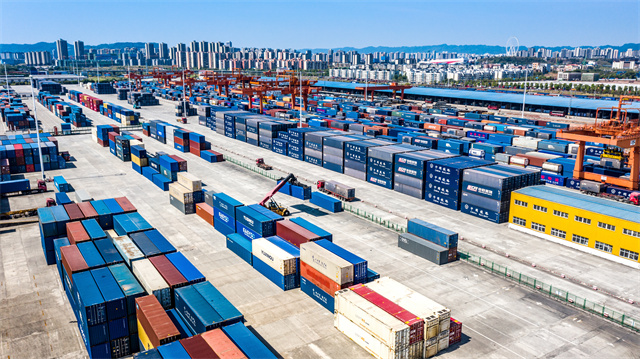
At the Tuanjie Village railway container center station in Chongqing’s Shapingba district, gantry cranes swing their long arms, containers flow in an orderly manner, and the sound of train whistles occasionally cuts through the sky.
Liu Daipeng, a field operations supervisor at the China Railway United Container Chongqing branch, stands before a large screen in the dispatch room, quickly switching his gaze between train information and live site footage. After a computer terminal displays an electronic waybill and container loading plan for a train, he rapidly issues work orders. Dozens of trucks at the yard, several kilometers away, begin orderly loading and unloading.
Behind this busy yet orderly yard operation lies a transformation in logistics transportation methods, a change that largely began with a small document.
On December 22, 2017, the world’s first international trade goods settled using a “railway bill of lading international letter of credit” arrived at the Chongqing Free Trade Pilot Zone’s Xiyong area via the China-Europe Railway Express.
Over the nearly ten years since, using a single bill of lading as a lever, Chongqing has turned the railway waybill from a simple “shipping receipt” into a financial tool with property rights functions, progressing from domestic pilot to United Nations convention, and driving the evolution of international trade rules.
On December 22, 2017, at the Chongqing railway port, a China-Europe Railway Express train slowly pulled in from Germany. The parallel-imported cars it carried were not an ordinary cargo shipment—the world’s first international trade goods settled using a “railway bill of lading international letter of credit” had officially arrived in Chongqing.
Before this, global trade rules had long been “dominated by the sea.” The bill of lading, as the “document of title” in international trade, symbolized ownership of goods and was a key basis for letter of credit settlement and financing collateral. However, this core document was only applicable to maritime transport. International railways could only issue waybills, which lacked the function of a document of title, preventing financial institutions from using them for settlement or financing.
This meant that when inland cities like Chongqing engaged in cross-border trade via railway, the international convention of “no document of title for land trade” became the biggest obstacle.
Change began in 2016. Chongqing worked to connect with Chinese banks that had overseas branches, promoting their recognition of the settlement validity of railway bills of lading, while also coordinating with transport companies like Sinotrans to establish cargo security mechanisms. After careful selection, cars—which are durable, retain value, and have mature sales channels—became the test vehicle.
In December 2017, the Chongqing branch of ICBC opened the world’s first “railway bill of lading international letter of credit” on the China-Europe Railway Express, granting it cargo control functions and property rights attributes, and applying it on a large scale.
This innovation quickly benefited companies. Fu Shigang, general manager of Chongqing Schmidt Trading Co., Ltd., noted: “Thanks to the railway bill of lading, we only needed to pay over 1.2 million yuan in cash after financing, instead of the original over 7.8 million yuan for the goods.” Previously, banks only recognized maritime bills of lading, so when companies imported goods by rail, they had to wire the full amount in advance, putting significant financial pressure on them. “Now, the railway bill of lading financing model is very convenient. Not only is the financial pressure greatly reduced, but we also enjoy the benefit of rail transport saving over 20 days compared to sea transport.”
After the first successful case, Chongqing quickly promoted large-scale application. On March 23, 2018, 12 parallel-imported cars using railway bill of lading letters of credit as the international settlement method arrived at the