Xi Jinping attends welcome ceremony hosted by Kim Jong Un.
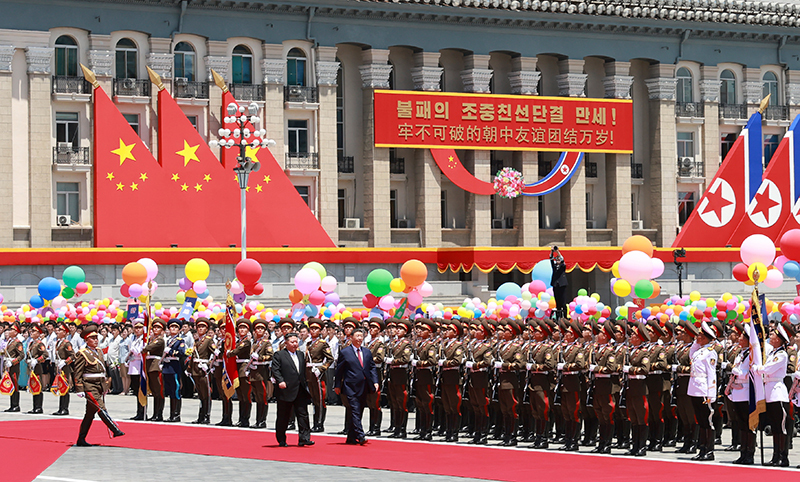
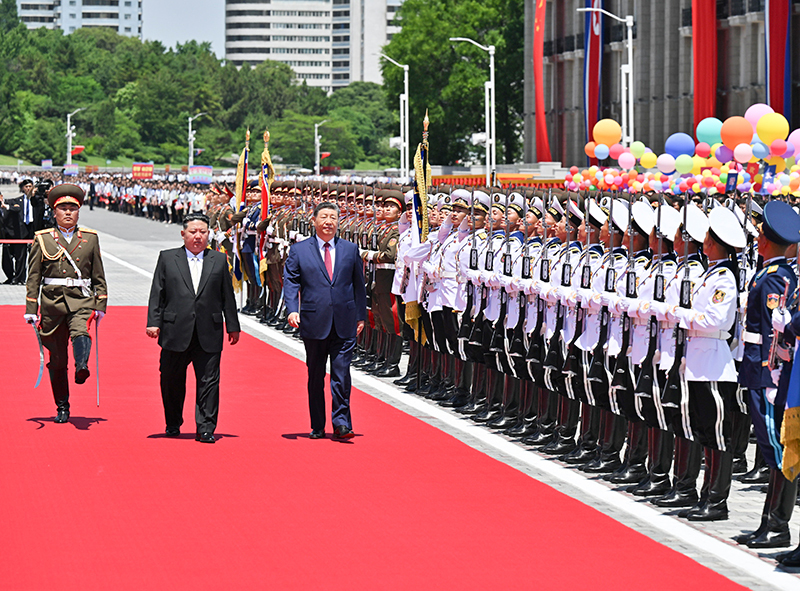
At noon on June 8 local time, Kim Jong-un, General Secretary of the Workers’ Party of Korea and Chairman of the State Affairs Commission, held a grand welcome ceremony for Xi Jinping, General Secretary of the Central Committee of the Communist Party of China and President of the People’s Republic of China, at Kim Il-sung Square in Pyongyang. Xi Jinping, accompanied by Kim Jong-un, reviewed the honor guard of the Korean People’s Army.
At noon on June 8 local time, Kim Jong-un, General Secretary of the Workers’ Party of Korea and Chairman of the State Affairs Commission, held a grand welcome ceremony for Xi Jinping, General Secretary of the Central Committee of the Communist Party of China and President of the People’s Republic of China, at Kim Il-sung Square in Pyongyang.
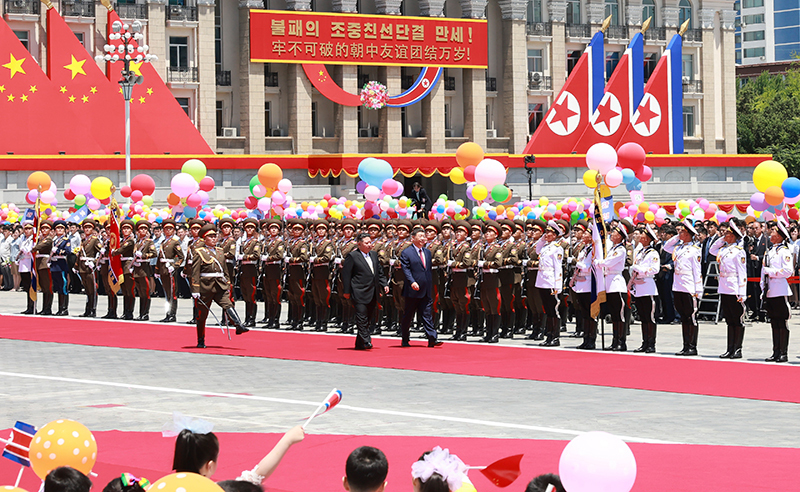
In the center of Kim Il-sung Square hung large portraits of the top leaders of both parties and countries. On both sides, banners reading “Long live the unbreakable DPRK-China friendship” and “Eternal DPRK-China friendship” in both Korean and Chinese were prominently displayed. The national flags of both countries fluttered in the wind, and the welcoming crowd was cheerful and eagerly awaited.
At noon on June 8 local time, Kim Jong-un, General Secretary of the Workers’ Party of Korea and Chairman of the State Affairs Commission, held a grand welcome ceremony for Xi Jinping, General Secretary of the Central Committee of the Communist Party of China and President of the People’s Republic of China, at Kim Il-sung Square in Pyongyang. Xi Jinping, accompanied by Kim Jong-un, reviewed the honor guard of the Korean People’s Army.
At noon on June 8 local time, Kim Jong-un, General Secretary of the Workers’ Party of Korea and Chairman of the State Affairs Commission, held a grand welcome ceremony for Xi Jinping, General Secretary of the Central Committee of the Communist Party of China and President of the People’s Republic of China, at Kim Il-sung Square in Pyongyang. Xi Jinping, accompanied by Kim Jong-un, reviewed the honor guard of the Korean People’s Army.
When Xi Jinping and his wife Peng Liyuan arrived in their vehicle, cavalry escorts lined up to greet them, and the military band played a welcome tune. Kim Jong-un and his wife Ri Sol-ju welcomed them in the square. Xi Jinping and Peng Liyuan, along with Kim Jong-un and Ri Sol-ju, shook hands with each other’s accompanying personnel. The top leaders of both parties and countries ascended the reviewing stand together. The military band played the national anthems of China and North Korea, and a 21-gun salute was fired. Xi Jinping, accompanied by Kim Jong-un, reviewed the honor guard of the Korean People’s Army. The guards shouted in Korean, “Wish Comrade Xi Jinping good health!” Afterwards, Xi Jinping and Kim Jong-un watched the march-past together.
At noon on June 8 local time, Kim Jong-un, General Secretary of the Workers’ Party of Korea and Chairman of the State Affairs Commission, held a grand welcome ceremony for Xi Jinping, General Secretary of the Central Committee of the Communist Party of China and President of the People’s Republic of China, at Kim Il-sung Square in Pyongyang. Xi Jinping and Kim Jong-un watch the march-past together.
People from all walks of life in Pyongyang, along with children, dressed in festive attire, held flags
Kim Il-sung Square
Kim Il-sung Square is a large public square in central Pyongyang, North Korea, named after the country’s founding leader. Completed in 1954, it has been the site of major military parades, mass rallies, and political celebrations, reflecting the nation’s socialist ideology. The square is architecturally significant for its symmetry and alignment with the Juche Tower, symbolizing the regime’s power and historical narrative.
Pyongyang
Pyongyang is the capital and largest city of North Korea, with a history dating back over 2,000 years as an ancient capital of the Goguryeo kingdom. Heavily rebuilt after the Korean War (1950–1953), the city is now defined by monumental socialist architecture, including the Juche Tower and Kim Il-sung Square, as well as grand statues and museums dedicated to the country’s ruling Kim dynasty. Today, it serves as the political, economic, and cultural center of the isolated nation.
Workers’ Party of Korea
The Workers’ Party of Korea (WPK) is the founding and ruling political party of North Korea, established in 1949 through the merger of the North Korean Workers’ Party and the South Korean Workers’ Party. Under the leadership of the Kim dynasty, it has governed the country with a state ideology of Juche (self-reliance) and Songun (military-first), maintaining a one-party system and tight control over all aspects of society. The WPK remains the central authority in North Korean politics, organizing mass rallies and guiding the nation’s economic and military policies.
State Affairs Commission
The State Affairs Commission is a key governmental body in North Korea, responsible for overseeing the country’s highest state affairs and national defense. It was established in 2016 under the leadership of Kim Jong-un, replacing the former National Defense Commission as the supreme administrative authority. The commission plays a central role in shaping and executing major policies, particularly those related to security and the military.
Communist Party of China
The Communist Party of China (CPC) is the founding and ruling political party of the People’s Republic of China, established in 1921 in Shanghai. It led the Chinese Revolution, culminating in the establishment of the PRC in 1949, and has since overseen the country’s transformation into a major global power under its one-party system. The CPC continues to guide China’s development through its policies of socialism with Chinese characteristics.
People’s Republic of China
The People’s Republic of China, established on October 1, 1949, is a vast East Asian nation with a rich, millennia-long civilization preceding its modern founding. It emerged after the Chinese Communist Party led by Mao Zedong won a civil war against the Nationalist government, ushering in a new era of socialist governance. Today, it is a global superpower known for its rapid economic growth, ancient landmarks like the Great Wall, and cultural traditions that blend communist ideology with deep historical roots.
Korean People’s Army
The Korean People’s Army (KPA) is the military force of North Korea, officially founded on February 8, 1948, though its roots trace back to anti-Japanese guerrilla units led by Kim Il-sung in the 1930s. It operates under the absolute control of the Workers’ Party of Korea and plays a central role in the country’s ideology of “Songun” (military-first policy). The KPA is known for its large size, emphasis on loyalty, and development of nuclear and missile programs, which have made it a key factor in regional and global security dynamics.
People’s Republic of China
The People’s Republic of China, established on October 1, 1949, is a vast East Asian nation with one of the world’s oldest continuous civilizations, dating back thousands of years. It emerged from a long history of imperial dynasties, republican struggles, and civil war, with the Communist Party under Mao Zedong taking power. Today, it is a major global economic and political power, known for its rapid development, rich cultural heritage, and significant landmarks like the Great Wall and the Forbidden City.