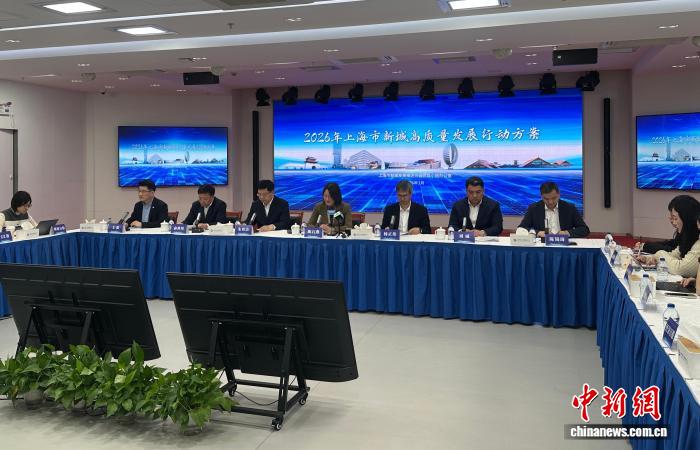
On March 26, a press briefing was held on the 2026 Shanghai New City High-Quality Development Action Plan. Relevant officials introduced the overall action plan for Shanghai’s new cities in 2026 and the respective development action plans for the five new cities.
It was reported that in 2025, the combined industrial output value of six key industrial sub-sectors in the new cities exceeded one trillion yuan, all achieving positive growth. Among them, sectors such as medical devices and high-end equipment in Jiading New City, Beidou and low-altitude economy in Qingpu New City, and the full industrial chain for large aircraft in Nanhui New City saw rapid double-digit growth in output value.
Simultaneously, this year the “Five New Cities” will continue to promote the concentration of resources and factors, maintaining a positive development momentum. In shaping the industrial ecosystem, Shanghai will accelerate the construction of innovation platforms such as the Shanghai Scientific Instruments Innovation Port, the Huawei Yangtze River Delta AI+ Joint Innovation Center, and the national-level civil aviation manufacturing pilot platform. Projects including the expansion of the United Imaging production and R&D base, the Chenzhu Instrument R&D and manufacturing base, and the expansion of the RAAS Fengxian production base will be completed and put into operation. To encourage innovation and entrepreneurship, efforts will be made to enhance the capabilities of university clusters in areas like Songjiang, Fengxian, and Lingang. Leveraging platforms such as universities, industrial parks, and incubators in the new cities, collaborative creation spaces will be established, and supporting services like youth hostels and talent apartments will be optimized.
During the “14th Five-Year Plan” period, 98 new primary and secondary schools and kindergartens were opened in the new cities. The city’s first “Future School,” Dishui Lake School, commenced operations. A number of municipal-level top-tier hospital projects, including Xinhua Hospital (Fengxian Branch) and Ruijin Hospital Jiading Branch (Phase II), were completed and put into use. Events such as the Around Shanghai · New City Cycling Race and Grassland Music Festival were held. This year, Shanghai’s “Five New Cities” will further solidify their service functions, optimizing resource allocation through both software and hardware improvements to continuously enhance service quality and efficiency.
It was introduced that this year the “Five New Cities” plan to open 9 new primary and secondary schools and kindergartens, and accelerate the construction of the East China Normal University Lingang Campus and Tongji University Lingang Campus. Efforts will be made to complete and put into operation projects like the Zhongshan Hospital National Medical Center (Qingpu New City Branch), the Songjiang Branch of Shanghai First People’s Hospital (Phase II), the Lingang Branch of Shanghai Sixth People’s Hospital (Phase II), and the Lingang Branch of Pudong Hospital. Comprehensive transportation plans for the districts where the new cities are located will be issued and implemented, aiming to achieve basic connectivity of the new city green ring corridors. Furthermore, Shanghai will support the new cities in piloting comprehensive reforms for basic education and continue to develop “Future Schools.” Pilots for infant and toddler care services for very young children will be explored in suitable new cities. Guidance will be provided to municipal hospital branches in the new cities to improve their “one hospital, one policy” approach, continuously enhancing operational efficiency. The layout of community night school points will be increased to enrich the doorstep service system.
At the same time, based on strengthening municipal-level coordination and city-district collaboration, the network of partners for the new cities will be continuously expanded. Active efforts will be made to expand linkages and cooperation with diverse entities such as universities, research institutes, cultural and museum venues, enabling various actors to better contribute to the development of the new cities. The role of the city-district two-level publicity linkage mechanism will continue to be leveraged to carry out a series of promotional activities, fostering a youth-friendly development environment in the new cities.