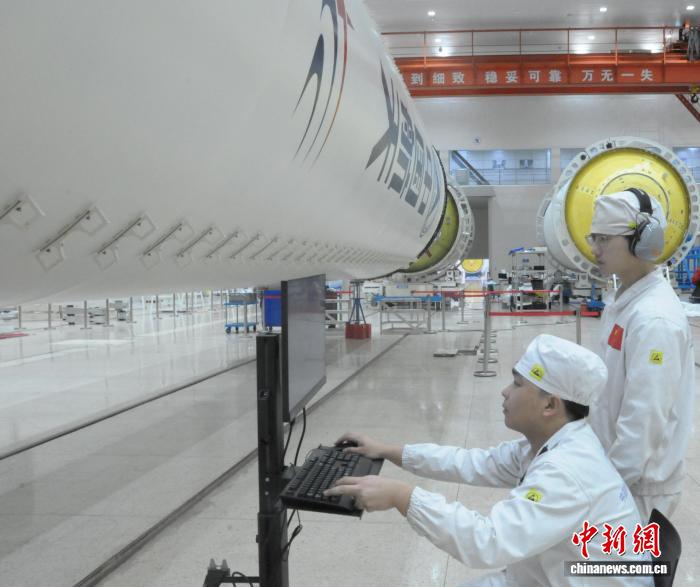
Artificial intelligence is becoming the “new propellant” in the aerospace field. At the Shanghai Aerospace Equipment Manufacturing Factory under the Eighth Academy of China Aerospace Science and Technology Corporation, the manufacturing of launch vehicles like the Long March 12 has boarded the “high-speed train” of intelligent production.
The person in charge of the smart factory project stated that unlike manufacturing in sectors such as automobiles, aerospace products involve discrete manufacturing, characterized by single-unit, small-batch production and a need for customization. Focusing on the demand for batch production of launch vehicles, the factory continues to advance the intelligent production model, reshaping research and production capabilities.
It was explained that the pipelines for each type of rocket need to be adjusted according to mission requirements. Calculating based on over 100 process documents, the traditional model takes about one week to complete, while using AI tools can compress the planning cycle to one day.
“We extract the relevant design parameters and requirements, ‘feed’ them to a dedicated model, and then, after manual optimization, form an intelligent process flow,” it was said.
The intelligent production model also provides greater assurance for rocket launch capacity.
The rocket propellant tank is the storage vessel for propellant and oxidizer in a launch vehicle. The new generation of launch vehicles is developing towards integration, larger size, and lighter weight, which includes upgrading the traditional multi-piece welded structure of the tank bottom to an integrated structure.
The factory collaborated with multiple organizations to form a research team, manufacturing a rocket integrated tank bottom with a diameter of 4 meters, which was applied to the first flight rocket of the Long March 12 launch vehicle. Intelligent processes were utilized in this effort.
It was explained that in the traditional mode, processes such as milling, measurement, and parameter adjustment need to be completed sequentially in separate steps. The new process involves measuring thickness while milling, optimizing processing parameters in real-time and feeding them back to the equipment for execution, while simultaneously completing full-process data collection.
It is reported that in 2025, six departments including the Ministry of Industry and Information Technology announced China’s first list of 15 pilot-level smart factories for cultivation. The factory’s “High-Reliability, Large-Scale Aerospace Product Full-Process Chain Dynamic Smart Factory” successfully made the list.