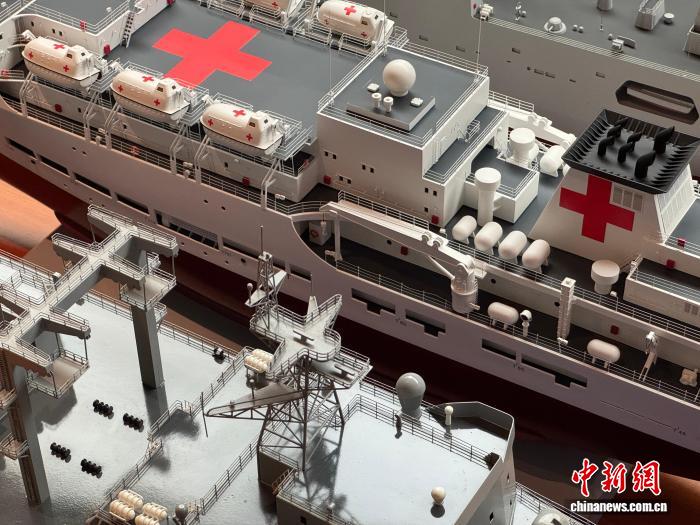
The “Basic Exhibition of Military Navigation” at the China Maritime Museum has reopened with an updated display.
On April 23, to celebrate the 77th anniversary of the founding of the Chinese People’s Liberation Army Navy, the China Maritime Museum’s “Basic Exhibition of Military Navigation” opened with a renewed display.
“We hope that through this exhibition, we can plant the seeds of patriotism and a strong military in the hearts of the younger generation.”
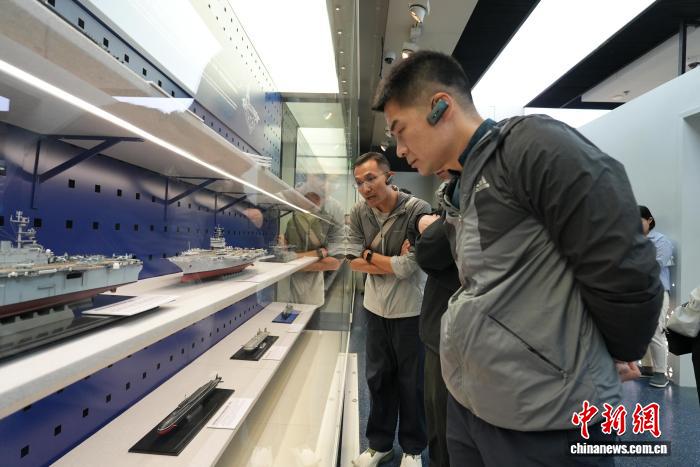
The exhibition is divided into five units: “Early Navy,” “Upgrading with Assistance,” “Independent Development,” “Great Power Navy,” and “Warships of the World.” It features exquisite models from the museum’s collection, using both time and ship types to tell the story of China’s naval self-strengthening journey and the parallel development of global military navigation.
A highlight of the exhibition is the selection of highly representative modern Chinese naval “national heavy equipment” ship models, prominently featuring the aircraft carrier “Fujian,” the aircraft carrier “Shandong,” the Type 076 amphibious assault ship, the Type 075 amphibious assault ship, the Type 094 nuclear submarine, and the Type 055 10,000-ton missile destroyer, offering visitors a visual feast of military navigation.
Visitors touring the China Maritime Museum.
Using modern technology, the exhibition has carefully created several interactive displays that combine knowledge and fun, including “Exploring the Mystery of Submarine Diving,” “Secrets of Supply Ships Revealed,” “Master of Sea Mine Clearance,” “King of Amphibious Loading,” “Aircraft Carrier Strike Group: Attack,” “Chinese Naval Ship Guide,” and “Chinese Naval Aviation Aircraft Guide.” These exhibits aim to educate through entertainment and immerse visitors in an interactive experience.
China Maritime Museum
The China Maritime Museum, located in Shanghai, is the largest maritime museum in China. Established in 2010, it showcases the country’s rich maritime history, including ancient shipbuilding, navigation technology, and the legacy of the Maritime Silk Road. The museum features extensive exhibits on naval exploration, trade, and modern maritime developments.
Basic Exhibition of Military Navigation
The Basic Exhibition of Military Navigation is a specialized museum display that explores the history and technology of naval warfare and maritime navigation. It typically features historical artifacts, model ships, navigational instruments, and interactive exhibits highlighting key developments from ancient seafaring to modern naval strategies. The exhibition aims to educate visitors on the critical role of navigation in military operations and national defense.
Fujian
Fujian is a coastal province in southeastern China known for its mountainous terrain, historic port cities, and unique cultural heritage. It was a major starting point for the Maritime Silk Road and has a rich history of overseas trade and emigration, particularly to Southeast Asia. The province is also famous for its Fujian tulou, large, circular earthen buildings that served as fortified communal homes for Hakka families, and for its distinct Minnan and Fuzhou dialects.
Shandong
Shandong is a coastal province in eastern China, renowned as the birthplace of Confucius in Qufu, making it a cradle of Confucian culture and philosophy. Historically, it was home to the ancient states of Qi and Lu during the Zhou dynasty
</
China Maritime Museum
The China Maritime Museum, located in Shanghai, is one of the largest and most comprehensive maritime museums in Asia. It was established to showcase China’s rich maritime history, from ancient shipbuilding and navigation to modern naval achievements. The museum features extensive exhibits, including historical vessels, maritime artifacts, and interactive displays that highlight China’s role in global maritime exploration and trade.
Basic Exhibition of Military Navigation
The **Basic Exhibition of Military Navigation** is a specialized museum display that explores the historical and technological evolution of naval warfare and maritime navigation. It typically features artifacts, models, and interactive exhibits covering ancient sailing techniques, the development of military vessels, and modern navigation systems used by navies worldwide. The exhibition highlights key milestones in military maritime history, such as the transition from sail to steam power and the role of navigation in major naval conflicts.
Fujian
Fujian is a coastal province in southeastern China known for its mountainous terrain, historic port cities, and unique cultural heritage. It was a major starting point for the Maritime Silk Road, with Quanzhou serving as a key international trade hub during the Song and Yuan dynasties. The region is also famous for its distinctive tulou (earthen roundhouses) built by the Hakka people, as well as its rich traditions in tea production, particularly oolong teas like Tieguanyin.
Shandong
Shandong is a coastal province in eastern China known for its rich cultural heritage, particularly as the birthplace of Confucius in Qufu. Historically, it was a key center of ancient Chinese civilization, with the states of Qi and Lu flourishing there during the Zhou dynasty. Today, it is famous for Mount Tai, a sacred Taoist mountain, and its vibrant port city of Qingdao.
Type 076 amphibious assault ship
The Type 076 amphibious assault ship is a new class of large amphibious warfare vessel under development for the People’s Liberation Army Navy of China. Designed to support power projection and amphibious operations, it is expected to feature enhanced capabilities, including the potential use of electromagnetic catapults for launching fixed-wing aircraft. As a successor to the Type 075 class, the Type 076 represents China’s continued efforts to modernize its naval forces and expand its blue-water capabilities.
Type 075 amphibious assault ship
The Type 075 amphibious assault ship is a class of landing helicopter dock (LHD) warship built for the People’s Liberation Army Navy (PLAN) of China. The first vessel, Hainan, was launched in September 2019 and commissioned in April 2021, marking a significant expansion of China’s amphibious warfare capabilities. These ships are designed to support helicopter operations, carry landing craft, and deploy marines, reflecting China’s growing focus on power projection and amphibious assault operations.
Type 094 nuclear submarine
The Type 094 nuclear submarine is a class of ballistic missile submarines developed by China for its naval forces, designed to carry JL-2 submarine-launched ballistic missiles as part of the country’s nuclear deterrent. Its development began in the late 1990s, with the first boat entering service around 2007, though specific details remain classified. This submarine represents a significant step in China’s strategic capabilities, enhancing its second-strike nuclear potential.
Type 055 10,000-ton missile destroyer
The Type 055 is a class of advanced 10,000-ton guided-missile destroyers developed for the Chinese People’s Liberation Army Navy. First launched in 2017, it is one of the largest and most powerful surface combatants in the world, equipped with cutting-edge radar and vertical launch systems capable of firing a wide range of missiles. Its development represents a significant milestone in China’s naval modernization, enhancing the fleet’s air defense, anti-ship, and anti-submarine warfare capabilities.