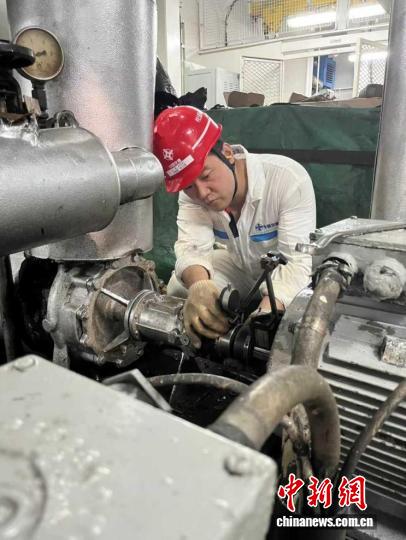
On May 14 in Shanghai, behind the golden waterway of the Yangtze River estuary, dredging vessels form an invisible “underwater Great Wall” to ensure safe navigation. A senior engineer and leader of a skills master studio has worked in the dredging industry for nearly 20 years. Starting as a mechanic, he grew into a national technical expert through dedicated practice in this niche field.
The engine room is the power core of a dredger, often hot, noisy, and harsh. He works there long-term, maintaining the ship’s power, dredging, and electrical systems. With keen observation and rich experience, he assesses equipment conditions by listening, checking parameters, and examining traces, accurately identifying risks. He acts as a “chief doctor” for the ship’s equipment, able to predict potential failures and quickly handle various malfunctions.
To address the reliance on imported core equipment for dredging vessels, he led a team to overcome this challenge. Previously, imported common rail valve groups for MAN electronically controlled injection engines were costly, slow to supply, and at risk of being cut off. His team conducted hundreds of disassembly tests and successfully localized the repair of these components, meeting performance standards and saving the company over 2 million yuan annually. Over a decade, he led more than ten technical innovations, including a modification to the lubrication system of high-pressure water pump bearing boxes, which won the 2024 Shanghai Employee Rationalization Suggestion Innovation Award, continuously optimizing ship operational efficiency.
Working at sea involves complex conditions and occasional emergencies. Over his career, he has handled over a hundred ship emergencies, calmly resolving issues with professional skill, preventing multiple major accidents and avoiding casualties or significant property losses, firmly safeguarding navigation safety.
At the same time, he focuses on talent development. Using the skills master studio platform, he turns practical experience into teaching materials. He mentors technical personnel, with three of his apprentices becoming national technical experts. The studio has trained 248 senior technicians, technicians, and senior workers. In the past three years, he has conducted various specialized training sessions covering hundreds of people, also addressing gaps in training for clean-energy ship personnel in the country.
As a representative of the Shanghai Municipal People’s Congress, he focuses on crew rights. In 2024, he submitted proposals on caring for crew members, promoting joint policies from multiple Shanghai departments on shipping talent settlement and talent introduction incentives. Dedicated to the rivers and seas, he remains true to his original intention, using expertise as an oar and responsibility as a rudder, steadfastly guarding the stable and long-term development of the dredging industry.
Yangtze River estuary
Great Wall
Yangtze River estuary
Yangtze River estuary
Great Wall
Shanghai
Related news

Veolia China Releases First ESG Report: Driving Ecological Transition and Carbon Goals Through Innovation
Shanghai Municipal People’s Government

Shanghai Private Sector Representatives Discuss Initial Aspirations and Responsibilities, Ideals and Beliefs Report Inspires Motivation for Progress

Adidas Global CEO Impressed by Chinese Youth’s Openness and Confidence During Interaction with University Students