Facing the challenges of diverse community types, complex personnel structures, and multiple resident demands at the grassroots level, the Party Working Committee of Baizhifang Street, Xicheng District, adheres to the leadership of Party building. Taking the opportunity of Banbuqiao Community being included in the renovation and improvement of Beijing’s governance-type communities, it focuses on the diverse needs of “one old, one young” and new employment groups. It has explored and formed the “Five Micro-Step Governance” community governance brand, integrating “micro-grids, micro-organizations, micro-services, micro-activities, and micro-consultations.” This approach precisely extends grassroots governance to residents, achieving a significant decrease in hotline complaints and a dual increase in problem resolution and satisfaction rates.
Strengthening the governance foundation makes community self-governance more confident. Based on eight grids, Banbuqiao Community further refined “micro-grids,” assigning one social worker grid leader and multiple resident party member grid members to each grid. It implemented a work mechanism of “daily checks, snapshots, timely reports, and quick handling.” The community innovatively established a “personnel and property weekly record” method, creating dynamically updated resident information ledgers for each of the 23 buildings. Details such as who is renovating, which household is moving, and which elderly person needs special attention are promptly “profiled” after grid inspections, ensuring a clear understanding of the baseline, situation, and dynamics. To date, the community has proactively identified and resolved over 150 resident concerns. Building on this, the community unearthed skilled individuals and talents, incubating 15 functional “micro-organizations,” including an emergency repair team of veteran party members and a love assistance team. Led by party member backbones, these cover all aspects of community services, shifting governance from community-led to resident self-governance.
Optimizing the governance mechanism enhances the quality of livelihood matters. The community innovatively implemented a “four-order” micro-service model: “residents place orders, the community assigns orders, party members fulfill orders, and the public evaluates orders.” This approach uses project acceptance to mobilize various forces to integrate into community governance. During the year, partner units actively accepted 24 governance projects and conducted over 260 activities, turning “joint public affairs” from a concept into a norm. The heating renovation in Yurenli Residential Area is a typical case. Facing the long-standing “difficult and persistent” problem of complex property rights and low heating temperatures, the Street Party Working Committee listed it as a key annual task. Through repeated coordination via the “whistle and report” mechanism, it ultimately mobilized the property owner to invest funds for boiler upgrades, achieving zero heating complaints.
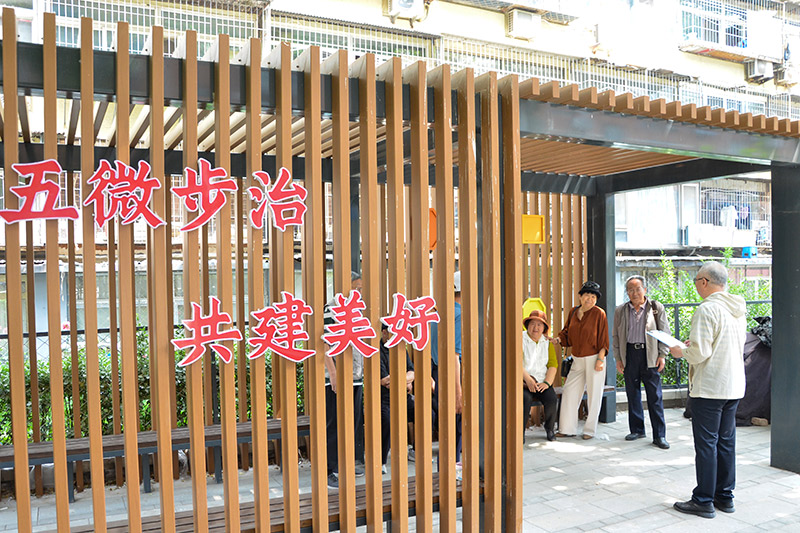
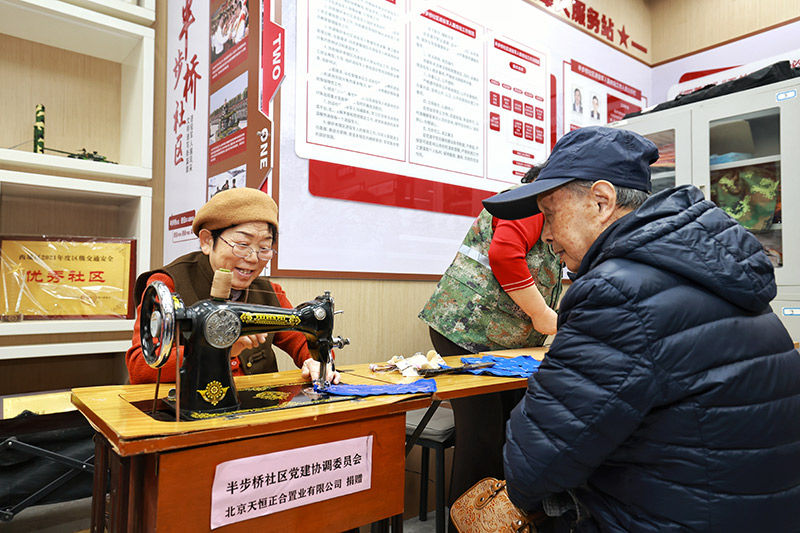
Activating the governance nerve endings makes participation more vibrant. Actively practicing the governance philosophy of “Fangjian Office · People Satisfaction,” the community relies on the “micro-consultation” mechanism. Grid leaders bring together party member backbones, resident representatives, property management, and functional departments to sit and discuss together, allowing residents to decide their own affairs. This efficiently resolved over 20 resident demands during the year. Addressing the aging infrastructure of Compound 13, the community gathered public opinion to build a “Neighborhood Discussion Pavilion,” added non-motor vehicle sheds and charging ports, enabling residents to handle matters collaboratively at their doorstep. Meanwhile, it regularly conducts all-age-friendly “micro-activities” such as the “Monthly Lei Feng Day” convenience services and after-school care, promoting a “two-way effort” between services and self-governance.
Innovating governance models makes collaborative education more grounded. Leveraging the superior resources of the Xicheng District Committee Social Work Department, the street established close cooperation with the Department of Political Science, School of Social Sciences, Tsinghua University, setting up an on-site teaching point for the course “Contemporary Chinese Grassroots Governance.” Using the refined governance experience of Banbuqiao Community as a practical sample, it conducts on-site teaching for university students around topics such as Party-building-led grassroots governance, community resident self-governance, and deliberative consultation. This promotes academic achievements to be close to people’s livelihoods, facilitates the transformation of scientific research results into practice, and helps the street borrow wisdom and improve the modernization level of grassroots governance capabilities.
A relevant official from the Xicheng District Committee Social Work Department stated that the “Five Micro-Step Governance” work method of Banbuqiao Community in Baizhifang Street has not only significantly reduced hotline complaints and steadily improved