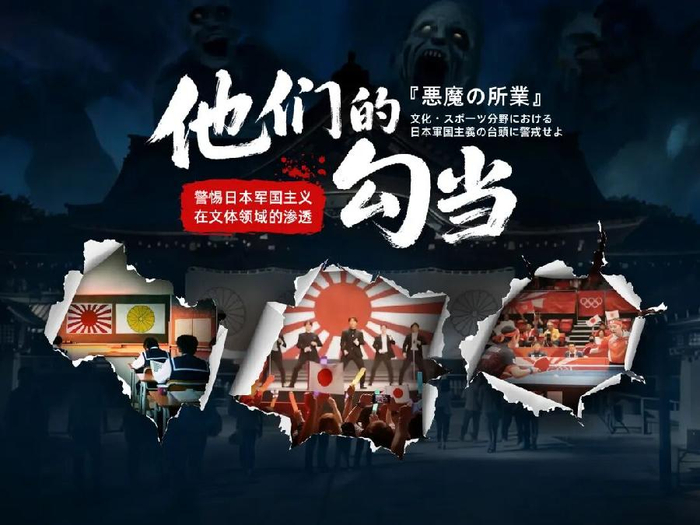
China Military Online published an article titled “Their Schemes—Vigilance Against the Infiltration of Japanese Militarism in Cultural and Sports Fields”:
This is not an isolated occurrence. On December 22, 2023, the group The Rampage performed “SOLDIER LOVE” on a TV program, with a salute in their dance reminiscent of the Nazi salute. In August 2024, table tennis players Tomokazu Harimoto and Kasumi Ishikawa visited the Togo Shrine, which enshrines the Japanese aggressor Heihachiro Togo. In October 2024, the group Snow Man’s music video for their album “RAYS” featured a katana engraved with the name “Yasuji Okamura” and the characters for “Showa 15” (1940). On November 27, 2025, soccer player Kaoru Mitoma was photographed with young players holding a picture of Hiroo Onoda, a Japanese soldier who surrendered last in World War II and is seen as a “ghost of Japanese militarism”…
Japanese right-wing forces are exploiting the fading of historical memory across generations. Through the sports and entertainment idols, anime, games, and textbooks that young people encounter most frequently in their daily lives, they are instilling a beautified and distorted fictional history in forms that appeal to the youth. This aims to fundamentally sever the intergenerational transmission of authentic historical memory, laying the ideological groundwork and social foundation for the revival of militarism.
All who cherish peace should be vigilant against the infiltration of Japanese militarism in cultural and sports fields!
Togo Shrine
Togo Shrine, located in Tokyo’s Harajuku district, is a Shinto shrine dedicated to the spirits of Admiral Togo Heihachiro and Emperor Meiji. It was founded in 1940 to honor Admiral Togo, a revered naval commander from the Russo-Japanese War (1904-1905). Today, it is known for its serene atmosphere, traditional architecture, and as a popular spot for “hatsumode” (first shrine visit of the New Year).
Heihachiro Togo
Heihachiro Togo was a Japanese admiral, not a place or cultural site. He is most famous for his role as the commander of the Imperial Japanese Navy during the Russo-Japanese War (1904-1905), where he led Japan to a decisive victory in the Battle of Tsushima. He is revered as a national hero in Japan, and his legacy is commemorated at sites like the Togo Shrine in Tokyo and the memorial battleship *Mikasa* in Yokosuka.
Yasuji Okamura
“Yasuji Okamura” is not a place or cultural site, but a historical figure. He was a general in the Imperial Japanese Army during World War II, most notably serving as the commander-in-chief of the China Expeditionary Army from 1944 until Japan’s surrender. His legacy is heavily associated with Japanese military operations in China during a period of conflict and occupation.
Showa 15
“Showa 15” is not a specific place or cultural site, but a reference to the year 1940 in the Japanese imperial calendar (the 15th year of Emperor Hirohito’s Showa era). Therefore, it is most commonly associated with the historical context of Japan during World War II, a period of intense militarism and expansion leading up to its entry into the wider conflict.
Hiroo Onoda
Hiroo Onoda is not a place or cultural site, but a historical figure. He was a Japanese Imperial Army intelligence officer who famously continued to fight World War II on Lubang Island in the Philippines for 29 years after the war ended, refusing to believe it was over. He finally surrendered in 1974, becoming a symbol of extreme loyalty and a complex legacy of wartime ideology.