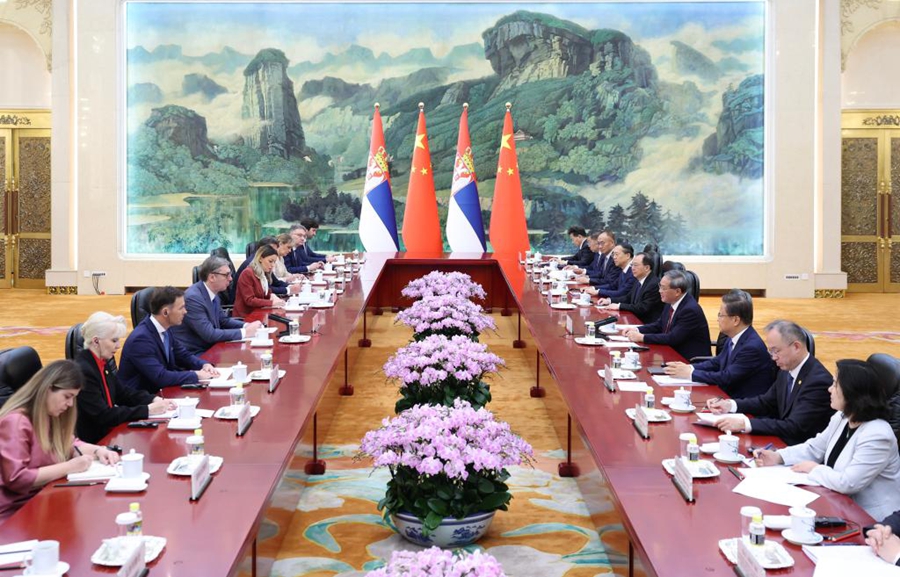
On the morning of May 25, Chinese Premier Li Qiang met with Serbian President Aleksandar Vucic, who was on a state visit to China, at the Great Hall of the People in Beijing.
Li Qiang stated that this year marks the 10th anniversary of the establishment of the China-Serbia comprehensive strategic partnership. In recent years, the heads of state of China and Serbia have maintained close and positive interactions, providing strategic guidance and important support for the development of bilateral relations. That afternoon, a meeting was held with President Vucic to further plan the building of a China-Serbia community with a shared future in the new era. China is willing to work with Serbia to continue efforts, always acting as mutually trusting partners, firmly supporting each other’s core interests, deepening and solidifying cooperation in various fields, better serving their respective modernization efforts, and bringing more benefits to the people of both countries.
Li Qiang pointed out that China is willing to strengthen development strategy alignment with Serbia, better utilize mechanisms such as the bilateral economic and trade mixed committee and investment working group, further unleash the positive effects of the bilateral free trade agreement, and expand and optimize bilateral economic and trade cooperation. China is willing to import more high-quality products from Serbia, support more capable Chinese enterprises to invest in Serbia, and expand cooperation in emerging fields such as artificial intelligence, new energy, advanced manufacturing, and green low-carbon development, to better empower the development of both countries. The Hungary-Serbia railway is a flagship project of the Belt and Road Initiative. China is willing to work with Serbia to ensure the maintenance and operation of the Serbian section and actively promote the early opening of the entire line. Both sides should deepen cultural and people-to-people cooperation in tourism, education, sports, and media to enhance mutual understanding and affinity between their peoples. Amid the current complex and evolving international situation, China is willing to strengthen coordination and cooperation with Serbia on platforms such as the United Nations, practice true multilateralism, promote the implementation of the four global initiatives, and build a more just and equitable global governance system.
Vucic said that China is Serbia’s ironclad friend, with deep friendship between Serbia and China, and the two countries always trust and support each other. The first successful state visit to Serbia in 2016 injected strong momentum into the in-depth development of bilateral relations. Serbia firmly adheres to the One-China principle and will continue to give firm support on issues concerning China’s core interests. China’s investment and cooperation have strongly promoted Serbia’s development. Serbia congratulates China on its tremendous achievements in economic and social development and is willing to maintain high-level exchanges with China, further leverage the dividends of the bilateral free trade agreement, deepen cooperation in trade, investment, agriculture and food, infrastructure construction, artificial intelligence, clean energy, and other fields, and promote cultural and people-to-people exchanges in education, tourism, and media. Serbia is willing to maintain close multilateral communication and coordination with China, firmly uphold multilateralism, and safeguard international fairness and justice.
A meeting was attended.
Great Hall of the People
The Great Hall of the People is a monumental state building located on the western side of Tiananmen Square in Beijing, China. Constructed in just ten months between 1958 and 1959, it was built as part of the “Ten Great Buildings” project to celebrate the 10th anniversary of the People’s Republic of China. The hall serves as the primary venue for the National People’s Congress and other major political and cultural events.
Beijing
Beijing, the capital of China, is one of the world’s oldest continuously inhabited cities, with a history spanning over 3,000 years. It served as the imperial capital for much of the Ming and Qing dynasties, home to iconic landmarks like the Forbidden City and the Great Wall. Today, it stands as a vibrant modern metropolis, blending ancient cultural heritage with rapid urban development.
<div
Great Hall of the People
The Great Hall of the People is a monumental state building located on the western side of Tiananmen Square in Beijing, China. Constructed in just ten months in 1959 as part of the “Ten Great Buildings” project to celebrate the 10th anniversary of the People’s Republic of China, it serves as the primary venue for the National People’s Congress and other major political and cultural events. The hall is renowned for its vast size, grand halls, and iconic auditorium, symbolizing the political power and architectural ambition of modern China.
Beijing
Beijing, the capital of China, is a city with a history spanning over 3,000 years, serving as the nation’s political and cultural center for centuries. It is home to iconic landmarks such as the Forbidden City, the Great Wall, and Tiananmen Square, reflecting its imperial past and modern significance. Today, Beijing blends ancient traditions with rapid modernization, hosting major events like the 2008 Summer Olympics and serving as a global hub for innovation and diplomacy.
Hungary-Serbia railway
The Hungary-Serbia railway is a major infrastructure project aimed at modernizing the rail link between Budapest and Belgrade, covering approximately 350 kilometers. Originally part of historic routes connecting Central and Southeastern Europe, the current upgrade is largely funded by China as part of its Belt and Road Initiative, with construction beginning in 2021. Once completed, it is expected to significantly reduce travel time and enhance regional trade and passenger connectivity.
Belt and Road Initiative
The Belt and Road Initiative (BRI) is a global infrastructure and economic development strategy proposed by China in 2013, aiming to enhance connectivity and cooperation across Asia, Europe, and Africa. It revives the ancient Silk Road trade routes by investing in ports, railways, and energy projects, while also promoting cultural exchange. The initiative has grown into one of the world’s largest infrastructure networks, involving over 150 countries and international organizations.
United Nations
The United Nations is an international organization founded in 1945 after World War II to promote peace, security, and cooperation among nations. Its headquarters in New York City serves as a forum for member states to address global issues such as conflict, human rights, and sustainable development. With 193 member states, it remains a central pillar of modern diplomacy and multilateral governance.
Forbidden City
The Forbidden City, located in the heart of Beijing, China, served as the imperial palace for 24 emperors during the Ming and Qing dynasties from 1420 to 1912. Construction began in 1406 under Emperor Yongle, and the complex is the world’s largest collection of preserved ancient wooden structures. Today, it is a UNESCO World Heritage site and houses the Palace Museum, showcasing centuries of Chinese art and history.
Great Wall
The Great Wall of China is a series of fortifications built across historical northern borders to protect Chinese states and empires from invasions. Construction began as early as the 7th century BC, with major additions under the Ming Dynasty (1368–1644). Today, it is a UNESCO World Heritage site and one of the most iconic symbols of China, stretching over 13,000 miles.
Tiananmen Square
Tiananmen Square is a large city square in central Beijing, China, named after the Tiananmen (Gate of Heavenly Peace) located to its north. Originally built in the 15th century during the Ming dynasty, the square was expanded in the 20th century and became a significant site for national celebrations and political events. It is also known for its proximity to key landmarks such as the Great Hall of the People, the National Museum of China, and the Mausoleum of Mao Zedong.