During the listening test on the afternoon of the 8th, temporary traffic management measures will be taken on roads around exam sites in Beijing.
The 2026 General College Entrance Examination (hereafter referred to as the “Gaokao”) for regular higher education institutions in Beijing will be held from June 7 to June 10 (Sunday to Wednesday). There are many exam centers in Xicheng, Dongcheng, and Haidian, and traffic around the exam centers will be heavy for short periods before and after each exam session.
Traffic management authorities have developed personalized traffic plans for each exam center, deployed special maintenance posts, activated high-level duty plans during the exam period, set up temporary parking areas, and dispatched all motorcycle patrol officers to strengthen traffic guidance and order maintenance around the exam centers. Real-time traffic information will be released through multiple channels to serve public travel, ensuring smooth and orderly traffic across the city.
Examinees and their parents are reminded to carefully verify the specific locations of their exam centers in advance and reasonably plan travel times, routes, and modes of transportation.
Gaokao Traffic Forecast
01
Traffic congestion around exam centers one hour before exams and after exams end
This year, the first day of the Gaokao falls on a Sunday, so travel traffic and exam drop-off traffic will mix, affecting urban road networks. Areas where scenic spots, shopping districts, and exam centers are close together will also experience parking shortages.
The last three days of the Gaokao are workdays. On June 9 (Tuesday) and June 10 (Wednesday), from 7:00 AM to 7:45 AM, exam drop-off traffic will overlap with the morning rush hour, putting particular pressure on roads around exam centers.
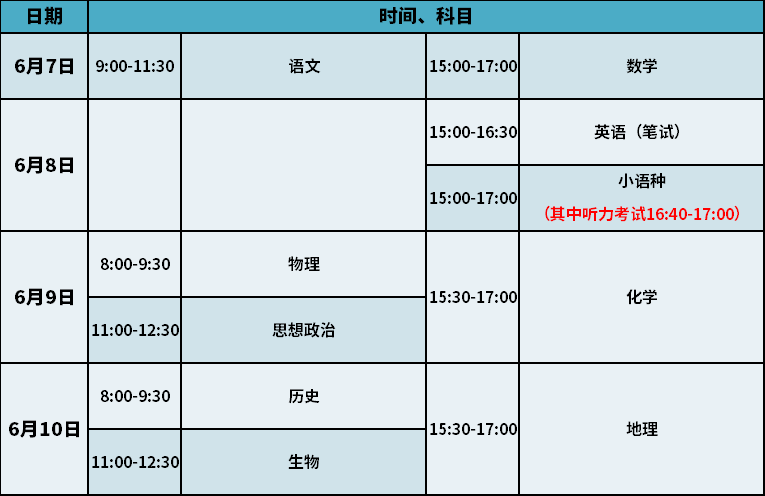
This year’s exam schedule:
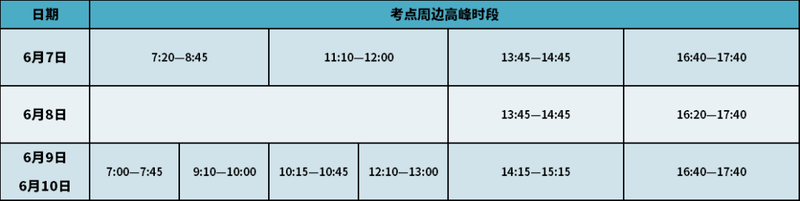
Traffic around exam centers is expected to be heavy one hour before exams and after exams end. On June 7, during the four periods of 7:20-8:45, 11:10-12:00, 13:45-14:45, and 16:40-17:40; on June 8, during the two periods of 13:45-14:45 and 16:20-17:40; and on June 9 and 10, during the six periods of 7:00-7:35, 9:10-10:00, 10:15-10:45, 12:10-13:00, 14:15-15:15, and 16:40-17:40, traffic pressure on roads around exam centers will be high.
02
Many exam centers in Xicheng, Dongcheng, and Haidian; heavy traffic in some areas
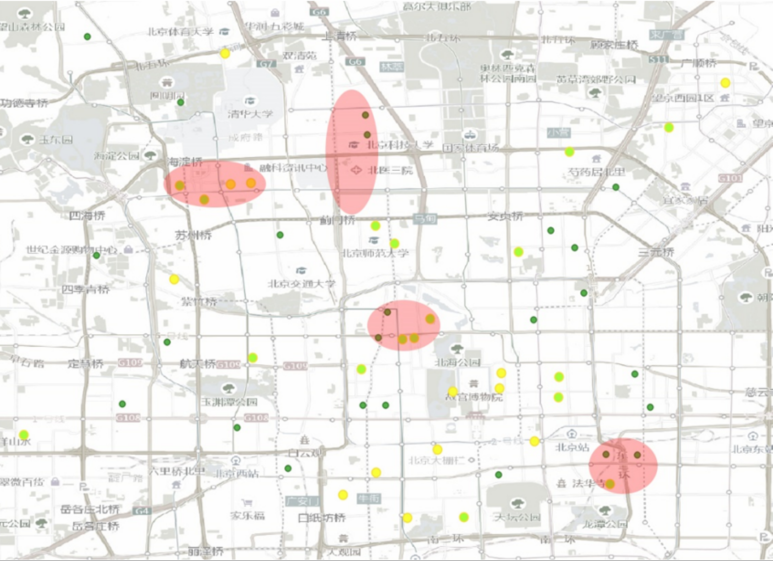
In terms of exam center distribution, there are many exam centers in Xicheng, Dongcheng, and Haidian. Areas such as Guangqumen, Di’anmen, Hepingli, Zhongguancun, and around Xueyuan Road have dense clusters of exam centers, which may lead to concentrated traffic. During the Gaokao period, traffic is expected to be heavy on the East Second Ring Road at Guangqumen Bridge, the East Third Ring Road, the East Fourth Ring Road, Lianshi Road, Fushi Road, Wanquanhe Road, the Zhongguancun South Street to Zhongguancun North Street line, and Haidian South Road. Traffic pressure will be particularly noticeable on June 9 and 10.
03
Temporary traffic management measures will be implemented on roads around 16 exam centers during the minor language listening test on the afternoon of June 8
On the afternoon of June 8, the Gaokao English (written) and minor language (including listening) exams will be held. To ensure the smooth conduct of the listening tests, traffic management authorities will implement temporary traffic management measures on roads around the following locations: Beijing Hongzhi Middle School in Dongcheng
Xicheng
Xicheng is a historic district in central Beijing, China, known for its rich cultural heritage and iconic landmarks such as the Shichahai Lake area, Prince Gong’s Mansion, and the White Pagoda Temple. Originally part of the imperial city during the Ming and Qing dynasties, it housed many royal gardens, temples, and aristocratic residences. Today, Xicheng preserves a blend of ancient alleyways (hutongs) and modern urban life, reflecting centuries of Chinese history and tradition.
Dongcheng
Dongcheng is a historic district in Beijing, China, known for housing many of the city’s most iconic cultural sites, including the Forbidden City and the Temple of Heaven. Its name means “Eastern City,” reflecting its location east of the city’s central axis, and it has been a core area of Beijing since the Ming and Qing dynasties. Today, Dongcheng blends ancient imperial heritage with vibrant modern life, featuring traditional hutongs, museums, and bustling commercial streets.
Haidian
Haidian is a district in northwestern Beijing, China, historically known for its imperial gardens and cultural sites, including the ruins of the Old Summer Palace (Yuanmingyuan) and the Summer Palace. It has evolved into a major hub for education and technology, hosting prestigious universities like Peking University and Tsinghua University, as well as the Zhongguancun tech zone. Today, Haidian blends its rich historical heritage with modernity as a center for innovation and learning.
Guangqumen
Guangqumen is a historic gate located in the southeastern part of Beijing’s old city wall, originally built during the Ming Dynasty as part of the city’s fortifications. It served as a key passage for travelers and goods moving between the city and the southern regions. Today, while the original gate no longer stands, the area remains a bustling district known for its markets and cultural significance in Beijing’s urban landscape.
Di’anmen
Di’anmen, or the “Earthly Peace Gate,” was a historic gate in Beijing, originally built in 1420 during the Ming Dynasty as the northern entrance to the Imperial City. It served as a counterpart to Tiananmen (the “Gate of Heavenly Peace”) and was part of the ceremonial route leading to the Forbidden City. Though the original gate was demolished in the 1950s for road construction, its name and legacy remain an important part of Beijing’s cultural heritage.
Hepingli
Hepingli is a large residential neighborhood in Beijing’s Dongcheng District, originally developed in the 1950s as one of the first planned communities in New China, inspired by Soviet urban design. Its name, meaning “Peace and Reason,” reflects the era’s socialist ideals, and the area is known for its tree-lined streets and distinctive low-rise apartment blocks. Today, Hepingli retains a quiet, historic charm, offering a glimpse into mid-20th-century Beijing life.
Zhongguancun
Zhongguancun, located in Beijing’s Haidian District, is often called “China’s Silicon Valley” due to its role as a major hub for technology and innovation. Its history traces back to the 1980s, when it emerged from a cluster of electronics markets and research institutions into a thriving tech zone, later designated as a national-level innovation demonstration area. Today, it houses numerous startups, global tech giants, and leading universities, driving China’s advancements in fields like artificial intelligence and information technology.
Beijing Hongzhi Middle School
Beijing Hongzhi Middle School is a historic secondary school located in Beijing, China, originally founded in 1902 during the late Qing Dynasty as one of the earliest modern schools in the country. It was established with the mission of promoting Western learning and Chinese cultural traditions, and has since evolved into a well-regarded institution known for its academic excellence and rich educational heritage. Over the decades, the school has contributed significantly to China’s modern education system, nurturing generations of students.