Beijing’s Sub-Center Advances Toward Becoming a World-Class Tourist Destination
The Beijing Sub-Center Cultural Tourism Zone has welcomed a new addition. The Wanli International Entertainment Complex became an instant hit upon opening. Since its trial operation began on December 19 last year, it took only 16 days to receive over 2.45 million visitors, with total sales exceeding 200 million yuan.
The pace of new additions to the Sub-Center Cultural Tourism Zone will continue to accelerate: The Vertex Park, which introduces international family-friendly IPs like Peppa Pig and Barbie, will officially debut this year. The Haichang Ocean Park is set to begin trial operations in 2027. The City Sports Center, featuring a stadium with a capacity of over ten thousand, will open its doors in 2028. Projects such as the Mars Sci-Fi City, Ferrari World Entertainment Complex, and the “Fly to Sagittarius – Launch Camp” have also been signed.
The dense layout of multiple major projects marks the Sub-Center’s cultural tourism industry entering a new stage of cluster development. The Sub-Center will build a complementary and symbiotic cultural tourism industry ecosystem.
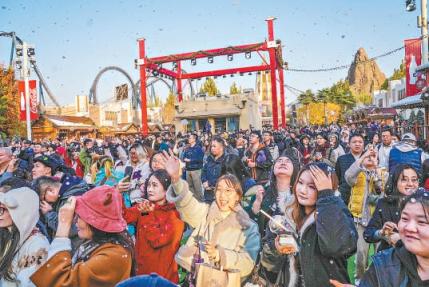
Visitors enjoying the excitement of Universal.
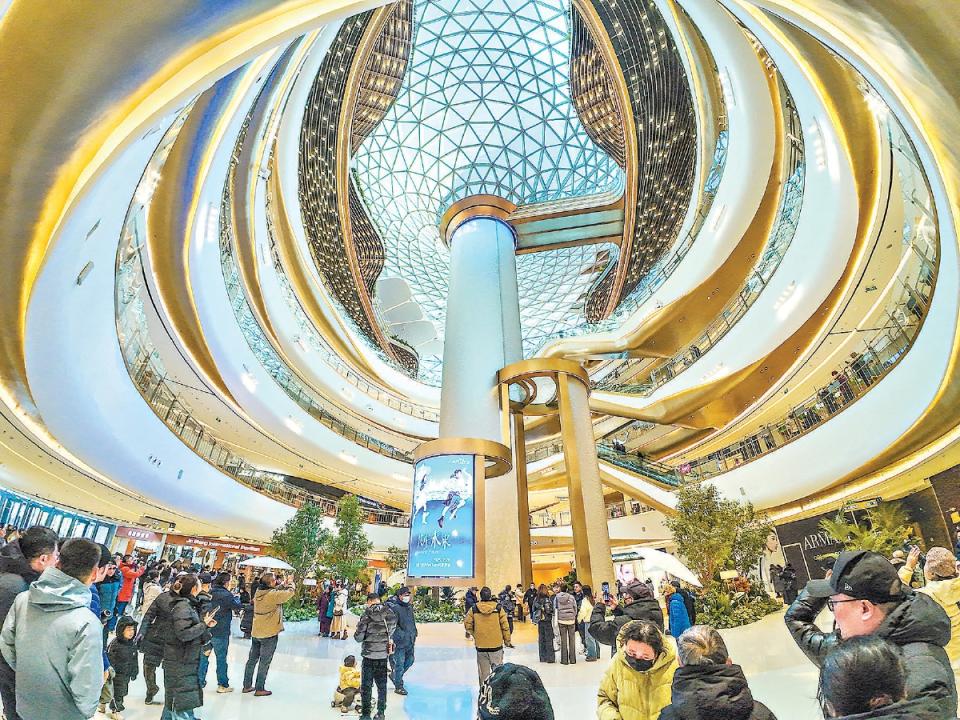
The suspended water feature at Wanli attracts visitors and residents for photos.
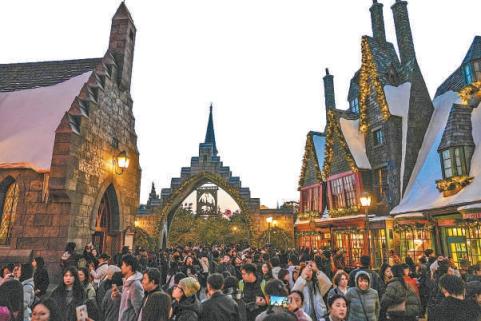
Visitors enjoying the Universal Resort.
Core Leadership
Differentiated Layout to Alleviate Homogenization Concerns
“Our goal is to build a well-considered industrial ecosystem,” stated the head of the Industrial Promotion Department. The Cultural Tourism Zone benchmarks against international-level tourism resorts like Orlando in the USA and Sentosa in Singapore, adopting the market-validated “cluster effect” development model. The core principle is “differentiated complementarity,” ultimately achieving coverage for all age groups and round-the-clock entertainment supply.
Strong upward growth curves outline the vitality of the Sub-Center’s cultural tourism industry: In 2025, Tongzhou District received over 26 million tourists, with tourism spending increasing by 12.5% year-on-year, ranking second in the city for growth rate. From January to October 2025, revenue for cultural and arts enterprises in Tongzhou District grew by 33.5% year-on-year, revenue for large-scale cultural, sports, and entertainment enterprises grew by 11.2%, and their share of GDP increased to 4.7%. This indicates that cultural tourism has become a pillar industry driving regional development in the Sub-Center.
As the “core” of the Cultural Tourism Zone, the Beijing Universal Resort receives over ten million visitors annually, with popular attractions often having long queues. It focuses on teenagers and young families, offering high-intensity, high-quality immersive rides and special effects performances, forming a powerful core attraction. The various new projects surrounding it are precisely filling market gaps and achieving differentiated positioning.
Vertex Park focuses on young families with children. The world’s first Peppa Pig indoor snow and ice park will recreate scenes from the animation, building a dreamy fairy-tale world. The Ferrari World Entertainment Complex, themed around high-speed competition, targets youth groups and automotive culture enthusiasts, filling a gap in speed entertainment. Haich
Beijing Sub-Center Cultural Tourism Zone
The Beijing Sub-Center Cultural Tourism Zone is a modern cultural and recreational hub located in the Tongzhou district, developed as part of Beijing’s urban expansion to alleviate pressure on the city’s historic core. It features contemporary landmarks like the Beijing Grand Canal Museum and the Beijing City Library, built to promote cultural tourism and green development along the revitalized Grand Canal, a UNESCO World Heritage site with a history dating back over 2,500 years. This zone represents Beijing’s 21st-century vision, blending new cultural infrastructure with the ancient canal’s legacy.
Wanli International Entertainment Complex
The Wanli International Entertainment Complex is a large-scale leisure and tourism development project located in Wanli District, New Taipei City, Taiwan. Originally conceived in the 1990s, it was intended to be a major resort with hotels, a theme park, and a marina, but the project stalled due to financial and legal issues, leaving much of the site incomplete. Today, its abandoned structures, particularly the iconic decaying “ruins” of the Spanish-style hotel on the coast, have become an unexpected tourist attraction for urban explorers and photographers.
Vertex Park
Vertex Park is a modern urban recreational space located in the heart of the city, designed and opened in the early 2010s to revitalize a former industrial waterfront district. It is known for its striking geometric architecture, interactive light installations, and community-focused events, symbolizing the area’s transition from manufacturing to a hub for technology and public culture.
Haichang Ocean Park
Haichang Ocean Park is a major Chinese theme park operator with multiple large-scale ocean-themed parks across China, such as in Shanghai and Sanya. These parks, which opened in various years starting from the 2010s, combine aquariums, marine animal exhibits, thrill rides, and live shows to promote marine conservation and family entertainment. They represent a modern development in China’s tourism and leisure industry, focusing on immersive educational experiences within a commercial resort setting.
City Sports Center
The City Sports Center is a modern public recreational facility, typically built in the late 20th or early 21st century, designed to serve the fitness and athletic needs of a local urban community. These centers often evolve from earlier, simpler public gymnasiums or pools, reflecting a growing municipal focus on promoting health, wellness, and accessible sports for all residents. They commonly house amenities like swimming pools, basketball courts, and fitness studios under one roof.
Mars Sci-Fi City
“Mars Sci-Fi City” is not an actual historical or existing cultural site, but a popular concept in science fiction representing a futuristic human settlement on Mars. It typically symbolizes humanity’s aspirations for interplanetary colonization and technological advancement, often depicted in films, literature, and art. As a fictional construct, it has no concrete history, but it reflects ongoing real-world scientific efforts by agencies like NASA and SpaceX to eventually make human life on Mars a reality.
Ferrari World Entertainment Complex
Ferrari World Abu Dhabi is an indoor theme park located on Yas Island, United Arab Emirates, which opened in 2010 as the world’s first Ferrari-branded theme park. Its history is tied to celebrating the legacy of the Italian luxury sports car manufacturer, featuring attractions inspired by Ferrari’s design and racing heritage. The complex is famous for housing Formula Rossa, the world’s fastest roller coaster.
Beijing Universal Resort
The Beijing Universal Resort is a major theme park complex that opened in 2021 in the Tongzhou district. It is the fifth Universal Studios resort globally and features themed lands based on popular films like *Harry Potter* and *Transformers*. Its development reflects China’s growing entertainment tourism market and is a joint venture between Universal Parks & Resorts and several Chinese state-owned companies.