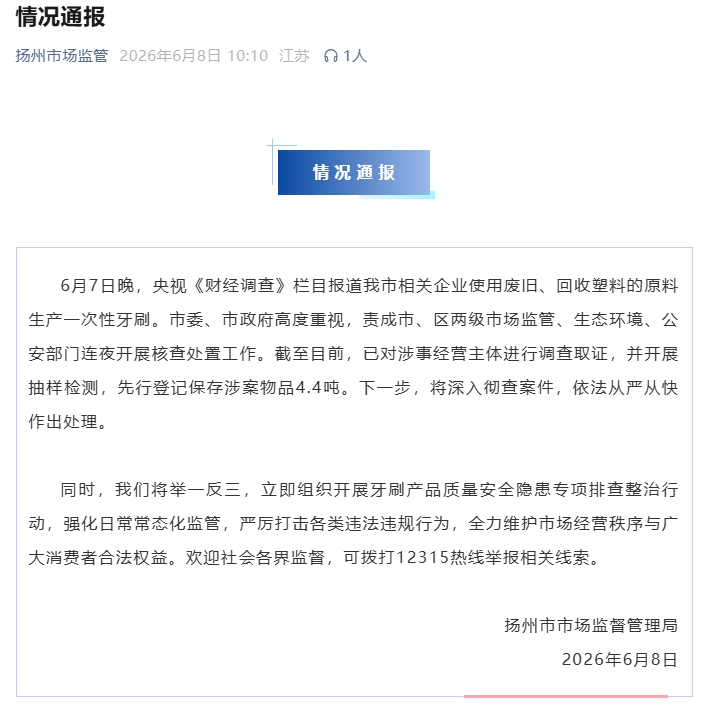
On June 8, the Yangzhou Market Supervision Administration issued a notice:
On the evening of June 7, the “Financial Investigation” program reported that companies in Yangzhou were using waste and recycled plastic materials to produce disposable toothbrushes. The municipal party committee and government attached great importance to this, instructing market supervision, ecological environment, and public security departments at both the city and district levels to conduct verification and handling operations overnight. As of now, investigations and evidence collection have been carried out on the involved business entities, sampling tests have been conducted, and 4.4 tons of related items have been temporarily detained. Next, the case will be thoroughly investigated, and the matter will be handled strictly and swiftly according to the law.
Shocking Production Sites
Exposé of Small Workshops Renovating Toothbrushes
According to earlier reports from “Financial Investigation,” the program recently received tips from consumers and industry insiders that some toothbrush manufacturers were suspected of illegally using various waste and recycled plastic materials to produce disposable toothbrushes, which were then sold in large quantities to the market.
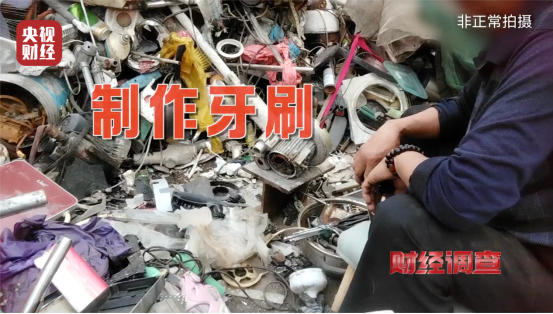
At a small waste collection station in Jiangdu District, Yangzhou, various waste plastics were piled up, including white barrels for chemical agents, old panels removed from home appliances, fan covers, and worn-out roller skates… A worker weighing the waste told reporters that these recycled plastics, after simple crushing, would be sent to various plastic product processing plants, a significant portion of which were specifically used to make toothbrushes.
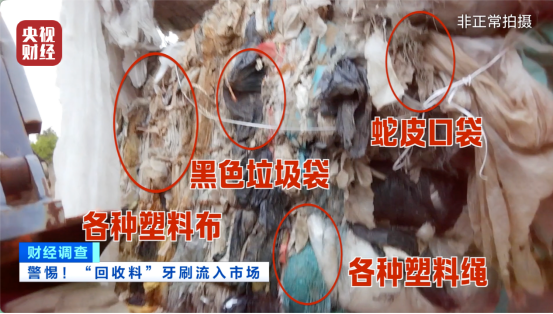
In the backyard of a house in Jiangdu District, reporters saw various processed disposable masks scattered around the yard, packed in colorful plastic bags and still sealed. The person in charge said that these recycled masks could be directly processed into plastic pellets for making toothbrushes in their small workshop. Insiders call this material “recycled material” or “reclaimed material.” In the same yard, reporters also saw a pile of plastic waste, packaged into square bales as tall as a person. The waste included various plastic sheets of indistinguishable colors, woven bags, black garbage bags, and plastic ropes. The person in charge told reporters that this garbage was also raw material for making disposable toothbrushes. The factory owner said that such low-cost “reclaimed material” is generally not used alone by toothbrush factories to make toothbrushes but is mixed in proportion with brand-new plastic materials to significantly reduce production costs. At another “reclaimed material” processing plant, reporters saw that the raw material consisted of leftover scraps from shoe factories making slippers.
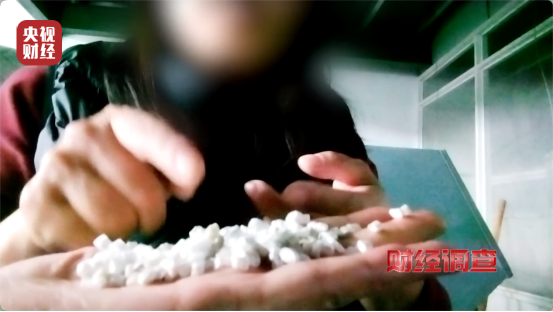
Following guidance from manufacturers, reporters arrived at the Hangsheng Science and Technology Park in Guangling District, Yangzhou, which houses several factories producing disposable hotel supplies. To cope with rising raw material costs, many small factories extensively used low-cost recycled plastics mixed with new materials to produce toothbrushes, with the material ratio flexibly adjusted based on the toothbrush pricing. In this industrial park, reporters also found an extremely low-priced disposable toothbrush with an ex-factory price of only six cents each. The manufacturer used a mixture of straw and recycled plastic to lower costs. Some manufacturers told reporters that if the toothbrush handle is made entirely from “reclaimed material,” it becomes brittle and can easily break inside the mouth during use.
An expert specializing in preventive medicine and environmental science research told reporters that the health risks of using disposable toothbrushes made from such “reclaimed material” come not only from the raw materials themselves. The repeatedly recycled plastics have complex compositions, and during high-temperature melting processing, new toxic and hazardous substances are generated. Disposable toothbrushes come into direct contact with the oral cavity, where the oral mucosa has good permeability and is dense with blood vessels. Combined with the surfactants in toothpaste, various harmful substances from the raw materials can easily penetrate the human body, posing multiple hidden dangers.
<div class