
1/18
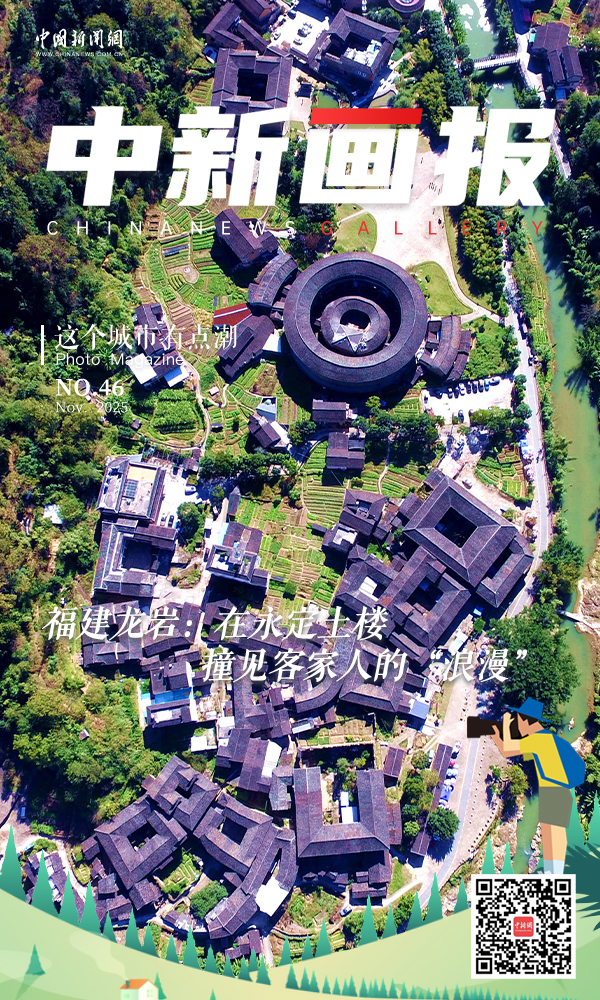
In the Yongding Tulou cluster in Fujian’s Longyan, the Hakka people’s romance is embedded within the circular and square rammed earth walls. These “Oriental castles” are not only the “magical filming location” for the animated film “Big Fish & Begonia,” but also attract countless tourists with their unique architectural aesthetics. The circular enclosed buildings not only contain centuries of daily life but also represent the Hakka people’s “hardcore romance.” The image shows a breathtaking aerial view of the Yongding Tulou cluster.
Yongding Tulou cluster
The Yongding Tulou cluster in Fujian Province, China, is a collection of distinctive earthen buildings constructed by the Hakka people between the 12th and 20th centuries. These large, fortified communal residences, often circular or rectangular in shape, were designed for defensive purposes and to house entire clans. Recognized as a UNESCO World Heritage site, they represent a unique form of communal living and vernacular architecture.
Fujian
Fujian is a coastal province in southeastern China with a rich maritime history and unique cultural traditions. It is renowned for its historic role in the ancient Maritime Silk Road and as the ancestral homeland for many overseas Chinese communities. The region is also famous for its distinctive tulou earthen buildings, a UNESCO World Heritage site, and its globally influential tea culture, including oolong varieties like Tieguanyin.
Longyan
Longyan is a prefecture-level city in the mountainous western region of Fujian Province, China, with a history deeply rooted in the Hakka culture. It is renowned as the ancestral homeland for many Hakka people worldwide and is famous for the Yongding Tulou, a UNESCO World Heritage site consisting of massive, fortified earth buildings constructed by the Hakkas between the 12th and 20th centuries. The city’s history is also marked by its role as a crucial base area for the early Communist movement during the Chinese Civil War.
Hakka people
The Hakka people are a Han Chinese subgroup with a migratory history originating from northern China, who moved southward over centuries to settle in regions like Guangdong, Jiangxi, and Fujian. Known for their unique communal living structures called tulou, these fortified earth buildings reflect their resilient culture and clan-based social organization. Today, the Hakka maintain a distinct identity through their language, customs, and global diaspora.
Oriental castles
“Oriental castles” is a broad term, but it often refers to the magnificent fortress-palaces built across the Middle East and Asia, such as those constructed by Islamic empires. A prime example is the Alhambra in Spain, a 13th-century Nasrid palace and fortress complex renowned for its intricate Islamic architecture, gardens, and rich history as the last Muslim stronghold in Western Europe. These structures frequently served as fortified royal residences, military strongholds, and centers of administration and culture.
Big Fish & Begonia
“Big Fish & Begonia” is a 2016 Chinese animated fantasy film, not a physical place, heavily inspired by Chinese mythology and Taoist philosophy. The story follows a teenage girl who travels to the human world and risks her life to resurrect the soul of a human boy, exploring themes of sacrifice, destiny, and the interconnectedness of life. The film’s visually stunning world draws from classical Chinese texts like the “Classic of Mountains and Seas” (Shan Hai Jing).
rammed earth walls
Rammed earth walls are an ancient construction technique that involves compacting layers of damp earth mixed with stabilizers like clay or lime into a temporary frame. This method has been used for thousands of years across various continents, from the Great Wall of China to medieval European structures. Today, it is experiencing a revival due to its sustainability, durability, and excellent thermal mass properties.
circular enclosed buildings
Circular enclosed buildings, often called rotundas, have ancient origins dating back to prehistoric times, such as Neolithic roundhouses and the Roman Pantheon. These structures have been used throughout history for diverse purposes including dwellings, religious sites, tombs, and public buildings. Their circular design often carries symbolic meaning, representing unity, eternity, or celestial bodies in various cultures.