Finance Minister Attends 113th World Bank Development Committee Meeting in 2026
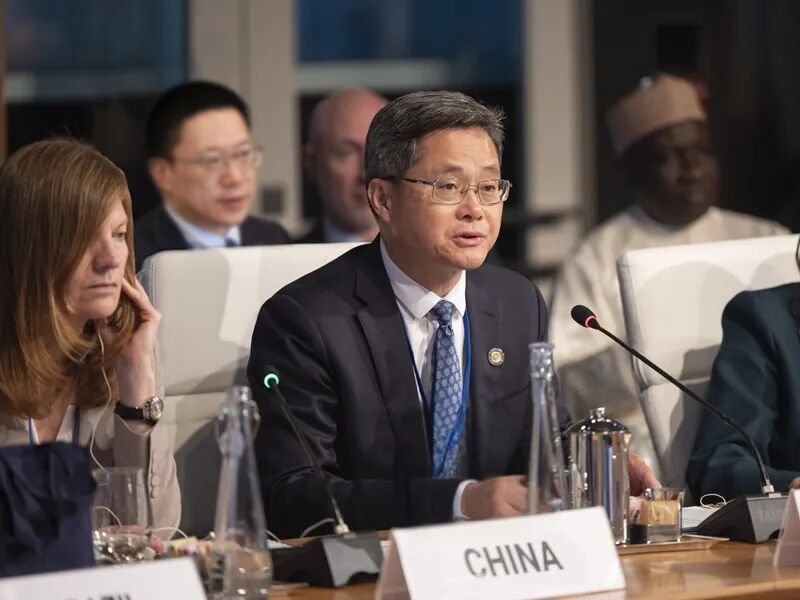
The World Bank’s Development Committee held its 113th meeting in Washington, D.C., where it reviewed and approved the report “Creating an Enabling Environment for Job Creation and Income Growth” and the “2025 Equity Review Board Report.”
It was stated that the current global economic recovery remains weak, with escalating geopolitical conflicts. There is hope that the World Bank will uphold multilateralism and contribute positively to maintaining the current international order. There is an expectation for the World Bank to mobilize more financial and intellectual resources to help developing members improve infrastructure, optimize the business environment, enhance endogenous growth momentum, promote high-quality and full employment, and strengthen the foundation for poverty reduction and shared prosperity. Furthermore, there is hope that the World Bank will achieve substantive progress in equity reform, further increase the voice and representation of developing countries, and safeguard the institution’s own legitimacy and credibility.
It was emphasized that as the world’s second-largest economy and the largest developing country, China has contributed approximately 30% to global economic growth in recent years, making a positive contribution to global development. China will continue to serve as a main engine of global growth, vigorously expand domestic demand, boost consumption, further unleash the vitality and potential of its ultra-large-scale market, and share the opportunities and benefits of its development with the world. For over 40 years, China and the World Bank have established a mutually beneficial partnership. There is a willingness to further deepen cooperation with the World Bank, share China’s reform experience with other developing countries, provide more global public goods, and ensure that the cooperation between China and the World Bank benefits the world.
During the meeting, bilateral talks were also held with representatives from various countries to exchange views on cooperation between China and the World Bank, as well as cooperation between China and relevant countries under the framework of multilateral development banks.
World Bank
The World Bank is an international financial institution founded in 1944 at the Bretton Woods Conference to help rebuild nations after World War II. Today, its primary mission is to provide loans, grants, and expertise to developing countries for projects aimed at reducing poverty and fostering sustainable economic development. It comprises two main institutions: the International Bank for Reconstruction and Development (IBRD) and the International Development Association (IDA).
Washington, D.C.
Washington, D.C., is the capital of the United States, founded in 1790 as a planned city to serve as the seat of the federal government. Its design, influenced by Pierre L’Enfant, features iconic landmarks like the White House and Capitol Building, which have been central to American political history since the early 19th century.
China
China is one of the world’s oldest continuous civilizations, with a recorded history spanning over 4,000 years, marked by successive dynasties and profound cultural, philosophical, and technological achievements. Today, it is a vast modern nation-state officially known as the People’s Republic of China, renowned for iconic cultural sites like the Great Wall, the Forbidden City, and the Terracotta Army, which reflect its immense historical depth and enduring global influence.
World Bank
The World Bank is an international financial institution founded in 1944 at the Bretton Woods Conference to help rebuild nations after World War II. Today, its primary mission is to provide loans, grants, and expertise to developing countries for projects aimed at reducing poverty and fostering sustainable economic development. It is headquartered in Washington, D.C., and consists of five cooperative organizations.
Washington, D.C.
Washington, D.C., is the capital of the United States, founded in 1790 as a planned city to serve as the nation’s seat of government. It is home to iconic landmarks like the White House, U.S. Capitol, and numerous monuments and museums, many of which commemorate American history and democracy. The city’s design was originally overseen by Pierre L’Enfant, and it has grown into a global political and cultural center.
China
China is one of the world’s oldest continuous civilizations, with a recorded history spanning over 4,000 years, marked by successive dynasties, profound philosophical traditions like Confucianism, and inventions such as paper and gunpowder. Today, it is a vast modern nation-state officially known as the People’s Republic of China, blending its immense historical heritage with rapid economic development and global influence. Its cultural landscape is defined by iconic sites like the Great Wall and the Forbidden City, which symbolize its ancient imperial past.
Great Wall
The Great Wall of China is an ancient series of fortifications built over centuries, primarily during the Ming Dynasty (1368–1644), to protect against nomadic invasions from the north. Stretching over 13,000 miles, it stands as a monumental feat of engineering and a powerful symbol of Chinese civilization. Today, it is one of the world’s most iconic cultural heritage sites and a major tourist destination.
Forbidden City
The Forbidden City, located in central Beijing, was the imperial palace of China’s Ming and Qing dynasties from 1420 to 1912. Constructed under Emperor Yongle, it served as the ceremonial and political heart of Chinese government for nearly 500 years. Today, it is preserved as the Palace Museum, a UNESCO World Heritage site housing vast collections of art and artifacts from the imperial era.
Terracotta Army
The Terracotta Army is a vast collection of life-sized clay soldiers, horses, and chariots discovered in 1974 near Xi’an, China. It was created to accompany and protect Qin Shi Huang, the first emperor of China, in the afterlife, and its construction began around 246 BCE. This UNESCO World Heritage Site represents one of the most significant archaeological finds of the 20th century, showcasing the military power and artistry of the Qin Dynasty.