
Chongqing, June 4 — Topic: How Are China’s Ecological Governance Achievements “Seen” and “Recognized” by the World?
June 5, 2026 marks the 55th World Environment Day and the 12th China Environment Day. Currently, the world faces severe challenges from intertwined crises including intensifying climate change, biodiversity loss, environmental pollution, and desertification expansion. Against this backdrop, China’s ecological governance path offers unique and applicable lessons for global efforts to address environmental crises and achieve sustainable development goals.
Why do China’s ecological governance achievements need to be “seen” by the world? How can they be translated into narratives that overseas audiences can intuitively understand in cross-cultural communication? Li Ren, Director of the Ecological Civilization Communication Research Center at Southwest University of Political Science and Law and one of the first chief environmental communication experts of the China Environmental Journalists Association, recently gave an exclusive interview on this topic.
The following is a summary of the interview:
Question: China has global influence in green technology and green industries. In overseas communication in this field, what are China’s successful cases, and what is the key to gaining international recognition?
Li Ren: From a communication perspective, international recognition is gradually built on “visible facts,” “usable products,” and “comparable results.” The reason China’s green technologies and industries have gained international attention is that they have transformed from domestically policy-driven “development achievements” into “public goods” in the global market and global governance.
In recent years, China has formed a relatively complete technology chain, industrial chain, and supply chain in areas such as new energy, energy storage, new energy vehicles, and photovoltaics, becoming a significant driving force for global green transformation.
Scale forms the basis of being “seen,” but the real key to international recognition lies in “credible technology, affordable costs, and sustainable cooperation.” For example, China’s photovoltaic industry has been widely deployed globally, not only due to sufficient production capacity but also because it has significantly reduced the cost of global clean energy use. The international communication of China’s green industries is more easily accepted, not just because “China is talking,” but because “the world is using.”
Another important success logic is the shift from “product communication to value communication.” Taking Chinese new energy vehicles going overseas as an example, overseas consumers initially focused on range, price, and intelligence levels. However, as product reputation forms, the green lifestyle, digital technology capabilities, and industrial innovation system behind them are gradually understood as part of Chinese-style modernization.
Overall, China’s green technologies and industries have gained international recognition because: first, they have hard power, with technological innovation and industrial systems forming the factual basis for communication; second, they have accessibility, allowing more countries, especially developing ones, to afford, use, and learn from them; and third, they have commonality, turning Chinese solutions into shared opportunities for global green development.
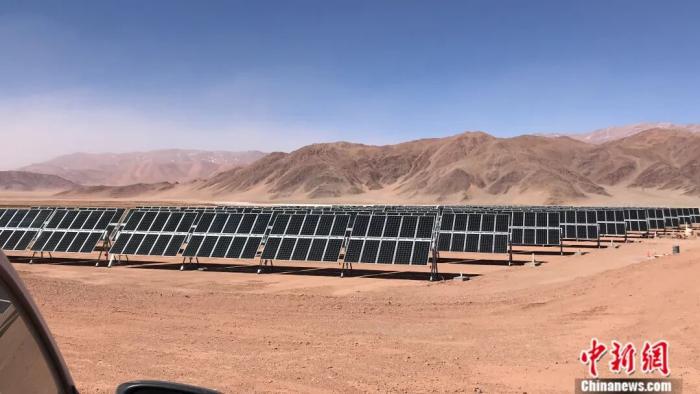
The largest photovoltaic power station in Latin America, built by a Chinese company in the Jujuy province of Argentina, in the Cauchari area. (File photo)
Question: Concepts like “lucid waters and lush mountains are invaluable assets” and “harmonious coexistence between humans and nature” have distinct Chinese philosophical roots. In cross-cultural communication, how can these be transformed into stories that different countries can intuitively understand?
Li Ren: These concepts inherit the ideological threads of “unity of heaven and man” and “following the way of nature” from traditional Chinese philosophy. In cross-cultural communication, the focus should be on narrative transformation. In international communication, the world should see how these concepts change the lifestyle of a river, a village, a city, or a family. Once concepts are concretized, they move from being “translatable” to being “identifiable.”
For example, the ecological restoration of the Tongluoshan mining area in Chongqing’s Liangjiang New Area has significant cross-cultural communication value. Tongluoshan is rich in limestone resources. Decades of open-pit mining left many mine pits as “ecological scars.” In recent years, Chongqing has promoted mine pit restoration, water system reconstruction, vegetation recovery, and landscape re-creation, transforming this area from an ecological “liability