Chongqing — As of 12:00 on June 7, a total of 17,982 personnel and 2,051 vehicles from professional emergency rescue teams across the city were on standby duty. Based on the current rainfall, water levels, and geological disaster trends, Chongqing has coordinated its emergency resources to carry out flood control and rescue operations while ensuring the smooth conduct of the national college entrance examination. Specific plans and pre-positioned rescue forces have been developed for all 112 examination sites across the city.
Chongqing has dynamically assessed and adjusted emergency response levels according to rainfall, water conditions, and geological disaster developments, updating the citywide response status in real time. Differentiated control measures, duty requirements, and prevention standards have been established based on response levels, with detailed work deployments to ensure that inspection patrols, early warnings, personnel transfers, and other measures are implemented, so that all flood control directives are effectively executed.
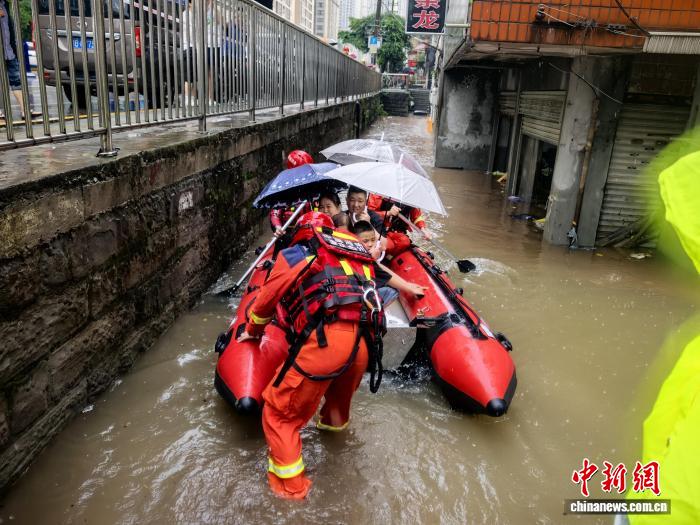
Photo shows firefighters in Hechuan District, Chongqing, transferring stranded residents.
To ensure the smooth conduct of the college entrance examination, specific support plans have been formulated for all 112 examination sites in Chongqing. A total of 562 professional rescue personnel and 106 vehicles have been pre-positioned at examination sites by various districts and counties. Additionally, 614 personnel at the municipal level and 677 at the district and county level are on standby at bases. As of 12:00 on June 7, a total of 17,982 personnel and 2,051 vehicles from professional emergency rescue teams across the city were on standby, comprehensively securing the examination safety line.
Heavy rainfall has caused waterlogging on roads in some areas of Chongqing. As of 12:00 on June 7, the Chongqing Emergency Management Bureau urgently dispatched 65 personnel from the municipal professional rescue corps and China Aneng Chongqing Rescue Base, along with over 20 sets of large equipment, to assist the affected Hechuan District. The total drainage capacity reached 22,600 cubic meters per hour. Hechuan District simultaneously sent 23 rescue personnel and drainage equipment for coordinated operations.
At the intersection of Hexiao Road and Huatan Avenue, the deepest waterlogged area in Hechuan District, the accumulated water volume was approximately 50,000 cubic meters. Local housing and construction departments and emergency authorities carried out operations combining sewer dredging with mobile drainage equipment, leading to a continuous decline in water levels.
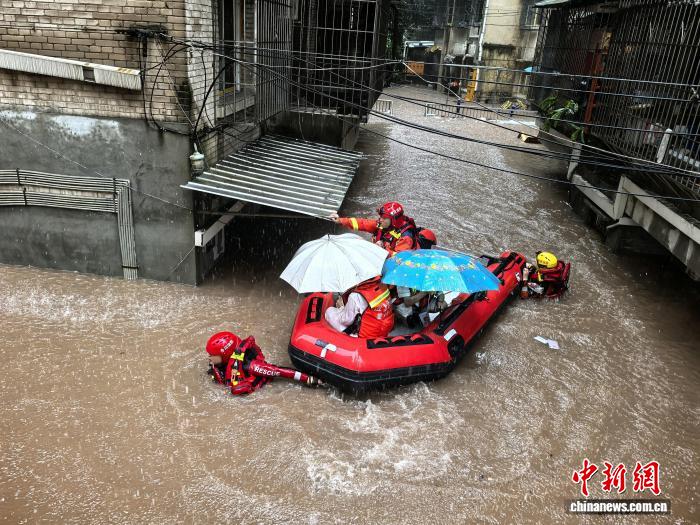
Photo shows firefighters in Hechuan District, Chongqing, transferring stranded residents.
All districts and counties in Chongqing have also responded promptly to the flood situation, comprehensively carrying out flood control, rescue, and hazard排查 work. Hechuan District upgraded its emergency response in stages, assembling 32 comprehensive emergency rescue teams totaling 538 personnel and 9 professional rescue teams totaling 141 personnel into second-level standby status. It issued 1,152 early warning text messages covering 140,500 people, and continuously broadcast prevention measures through a full media matrix and village-wide radio.
Jiangjin District arranged 15 staff members and 3 vehicles to be stationed at three college entrance examination sites. At the same time, it organized efforts to conduct thorough hazard inspections in key areas such as mountain flood and geological disaster points, low-lying areas, old houses, and river channels and ditches, ensuring early detection and early handling of hazards.
On the morning of June 7, Pengshui County dispatched emergency teams to townships and villages for rescue operations. The county mobilized over 1,000 person-times for patrol and inspection, focusing on 461 geological disaster risk points, 7 flood control weak points, and 72 mountain flood hazard areas. Wulong District’s emergency rescue teams went deep into heavily affected areas such as Jiangkou, Shiqiao, and Wenfu to evacuate residents and control dangerous zones, while also providing support at the Wulong Middle School examination site, with systematic support and mobile standby at the base.
Currently, flood control, rescue, and examination site support efforts are progressing in an orderly manner across Chongqing.