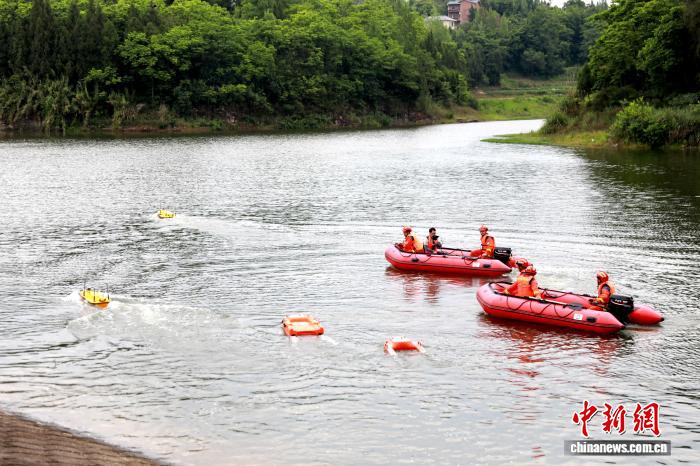
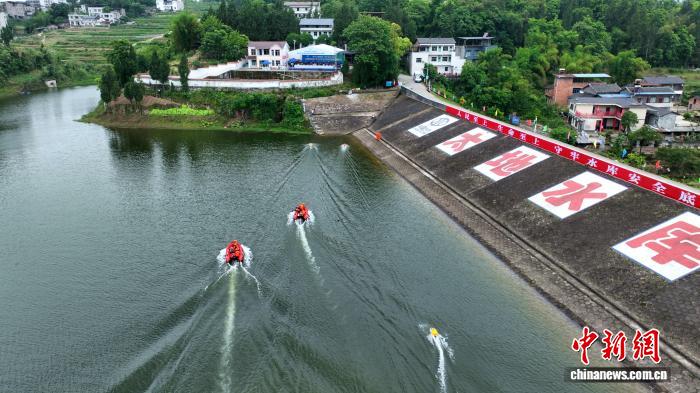
Emergency drill for reservoir dam safety uses robot dogs and underwater robots.
A reservoir dam safety emergency response drill was held on May 15 in Yunyang County, Chongqing, at the Taidi Reservoir. The drill simulated a scenario where heavy rainfall triggered a reservoir emergency, utilizing intelligent equipment such as drones, unmanned boats, robotic dogs, and underwater robots to establish an integrated “water, land, and air” emergency response system, providing a practical demonstration for reservoir safety during flood season in Chongqing.
The drill simulated heavy rainfall in the Shanshugou watershed and a potential emergency at Taidi Reservoir, focusing on major risks under extreme weather conditions. It covered key stages including monitoring and forecasting, consultation and assessment, dynamic warnings, risk analysis, high-tech support, and emergency evacuation. Typical emergency scenarios were set up, such as intelligent inspection and analysis, rescue operations, dam piping blockage, evacuation of residents, emergency flood discharge, and counter-terrorism response, providing a model for reservoir emergency drills across the city. Multiple departments including water resources, meteorology, emergency management, public security, and the township government coordinated to address the “three major risks” of basin flooding, reservoir failure, and mountain torrent disasters.
Yunyang County, located in the heart of the Three Gorges Reservoir area, has 178 registered reservoirs, ranking fourth in Chongqing, making safety management a challenging task. In recent years, Yunyang County has strictly implemented the “three responsible persons” for reservoir safety, building a comprehensive human defense system involving full participation, full process control, and full coverage. A total of 145 township reservoirs have been centrally managed by state-owned enterprises, and 115 have achieved standardized management. Meanwhile, a “sky, space, ground, water, and engineering” three-dimensional monitoring system has been established, equipped with intelligent devices such as drones, unmanned boats, and underwater robots, along with 496 video surveillance systems, with a monitoring online rate consistently above 99%, enhancing safety management efficiency through new water conservancy productivity. Taking this drill as an opportunity, Yunyang County will further strengthen responsibilities, address weaknesses, and strive to protect the safety of people’s lives and property, as well as the pristine reservoir water.
During the review, it was emphasized that all districts and counties in Chongqing should fully utilize the “smart management of water conservancy projects” application, strengthen “four pre” management during the flood season, implement reservoir emergency plans, clarify key steps such as emergency spillway excavation and resident evacuation organization, and pre-position emergency materials like plastic sheeting, woven bags, and sand and gravel at dangerous reservoirs and small earth-rock dams to ensure availability during extreme conditions. At the same time, measures such as “treating defects as they arise” and restricted operation for dangerous reservoirs must be strictly enforced, with reservoirs operating empty during the main flood season in principle, and operating above flood limit levels is strictly prohibited, to resolutely uphold the bottom line of preventing dam failure and casualties. It is hoped that this drill will further enhance awareness of potential dangers and strengthen responsibility, ensuring reservoir safety during the flood season.
Taidi Reservoir
Taidi Reservoir, located in China’s Fujian Province, is a scenic man-made lake constructed primarily for irrigation and flood control. Built during the mid-20th century, it has since become a popular local destination for leisure activities like boating and hiking, surrounded by lush hills. Its creation reflects the region’s efforts to manage water resources and support agricultural development.
Yunyang County
Yunyang County, located in Chongqing Municipality, China, is a historic area along the Yangtze River with a rich cultural heritage dating back over 2,300 years. It is known for the Zhang Fei Temple, a famous ancient shrine dedicated to the Three Kingdoms-era general, which was relocated to higher ground to preserve it from flooding after the construction of the Three Gorges Dam. Today,
Yunyang County
Yunyang County, located in Chongqing Municipality, China, is a historic area along the Yangtze River known for its ancient cultural heritage and dramatic landscapes. Its history dates back over 2,300 years, with notable sites like the Zhang Fei Temple, which was relocated and preserved during the Three Gorges Dam project. Today, Yunyang is recognized for its efforts in cultural conservation and as a scenic destination featuring the Longgang National Geological Park.
Chongqing
Chongqing is a major city in southwestern China, known for its dramatic mountainous landscape and role as a key industrial and transportation hub. Historically, it served as the wartime capital of China during the Second Sino-Japanese War (1937–1945) and has deep cultural roots as a gateway to the Yangtze River and the Three Gorges region. Today, it is famous for its spicy hotpot cuisine, futuristic skyline, and the stunning Hongya Cave complex.
Taidi Reservoir
The Taidi Reservoir is a significant water conservancy project located in China, primarily serving irrigation and flood control purposes for the surrounding agricultural regions. Its construction was part of mid-20th century infrastructure development efforts to manage water resources and support local farming communities. The reservoir has since become an important part of the local landscape, contributing to both ecological balance and economic stability in the area.
Three Gorges Reservoir area
The Three Gorges Reservoir area is the region surrounding the massive Three Gorges Dam on the Yangtze River in China. Created by the world’s largest hydroelectric project, which began construction in 1994 and was fully completed by 2012, the reservoir submerged numerous towns, archaeological sites, and farmlands, displacing over a million people. This area is now a major tourist destination, known for its dramatic landscapes, relocated historical relics, and the engineering marvel of the dam itself.
Shanshugou watershed
The Shanshugou watershed, located in the mountainous region of northern China, is known for its ecological significance as a key water source for surrounding areas. Historically, it has been part of traditional land use patterns, with local communities relying on its streams for agriculture and daily life. Today, efforts focus on conservation to protect its fragile ecosystem and ensure sustainable water supply.
Zhang Fei Temple
The Zhang Fei Temple, located in Yunyang County, Chongqing, China, is a memorial dedicated to the legendary Shu Han general Zhang Fei from the Three Kingdoms period. Originally built over 1,700 years ago, the temple was relocated to its current site in 2003 to protect it from flooding caused by the Three Gorges Dam project. It is renowned for its stunning architecture, ancient inscriptions, and cultural relics that celebrate Zhang Fei’s bravery and loyalty.
Three Gorges Dam
The Three Gorges Dam is a massive hydroelectric dam located on the Yangtze River in China’s Hubei province. Construction began in 1994 and was completed in 2012, making it the world’s largest power station in terms of installed capacity. The project was built to control flooding, generate clean energy, and improve river navigation, though it required the relocation of over a million people and has had significant environmental impacts.
Fujian Province
Fujian Province, located on China’s southeastern coast, is known for its mountainous terrain and long coastline. Historically, it was a key starting point for the Maritime Silk Road and a center for trade and emigration, with Quanzhou emerging as a major international port during the Song and Yuan dynasties. The province is also famous for its unique Tulou earthen buildings, UNESCO World Heritage sites built by the Hakka people, and its rich cultural heritage including Minnan and Hakka traditions.