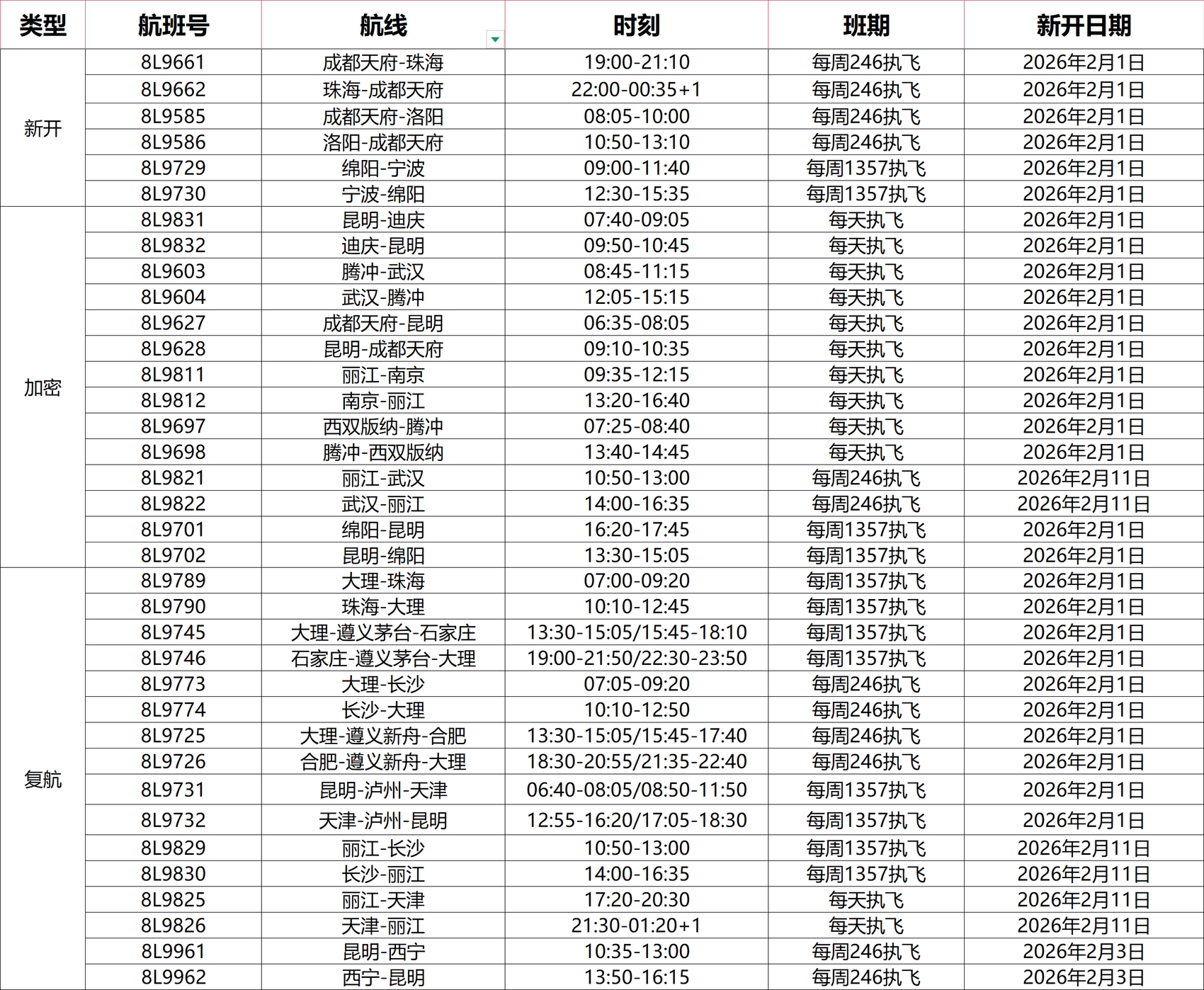
The 2026 Spring Festival travel rush is about to begin. Starting February 1st, Lucky Air will launch new direct routes from Chengdu Tianfu to Zhuhai and from Chengdu Tianfu to Luoyang, operating on Tuesdays, Thursdays, and Saturdays. A new route from Mianyang to Ningbo will operate on Mondays, Wednesdays, Fridays, and Sundays. Additionally, capacity will be increased on seven popular tourist routes, including Kunming to Chengdu Tianfu, Kunming to Diqing, Tengchong to Wuhan, and Lijiang to Nanjing, which will operate daily. The Kunming to Mianyang route will see increased frequency based on passenger demand, operating on Mondays, Wednesdays, Fridays, and Sundays, creating a flexible network to ensure travel capacity for both pre-holiday home returns and post-holiday trips. Resumed routes are designed to meet the dual demand of the “homecoming rush” and “travel rush,” including special itineraries like Kunming via Luzhou to Tianjin, operating on Mondays, Wednesdays, Fridays, and Sundays.
Chengdu Tianfu
Chengdu Tianfu refers to the broader Tianfu New Area, a modern economic and technological development zone established in 2010 in Chengdu, Sichuan Province. While it is a contemporary hub for finance, science, and innovation, its name “Tianfu” (天府), meaning “Land of Abundance,” historically reflects the region’s ancient reputation for agricultural richness and prosperity dating back over two millennia. Today, it symbolizes Chengdu’s transformation into a leading high-tech and business center in western China.
Zhuhai
Zhuhai is a modern coastal city in Guangdong Province, China, established as a special economic zone in 1980 to pioneer the country’s economic reforms. Historically a collection of fishing villages, it is now known for its clean environment, scenic coastline, and as the gateway to Macau. A key cultural landmark is the New Yuanming Palace, a partial reconstruction of Beijing’s Old Summer Palace, reflecting on modern Chinese history.
Luoyang
Luoyang is an ancient capital city in China’s Henan Province, historically serving as the seat of power for multiple dynasties, most notably the Eastern Zhou and Eastern Han. It is renowned as the eastern terminus of the Silk Road and a major cradle of Chinese civilization, famously housing the Longmen Grottoes, a UNESCO World Heritage site of Buddhist cave art carved over centuries.
Mianyang
Mianyang is a major city in Sichuan Province, China, known as a national science and technology hub, particularly for its role in China’s nuclear and aerospace industries. Historically, it has been a significant regional center for over 2,200 years and is also recognized as the hometown of the legendary ancient poet Li Bai. Today, it blends this rich cultural heritage with its modern identity as a key site for scientific research and development.
Ningbo
Ningbo is a major port city in Zhejiang Province, China, with a history dating back over 2,000 years. It served as a crucial hub on the ancient Maritime Silk Road, fostering trade and cultural exchange for centuries. Today, it is a modern economic center known for its deep-water port and well-preserved historical sites like the Tianyige, China’s oldest private library.
Kunming
Kunming is the capital of Yunnan Province in southwestern China, historically known as a key hub on the ancient Southern Silk Road. Today, it is famed as the “Spring City” for its mild climate and is a gateway to the region’s diverse ethnic cultures and natural attractions like the Stone Forest. Its modern development as a major city contrasts with its long history dating back over 2,000 years.
Diqing
Diqing, officially known as the Diqing Tibetan Autonomous Prefecture, is a scenic region in northwestern Yunnan Province, China, renowned as the gateway to the “Three Parallel Rivers” UNESCO World Heritage Site. Historically, it was a crucial part of the ancient Tea Horse Road, facilitating trade and cultural exchange between Tibet and Yunnan. Its cultural heart is the town of Shangri-La (formerly Zhongdian), which draws its name and identity from the mythical Himalayan utopia.
Tengchong
Tengchong is a historic border county in Yunnan Province, China, renowned for its volcanic geothermal landscape and as a key hub on the ancient Southern Silk Road. Its history is marked by significant WWII battles, notably the 1944 Chinese campaign to retake it from Japanese forces, which is commemorated at the National Memorial Cemetery. Today, it is a popular destination for its hot springs, volcanic parks, and well-preserved ancient towns like Heshun.