In the first four months of this year, Xinjiang’s foreign trade remained stable with steady progress and improved quality and efficiency, reaching a total import and export value of 172.71 billion yuan, a year-on-year increase of 4.2%. In April alone, the total import and export value reached 62.72 billion yuan, up 8.7% year-on-year, with sustained release of foreign trade growth momentum, showing a positive trend of regional concentration, structural optimization, active market entities, diversified markets, and upgraded product categories.
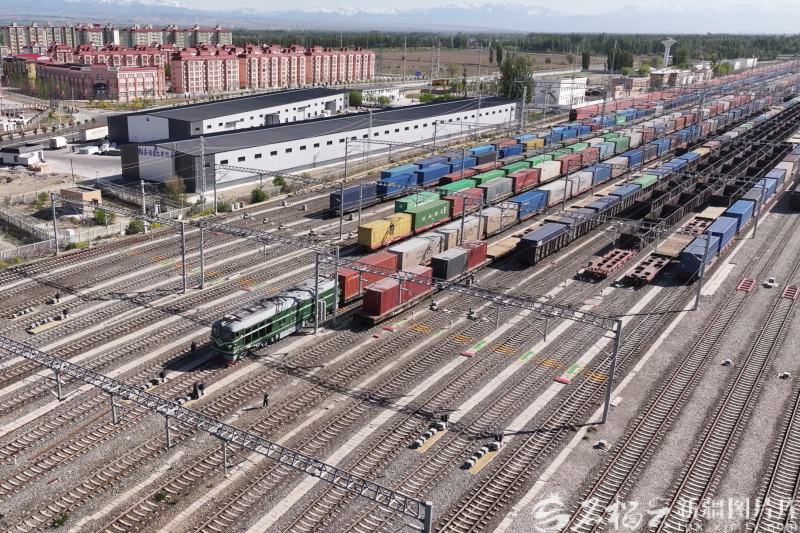
On April 21, at the Horgos railway port, a train departs from the standard gauge yard. (File photo)
The regional agglomeration effect of foreign trade is prominent, with the support role of leading prefectures and cities continuously strengthening. In the first four months, the four major foreign trade “leading” prefectures and cities—Ili Kazakh Autonomous Prefecture, Kashgar Prefecture, Urumqi City, and Bortala Mongol Autonomous Prefecture—had a combined import and export value of 145.14 billion yuan, accounting for 84% of Xinjiang’s total foreign trade, further strengthening the leading role of regional hubs.
Trade methods continue to optimize, with the main engine role of general trade becoming more prominent. In the first four months, Xinjiang’s general trade import and export value increased by 17.8% year-on-year, accounting for 59% of the region’s total foreign trade, becoming the core support for foreign trade growth. The import value through border resident mutual trade increased by 80% year-on-year; the export value through foreign contracted project goods increased by 195.9% year-on-year, accelerating the formation of a diversified trade business pattern.
The vitality of foreign trade business entities is unleashed, with independent brands and production-oriented enterprises improving export quality and efficiency. In the first four months, there were 3,065 foreign trade enterprises in Xinjiang with import and export records, a year-on-year increase of 17.4%. Among them, the number of private enterprises and foreign-invested enterprises increased by 17.7% and 51.2%, respectively; the import and export value of private enterprises increased by 4.3% year-on-year, accounting for 95.1% of Xinjiang’s total foreign trade, while the import and export value of foreign-invested enterprises increased by 221.8% year-on-year, with overall vitality of private and foreign-invested enterprises outperforming state-owned enterprises. During the same period, Xinjiang enterprises exported domestic independent brand goods up 12.3% year-on-year, accounting for 12.9% of Xinjiang’s export value; the export value of production-oriented enterprises in Xinjiang increased by 35.8% year-on-year, accounting for 7.4% of Xinjiang’s export value.
The driving effect of emerging markets is significant, with trade cooperation under the Belt and Road Initiative continuing to deepen. In the first four months, China’s Xinjiang saw a year-on-year increase of 5.7% in import and export value with Belt and Road countries, accounting for 87% of the region’s total foreign trade. Import and export values with emerging markets such as ASEAN and Africa increased by 35.1% and 158.4% year-on-year, respectively.
The structure of import and export goods continues to optimize, with notable imports of bulk commodities and stable exports of electromechanical products. In the first four months, Xinjiang imported 5.443 million tons of bulk commodities worth 7.64 billion yuan, up 29.5% and 18.2% year-on-year, respectively, accounting for 35.8% of total import value. Among them, the import value of edible oil increased by 57.1% year-on-year, and the import value of cotton increased by 608.2% year-on-year. On the export side, the export value of electromechanical products from Xinjiang increased by 5.7% year-on-year, accounting for 40.7% of total export value, driving export growth by 2.3 percentage points, with the supporting role of main export products remaining stable.
Horgos railway port
Horgos railway port
Related news
Police dismantle black market chain for illegal access to public records and AI-generated fake household registration certificates.

Building a National Advanced Manufacturing Base: ‘Made in Chengdu’ Shines Globally