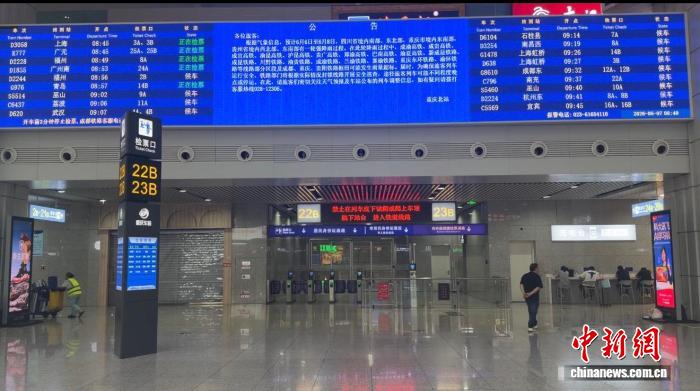
Chongqing, June 7 — On June 7, the Chongqing Station announced that due to heavy rain, a total of 26 trains were suspended at Chongqing Station that day.
Among them, 15 trains were suspended at Chongqing North Station, 6 at Chongqing West Station, and 5 at Chongqing East Station. The suspended trains mainly served routes from Chongqing to destinations such as Beijing, Shanghai Songjiang, Ningbo, Shenzhen, Guangzhou Baiyun, Harbin, Fuzhou, Huizhou, Xiushan, and Dazhou.
To effectively respond to the impact of the heavy rain, Chongqing Station has fully activated its flood safety emergency response mechanism, continuously organizing real-time train operation change information and promptly issuing delay and suspension notices through station announcement screens and bulletin boards.
Stations including Chongqing North, Chongqing West, and Chongqing East have also set up dedicated ticket refund and change service windows, equipped with staff to assist passengers in handling refunds, ticket changes, and related procedures via self-service ticket machines and the 12306 app.
Chongqing North Station
Chongqing North Station is a major railway hub in Chongqing, China, originally opened in 2006. It serves as a key terminus for high-speed rail lines, including the Chengdu-Chongqing and Zhengzhou-Chongqing routes, and underwent significant expansions to handle increasing passenger traffic. The station plays a vital role in connecting southwestern China with other regions, reflecting the city’s rapid modernization and growth as a transportation center.
Chongqing West Station
Chongqing West Station is a major high-speed railway hub in southwestern China, opened in January 2018. It was built to handle the increasing passenger traffic from the Chongqing-Guiyang and Chengdu-Chongqing high-speed rail lines, significantly improving regional connectivity. The station’s modern design and large capacity reflect Chongqing’s rapid development as a key transportation center in China.
Chongqing East Station
Chongqing East Station is a major railway hub currently under construction in Chongqing, China. Designed to serve as a key transportation node, it will integrate high-speed rail, intercity trains, and metro lines to improve regional connectivity. Once completed, it is expected to become one of the largest and most modern railway stations in Southwest China, supporting the city’s rapid economic growth.
Beijing
Beijing, the capital of China, is one of the world’s oldest continuous civilizations, with a history spanning over 3,000 years. It has served as the imperial capital for several dynasties, most notably the Ming and Qing, which left behind iconic landmarks like the Forbidden City, the Great Wall, and the Temple of Heaven. Today, Beijing is a vibrant modern metropolis that blends its rich cultural heritage with rapid contemporary development.
Shanghai Songjiang
Shanghai Songjiang is a historic district in southwestern Shanghai, known for its rich cultural heritage dating back over 2,000 years. Originally a county established during the Tang Dynasty, it later became a prosperous center of trade and culture, featuring landmarks
Chongqing North Station
Chongqing North Station is a major railway hub in Chongqing, China, originally opened in 2006 as a key part of the city’s expanding rail network. It serves as a critical transit point for high-speed trains, including those on the Chengdu-Chongqing and Chongqing-Wanzhou railways, connecting the region to other parts of the country. Over the years, the station has undergone expansions to accommodate growing passenger traffic, reflecting Chongqing’s rapid urban development.
Chongqing West Station
Chongqing West Station is a major high-speed railway hub in southwestern China, opened in January 2018. It serves as a key junction for the Chengdu-Chongqing and Chongqing-Guiyang high-speed lines, significantly improving regional connectivity. Its modern design and large capacity reflect the city’s rapid infrastructure development and role as a transportation gateway.
Chongqing East Station
Chongqing East Station is a major railway hub currently under construction in Chongqing, China, designed to serve as a key transportation center for the southwestern region. Its development is part of China’s extensive high-speed rail expansion, aiming to improve connectivity and stimulate economic growth in the area. Once completed, it will significantly reduce travel times and enhance travel efficiency between Chongqing and other major Chinese cities.
Beijing
Beijing, the capital of China, is one of the world’s oldest and most historically significant cities, with a history spanning over 3,000 years. It served as the imperial capital for the Ming and Qing dynasties, leaving behind iconic landmarks such as the Forbidden City, the Great Wall, and the Temple of Heaven. Today, it is a bustling modern metropolis that seamlessly blends its rich cultural heritage with rapid contemporary development.
Shanghai Songjiang
Shanghai Songjiang is a historic district in the southwestern part of Shanghai, known for its rich cultural heritage dating back over 4,000 years. It was once the political and cultural center of the region during the Ming and Qing dynasties, and is home to well-preserved sites like the Songjiang Mosque, the Square Pagoda, and the ancient water town of Cangcheng. Today, it blends traditional Chinese architecture with modern development, serving as both a residential area and a tourist destination.
Forbidden City
The Forbidden City, located in central Beijing, served as the imperial palace for 24 emperors of the Ming and Qing dynasties for nearly 500 years, from 1420 to 1912. Construction began in 1406 under Emperor Yongle and involved over a million workers, resulting in a vast complex of nearly 1,000 buildings. Today, it is a UNESCO World Heritage site and houses the Palace Museum, showcasing priceless Chinese art and artifacts.
Great Wall
The Great Wall of China is a series of fortifications built across northern China to protect against invasions, with construction starting as early as the 7th century BCE. The most famous sections, like those built during the Ming Dynasty (1368–1644), stretch over 13,000 miles and are a UNESCO World Heritage site. Today, it stands as a symbol of Chinese history and ingenuity, attracting millions of visitors annually.
Temple of Heaven
The Temple of Heaven in Beijing is a complex of religious buildings built in the early 15th century during the Ming Dynasty. Emperors of the Ming and Qing dynasties would visit it annually for ceremonies to pray to Heaven for a good harvest. It is renowned for its symbolic architecture and design, which reflect the ancient Chinese cosmology of a round heaven and a square earth.